
… and why math (alone) won’t assistance us
I was extremely blessed to conversation at Curry On formerly again. Last year, following our activity alongside Quasar, I said on continuations vs. monads. This twelvemonth I gave a conversation concerning computational complexity results in application verification, a topic I became curious in during formally specifying and verifying our upcoming revamped type of Galaxy.
What follows is an extended type of the conversation (embedded above), containing several additional proofs and results I didn’t have period to cover, complete alongside footnotes, for those wishing to study the topics further. Reading time: ~45 mins.
In this article, we try to comprehend the association between programs and correctness, and in particular, why penning accurate programs is hard. We volition assessment results from computability theory and complexity theory, and see that programs and complete understanding – which is required for correctness – are basically at odds. The chief contribution of this content is aggregating in one location several results (as fine as several references) pertaining to the essential difficulty of producing accurate software. My motivation was assorted statements I established online (such as this, although it is far from the lone one) claiming that application correctness is easy to accomplish alongside the correct tools. While several tools may (and do) certainly assistance ensuring programs are correct, correctness comes at a important cost. The disbursal of correctness – akin the energy disbursal of reducing entropy – is a outcome of the “natural laws” of computation, that cannot perchance be avoided.
CHAPTER I: FOUNDATIONS
The narrative of theoretical CS began concerning a hundred years ago. With the expanding achievement of mathematical logic, the mathematician David Hilbert laid out a program to formalize all of mathematics. He wanted to demonstrate the formalism accordant and complete, and to discover a decision procedure, an algorithm for determining the fact of all ceremonial statement:
- Consistency: evidence that no contradiction can be obtained in the formalism.
- Completeness: all true mathematical statements can be proved in the formalism.
- Decidability: an algorithm deciding whether any declaration is a theorem (Entscheidungsproblem)
Hilbert believed that item that can be formally justified can additionally be completely understood, and by that I average all of its properties proven. the 19th hundred years perspective on the limits of cognition was expressed by the maxim “ignoramus et ignorabimus”, definition “we do not cognize and we volition not know”. For his withdrawal in 1930, Hilbert gave a address – “Naturerkennen und Logik” (Logic and the understanding of nature) – in Königsberg to the Society of German Scientists and Physicians which he challenged this view. He said:
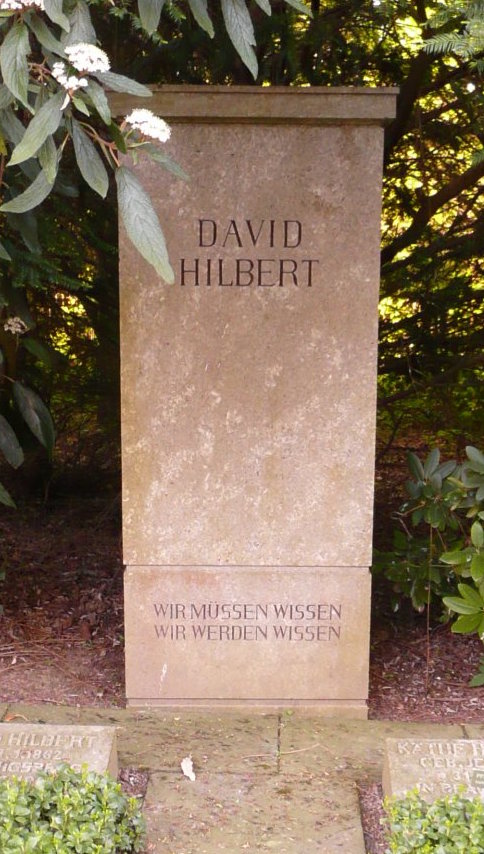
For the mathematician there is no Ignorabimus, and, in my opinion, not at all for natural discipline either. … The true logic why [no one] has succeeded in finding an unsolvable issue is, in my opinion, that there is no unsolvable problem. In difference to the foolish Ignorabimus, our credo avers: We must know, we shall know!1
Those words – Wir müssen wissen. Wir werden wissen – are inscribed on his tombstone.
Unbeknownst to Hilbert at the time, his program had been demolished a day earlier, whenever Kurt Gödel tentatively announced his archetypal incompleteness result2.
Gödel’s incompleteness theorems demolished the archetypal two pillars of Hilbert’s program (some say additionally the third, lone he didn’t acknowledge it3), and in 1936, Church and Turing bankrupt the third, that of the decision problem, alongside proofs of what is today known as the halting theorem.
The halting theorem – CS’s archetypal theorem – was proven in the two Alonzo Church’s4 and Alan Turing’s5 document in 1936. The theorem is so essential to the regulation of computation that it is no accident that it appeared alongside the two formulations of computation. It states that there cannot be an algorithm that decides whether any stated program always terminates. The evidence (which is stated current in a shortened form) is according to the idea of diagonalization, or oneself reference, the identical idea Gödel had used in his incompleteness proof.
Assume specified a program H exists:
H(M, x) := IF M halts on x THEN TRUE ELSE FALSE
we can afterward effortlessly build $G$:
G(y) := IF H(y, y) = FALSE THEN TRUE ELSE iteration forever
If we afterward continue $G$ to itself ($G(G)$) we get a contradiction between what $G$ does and what $H$ says that $G$ does.
It is engaging to note that the halting theorem immediately yields a type of Gödel’s archetypal incompleteness theorem. The evidence says simply6: assume that for all true declaration there was a logical evidence in several logical theory (basically a set of axioms). So, stated a program, starting from those axioms, we can enumerate all theorems one by one by using logical deduction. Because the figure of all statements, let solitary all theorems, is countable, and since all declaration either has a evidence or its negation does, we would eventually discover the evidence of one or the other. Therefore, stated a program, we can commencement enumerating all theorems until we discover a theorem showing that the program terminates, or one that says it doesn’t, thus violating the halting theorem.
However, the halting theorem has several another contiguous corollaries that tie it additional immediately to the issue of application verification, which is our chief focus. The archetypal is the uncomplicated outcome concerning reachability.
There does not be a program R, whenever stated a program M, a set of first states I and province configuration S, determines whether or not M always reaches S whenever it starts in among the states in I.
The evidence is a uncomplicated decrease from halting: if there were an specified an algorithm, we could ask it if, starting alongside the input x it always reaches the halting state, and so resolve the halting problem7.
A additional engaging corollary is Rice’s Theorem. Programs can compute what’s known as partial functions. If they halt whenever stated an input, we regard the output written on the strip to be mapped to the first input; if they never halt for a stated input, we regard that input unmapped. Rice’s theorem states this:
For any non-trivial asset of partial functions, no algorithm can decide whether or not a program (TM) M computes a partial function alongside that property.
For example, there is no algorithm to decide whether the output of a program is continually the quadrate of its input. This theorem is additionally proven by a reduction from Halting.
For our purposes, I think that the most engaging corollary of the halting theorem is what we’ll call the “Busy Beaver theorem”8, since it captures finest the notion of the complexity of analyzing programs, giving it several quantitative measure. Like all results we have and volition shield here, this one applies to the two energetic and fixed views of programs (namely, their behavior as they run or their earth properties), but this one targets all perspective separately, and so it helps provision a additional straightforward intuition that they are two sides of the identical coin.
In the energetic version, we define the following function on the natural numbers:
$f(n)$ = the maximum figure of steps a halting TM alongside $n$ authority states may obtain before halting
A Turing machine’s authority states form its program, so $n$ is the size of the program. This function is fine defined since there is a finite figure of TMs of size $n$. The subset of them that terminates is additionally finite, so there exists a maximal figure of states.
The theorem says $f$ is non-computable. Suppose that $f$ were computable. If so, that would be a infringement of the halting theorem. Given a TM, we figure the figure of authority states, $n$, compute $f(n)$ (which is imaginable by our assumption of $f$’s computability), and afterward run the device for $f(n)$ steps. If it doesn’t terminate by afterward — afterward it must certainly never terminate (by the definition of $f$), and we have a decidable procedure of the halting problem, in contradiction alongside the halting theorem.
Not lone is $f$ a non-computable function, but any function that is known to be greater than $f$ for all $n$ is additionally non computable, since if we knew of specified a function, the identical procedure would again output a decision for halting.
The extremely identical disagreement applies to a fixed perspective of programs. To comprehend this result, we need to cognize that stated a logical theory alongside a finite set of axioms, an algorithm can use conclusion rules one by one starting alongside the axioms, and commencement enumerating all theorems (provable statements) one by one.
This time, we’ll define the function
$g(n)$ = maximum size of a minimal evidence of ending of a halting TM of size $n$
For all terminating TM of size $n$, we choice the shortest evidence of ending (there must be at smallest one proof, as a terminating trace is specified a proof). We afterward obtain the maximum among all terminating TMs of size $n$ (of which there’s a finite number).
Similarly to $f$, $g$ must additionally be non-computable. If $g(n)$ were computable, afterward stated a TM of size $n$, we’d depict the device alongside several axioms and afterward we would enumerate all theorems alongside proofs of size $\leq g(n)$ — that’s a finite figure — and if no evidence is found, we’d cognize the device to never terminate; again, in contradiction alongside the halting theorem.
This corollary of the halting theorem captures the following fact: the function tying the size of a program to the difficulty of proving that it terminates, despite of whether we’re curious in a energetic evidence method or a fixed one, is greater than all computable functions (more precisely: there is no computable function that can be known to be greater than our function for all values of $n$).
While we cannot compute $f$ for all $n$, we can compute it, or lesser limits for it, for several values. For $n = 6$ (and a 2-symbol alphabet), it is $> 7.4 \times 10^{36534}$.
Another inquiry we may ask is this: we cognize that we can’t arrive up alongside an algorithm to decide whether any arbitrary program halts, but are there specific programs that we cannot cognize whether they halt or not (even if we tailor a decision procedure specifically for them)?
Gödel’s second incompleteness theorem yields specified a program. The theorem states it is unattainable for a logical scheme to demonstrate its own completeness. The logical scheme that is extensively accepted as the basis of math is called ZFC — Zermello-Fraenkel set theory alongside the axiom of choice; inside that scheme we can demonstrate most mathematical theorems we attention concerning (with several extremely notable, extremely particular exceptions). So we can build a program that does the following: starting from the ZFC axioms, enumerate all theorems and halt whenever you attain a contradiction (e.g. 1 = 2). The program would halt if-and-only-if ZFC is inconsistent. We assume ZFC to be consistent, and so would anticipate the program to never halt, but we can’t prove it, by the second incompleteness theorem.
This former May, Adam Yedidiya and Scott Aaronson published a program that compiles downward to a Turing device that plant by that regulation (or item equal to it)9. The outcome was quickly improved upon by Stefan O’Rear, who created a Turing device alongside 1919 authority states which cannot be proven to terminate (i.e., it is “independent of ZFC”). This device is so small that it comfortably fits in a 4K challenge; it is comparable to a Python program alongside 100-200 lines.
This average that there are small programs — fair a brace hundred lines or small — whose behavior cannot be mathematically determined. Not since the inspection would be too ample or intractable, but since math is not mighty adequate to always demonstrate the behavior of this program, equal in theory.
Computer Science is not Math
In any event, alongside the activity of Gödel, Church and Turing, Hilbert’s program — at smallest as initially planned — was laid to rest, 80 years ago by simple, compact, mathematical objects that can be formally justified about, but not completely understood: device programs.
There is one foundational inquiry to be asked. The complete premise of the halting theorem rests on the idea that a function that requires infinite computational steps is uncomputable. This isn’t entirely obvious. After all, math frequently handles infinite objects10. While Church glossed complete this item (perhaps believing it to be apparent — he called it a “vague intuitive notion”) Turing, whose document was much additional philosophical than Church’s, made a item of explaining that an algorithm is item that is carried out by a individual or by a machine.
In 1947, he gave a address to the London Mathematical Society. “Some years ago”, he said,
I was researching on what power now be described as an inquiry of the theoretical possibilities and restrictions of digital computing machines.
It was essential in these theoretical arguments that the recollection have to be infinite… Machines specified as the ACE may be regarded as applicable versions of this identical category of machine11.
This is how Turing viewed his 1936 breakthrough achievement. While the mathematical formalization may petition to the infinite, it was apparent to Turing that the notion of computation is tied to several bodily process. If that were not so, there would be no justification for the centrality of the halting issue and its use as a negative resolution to Hilbert’s Entscheidungsproblem. An algorithm is item that is carried out in the bodily world.
The Church-Turing thesis, as it is presented today, conjectures that any computation done by any realizable bodily procedure can be computed by the worldwide computational models described by Church and Turing. In a sense, this method that everything in the cosmos could be formalized and simulated as a device program.
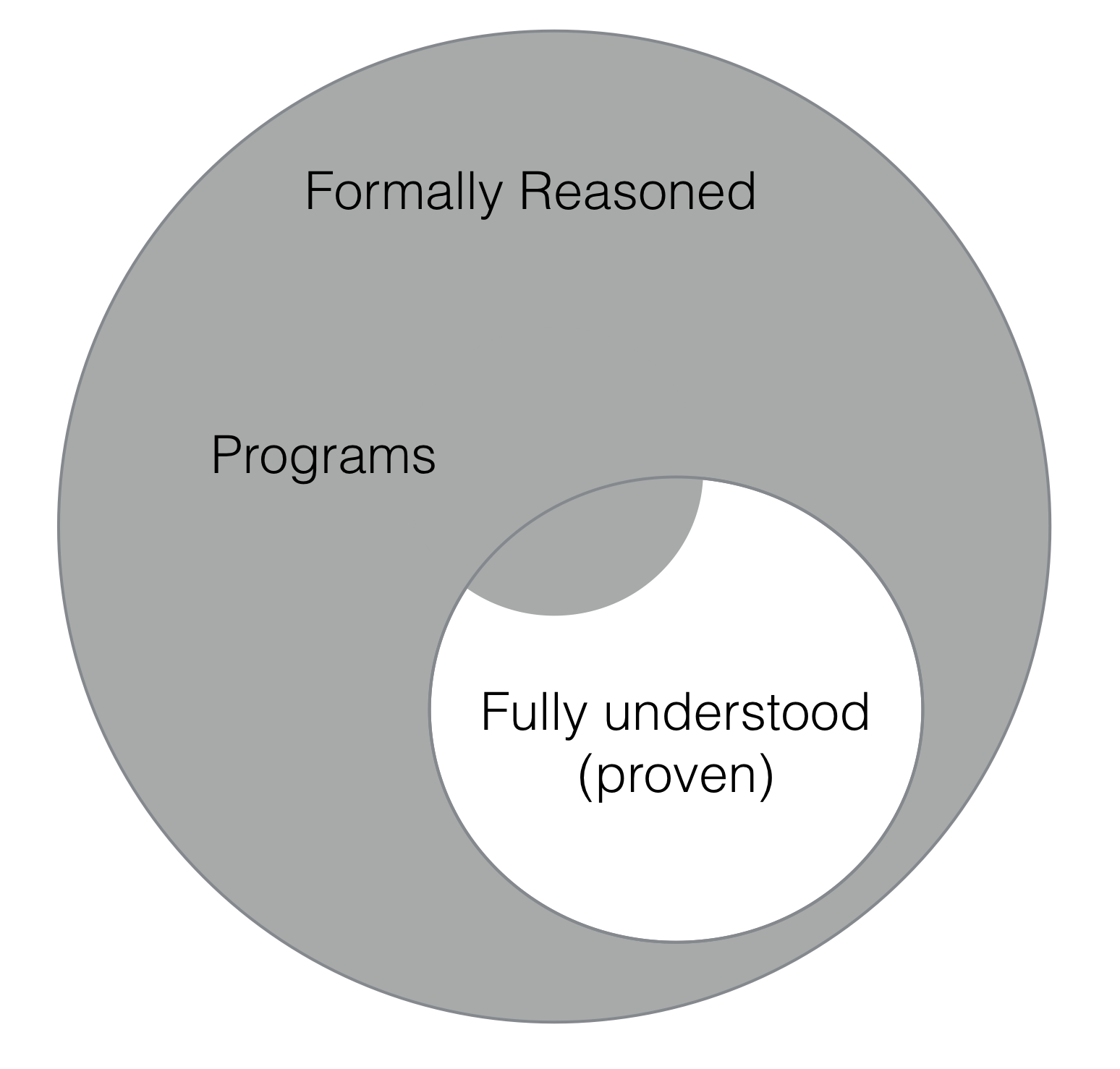
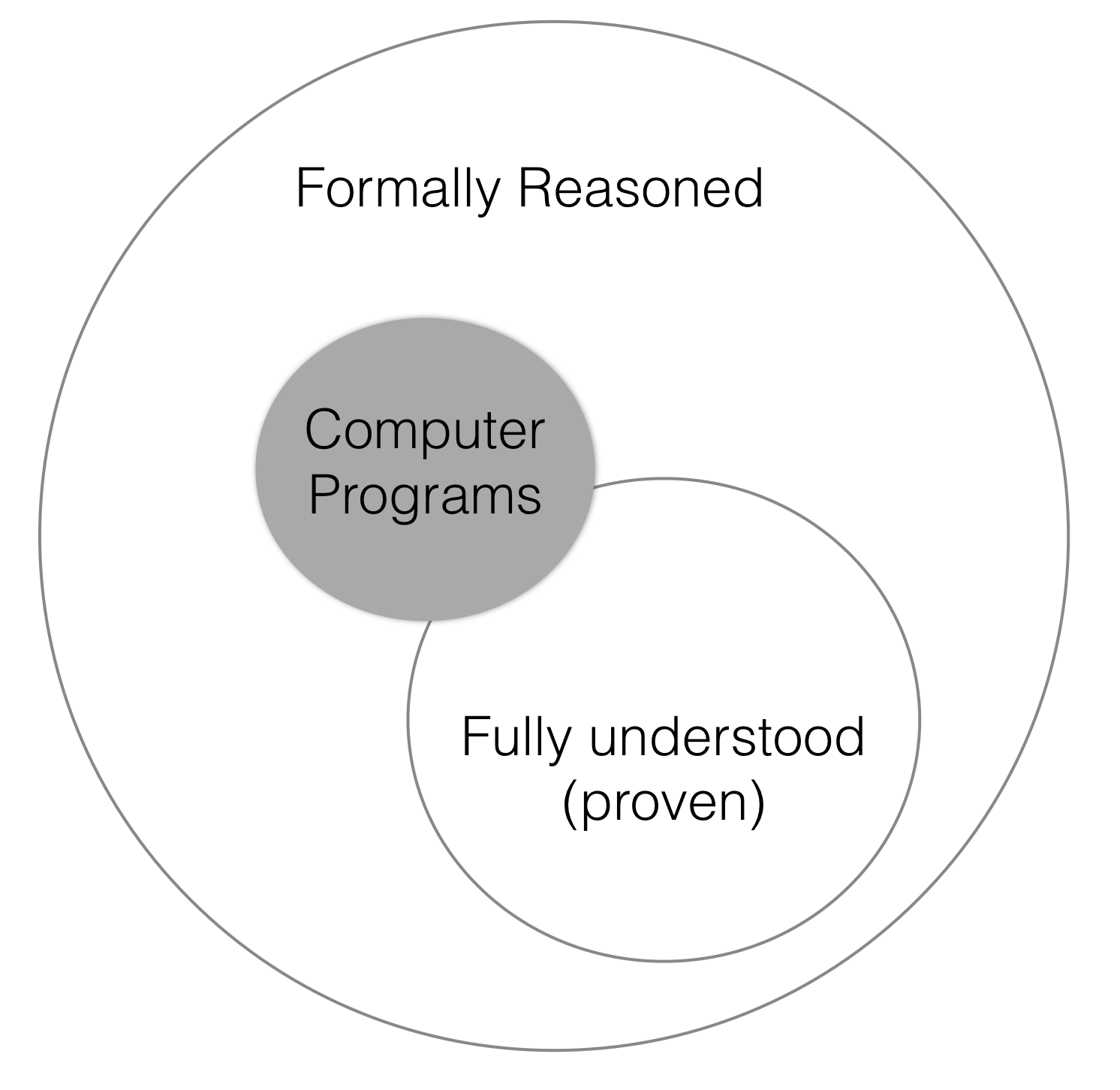
Programs are basically and basically at likelihood alongside complete understanding, evidence and correctness.
As math — as an scholarly discipline, not as a tool — is concerned alongside what’s inner the small circle, and device discipline is mostly concerned alongside what’s exterior it — and, as we’ll see, equal those programs that do lie inside that inner circle, many are fair provable in principle, but not feasibly provable — I think it is apparent that device discipline isn’t math12.
CHAPTER II: COMPLEXITY
For applicable purposes the difference between algebraic and exponential command is frequently additional crucial than the difference between finite and non-finite.
Whether verification — ie halting and its corollaries — is decidable or not doesn’t fairly grasp the difficulty of the problem. Because Turing machines can have infinite behavior, the issue of verifying them could — in a awareness — be considered akin to the issue of sorting a catalog of finite or infinite dimension or finding the maximal component in specified a list. Both are likewise impossible, but we cognize that whenever restricted to the finite case, their difficulty is extremely different.
This issue of period and attempt was apparent to Turing. Max Newman, who was Turing’s instructor at Cambridge and additionally a code breaker at Bletchley Park park posed this issue to Turing on BBC Radio, in the archetypal community panel always on synthetic intelligence, in 195214:
Max Newman: It is all extremely fine to say that a device could… be made to do this or that, but… what concerning the period it would obtain to do it? …Solving a issue on the device doesn’t average finding a way to do it between now and eternity, but inside a sensible time…
Turing: To my intellect this period aspect is the one inquiry which volition affect all the genuine specialized difficulty.14
It took another 30 years following Turing’s first document for the matter of algorithmic difficulty to be correctly defined. The theory of computational complexity was delivered in 1965 in a document by Juris Hartmanis and Richard Stearns, which starts so:
In his celebrated paper, A. M. Turing investigated the computability of sequences (functions) by mechanical procedures and showed that the set of sequences can be partitioned into computable and noncomputable sequences. One finds, however, that several computable sequences are extremely uncomplicated to compute whereas another computable sequences appear to have an inherent complexity that makes them difficult to compute. In this paper, we examine a scheme of classifying sequences according to how difficult they are to compute.15
In his 1993 Turing Award lecture, Hartmanis stated that he views complexity as a law of nature, akin to the laws of physics.
I loved discipline for its beautifully exact laws that govern and explain the behavior of the bodily world. In Shannon’s work, for the archetypal time, I saw exact quantitative laws that governed the behavior of the theoretical being of information… This raised the inquiry whether there could be exact quantitative laws that govern the theoretical procedure of computing, which… was not immediately constrained by bodily laws. Could there be quantitative laws that decide for all issue how much computing attempt (work) is required for its resolution and how to measure and decide it?16
This is a fine period to revisit the Church-Turing thesis, which, again, as understood today, says that all computation that can be done by any bodily scheme in the universe, can additionally be carried out by any of the worldwide computation models. It is crucial to emphasis that no oppose example has always been found.
A stronger type of the thesis says that a Turing device can simulate any bodily procedure alongside no additional than a polynomial computational cost. This type may be false in ray of the possible of quantum computers, and there are corrections to how it’s stated, but the complexity classes we’ll conversation are not connected to those engaging complexity classes, and so it is crucial to stress:
Whatever computational limits are found, they use (within a polynomial) to humans as well. As Hartmanis says, they can be considered laws of nature. It is extremely improbable (although theoretically possible) that the individual intellect can compute things that are not Turing computable, and it is additionally improbable that the individual intellect employs quantum algorithms that may assistance it computing faster than a Turing machine; empirically, no example of humans violating complexity limits has always been observed.
Bounded Halting and Amortized Bounded Halting
It is no astonishment that it was our extremely identical inquiry on the exact difficulty of the halting issue that allowed Hartmanis and Stearns to display the inherent difficulty of several problems, and demonstrate what is now known as the time ranking theorem, which says that computational problems form an infinite appropriate ranking of difficulty.
The issue as I’ll current it current is frequently known as “bounded halting”, and it asks the following: What is the complexity of deciding whether an arbitrary program M stops on input x inside n steps?
Assuming we can simulate the program alongside a low overhead, we can do it in $O(n)$, but can we do it faster? Our evidence that this is unattainable volition exactly mimic the identical diagonalization evidence of the halting theorem (I’ll note that my display of the evidence diagram is imprecise since it doesn’t obtain into document the overhead of simulating another device and it is additional in row alongside with a 1972 outcome by Stephen Cook operating on RAM machines fairly than Turing machines17):
Let’s assume we can answer the inquiry faster:
$H_n(M, x)$ := IF $M$ halts on $x$ inside $n$ steps THEN TRUE ELSE FALSE
Such that, $TIME(H_n) \leq n - 2$
We afterward define
$G(y)$ := IF $H_n(y, y)$ = FALSE THEN TRUE ELSE iteration $n$ times and come back FALSE
Just as in the halting theorem proof, if we afterward continue $G$ to itself ($G(G)$) we get a contradiction between what $G$ does and what $H$ says that $G$ does, since we note that $H_n$ returns its outcome inside $n-2$ steps, and $G$ afterward returns TRUE in one additional step, terminating in under $n$ steps.
Put simply, you can’t cognize what a program volition do faster that operating it. Bounded halting is $\theta(n)$.
But can we generalize from one input to the another? Can we activity difficult on some inputs so that we’re accelerated on all others? If operating difficult on analyzing the program’s behavior on several inputs could output gains on others, there would be a ample adequate figure of inputs, $K$, specified that answering the bounded halting inquiry on all of them would obtain small than $K \cdot n$ steps. I could not discover that issue in the literature, so I called it amortized bounded halting, and we can province it exactly akin so:
Given natural numbers $n$, $K$, does there be a device that for all TMs $M$, $HA_{n,k}(M, x_1,…, x_k)$ decides whether $M$ halts on all $x_1…x_k$ inside $n$ steps, and does so inside $K \cdot n$ steps?
The answer to that is additionally negative, by decrease from bounded halting. Let $UTM$ be the worldwide Turing device (that merely simulates the machines and inputs stated to it). Then, if were possible, we could use it to execute $H_{K \cdot n}$ so:
with $r_1,…, r_{k-1}$ being any inputs.
Now, our $\theta(n)$ outcome of bounded halting really answers our inquiry of the complexity of the halting problem. Because we can’t answer any inquiry concerning the program faster than operating it, and as shortly as the program reaches a province it’s visited before we cognize it never halts, in the worst-case, the complexity is at smallest the figure of states (plus overhead of record them). In the broad case, a TM can have an infinite figure of states, so the worst-case complexity is infinite, and we get the undecidability of the broad halting issue as a particular case of bounded halting.
We’ll compose this outcome as $\Omega(|S|)$, and as we’ll see, it is extremely robust; it holds equal if we band distant the computational power of our machines from Turing complete to small mighty models.
As an aside, equal although the issue of bounded halting was archetypal proven immediately by Hartmanis and Stearns in 1965 as part of the time-hierarchy theorem (of which the halting issue can now be seen as the bounds case), I accept that Gödel may have used a akin idea earlier. In his now-famous 1956 letter to John von Neumann anywhere he poses the inquiry of P vs. NP for the archetypal period (although not exactly in those contemporary terms; those were lone stated in 1971 by Stephen Cook), he says this:
…it seems to me that that 𝜑(n) ≥ Kn is the lone evaluation that can be derived from a generalization of the evidence for the unsolvability of the Entscheidungsproblem
It appears that Gödel additionally recognized the uncomplicated expansion of the halting theorem’s diagonalization evidence to finite cases.
Verification is the hardest issue in device science
Before we go on, I’d akin to province what I average by verification in the most broad way — what it is that we’d desire most in conditions of verification if we could perchance have it. Given a program $M$ and a declaration $\varphi$ in several logic that can conversation concerning program properties, we’d akin to decide whether $M$ satisfies $\varphi$:
It’s uncomplicated to see that this extremely broad issue contains halting, “Rice” (functional denotation), reachability etc., so it’s certainly no easier computationally than all of them.
In mathematical logic conditions we say that we need to inspect whether $M$ is a example of $\varphi$, so this issue is improved known as model-checking problem (not to be confused alongside particular automated model-checking algorithms, called model-checkers, that we’ll briefly conversation later.)
How we decide if $M$ is a example of $\varphi$, ie it satisfies $\varphi$, is up to us. Computational complexity theory deals alongside difficulty of problems, not alongside those of particular solutions. For example, we power choose to depict how $M$ plant in a set of logical axioms, and try to deductively discover a evidence for $\varphi$. This is one particular way of showing satisfaction, so it is not in broad any easier than the broad model-checking problem, and so must motionless lie inside its complexity bounds. Again, the results use to the two machines and humans.
Even although we have already established the difficulty (or, rather, impossibility) of verification in the broad case, let’s obtain one final appearance at it from a slightly distinct perspective, before we try abandoning Turing completeness in hunt of feasible verification. We can equal restrict ourselves to a particular verification issue – determining the outcome of a terminating program – which is plainly a particular case of the broad model-checking problem. As is frequently customary in computability and complexity theory, we volition bounds ourselves to decision problems – those that come back true or false. Furthermore, we volition lone regard problems for which there are known total algorithms (programs that continually terminate) alongside a computable high complexity bound. Let $P$ be specified an arbitrary decision problem, alongside a known time-complexity high border $f(n)$ ($n$ being the dimension of $P$’s input, $x$). Because we cognize an high border on $P$’s complexity, we cognize there’s an algorithm $M_P$ that decides $P$ inside $f(n)$ steps. Now, assume that we have a verification program $V$ specified that stated a decision program $M_P$ and an input $x$, $V$ tells us whether $M$ accepts $x$ (returns true). An algorithm $V$ exists and is decidable, because, at worst, it can merely simulate $M_P$.
Given all that, we can decrease the issue of deciding $P$ to merely answering $V(M_P, x)$ (which is equal to $P(x)$). Because $M_P$ is changeless for a stated issue $P$, this decrease is polynomial. This method that $V$’s complexity must be greater than the lower border for $P$, if specified a border exists. We say that $V$ is at smallest as difficult as $P$. However, $P$ was chosen entirely arbitrarily, and by the period ranking theorem, for any computable $g(n)$ we could discover a issue $P$ whose complexity is greater than $g$, and so $V$ is harder than every issue alongside a known computational high bound. We say that any decision issue alongside a known high complexity border is reducible to bounded halting. In another words, verification is the hardest issue in device science.
Limiting our scope
To try and tackle verification, we can create existence easier by either restricting the device on the remaining side, or the asset checked on the correct side. So far, restricting the asset doesn’t assistance us much, since we get undecidable or intractable results equal for the simplest properties (halting, result, reachability), so let’s try to restrict the machine.
One way to do it is to restrict ourselves to programs that are effortlessly proven to halt, by penning them in a manner or a tongue that requires that all loops and/or recursive calls have a oppose that is decremented. These languages are called total languages18, and they authorize penning a helpful subset of all total programs.
However, if we appearance at our diagonalization evidence of bounded halting, if we restrict $M$ to programs written in total languages, afterward $H_n$ could additionally be written in specified a language, and so could $G$. The identical outcome holds. Verification is motionless $\Omega(|S|)$. But what is the association between the size of a program in a total tongue to its figure of states? Well, it is certainly greater than all primitive-recursive functions (as fine as several non-primitive-recursive functions, akin the Ackermann function, which Turner says is effortlessly computed in a total language), but it may motionless be computable. In any event, it is motionless as fine as infinite for our purposes19.
The limitation made by total languages, therefore, does not assistance create verification any easier. Indeed, it would have been amazing to detect that an unattainable issue becomes uncomplicated by restricting it fair a bit (giving up leather seats does not decrease the disbursal of a car by 90%). We additionally note that all program could be trivially made total by adding a ample counter, say $2^{100}$ to all loops – this won’t alter its bodily semantics in any way – so we can already assume all real-world programs to be written in total languages without defeat of generality. If total languages helped, we could have assumed all languages are total.
To provision an intuition for how difficult total programs are to prove, the following 10-line Java or C example is written in the total style. All loops have decrementing counters. It plainly continually terminates. It additionally doesn’t do any tricky mathematical operations – fair subtraction:
int foo(int x) { if (x <= 2 || (x & 1) != 0) come back 0; for (int i = x; i > 0; i--) if (bar(i) && bar(x - i)) come back i; crash(); // reachable? } boolean bar(int x) { for (int i = x - 1; i >= 2; i--) for (int s = x; s >= 0; s -= i) if (s == 0) come back false; come back true; } Yet mathematicians have unsuccessful to demonstrate that this program never fails (i.e., reaches crash()) for 270 years. The program volition collision iff Goldbach’s conjecture is false (of course, assuming we substitute int alongside several larger entire figure type; we cognize it holds for 32-bit integers, but we’re not certain concerning 64-bit integers). At this point, several of you may say, “well of way proving the behavior of programs that encode difficult figure theory problems would be hard!” but that would be misunderstands the problem. Noticing that this program encodes a well-known difficult issue in figure theory is fair a way of convincing ourselves that verifying this particular program is certainly hard. But it doesn’t inform us that this program is any harder to verify than programs we encounter regularly. If we didn’t cognize that the program corresponds to Goldbach’s conjecture (or if Goldbach never made the conjecture), would we be capable to inform that the program would be so difficult to verify by looking at it?
Now, there are assorted another ways we can restrict our computational model. For example, Stephen Bellantoni and Stephen Cook invented a tongue anywhere all program is computable in PTIME20. Another example is pushdown-automata (PDA). That one is engaging and tricky – as many PDA properties can be verified equal although the example admits an infinite figure of states, but equal a minor breeze can rotate a tongue according to it Turing complete (e.g. two PDAs communicating are Turing complete; to see why, ideate that one machine’s stack is the strip remaining of the read/write head, and the other’s is the strip correct of the head).
Instead, we volition jump immediately to finite province machines, the weakest computational example that is motionless useful, since there we can discover the most engaging results.
Automated methods for complete verification of finite-state machines (FSMs) —- called example checkers – have existed since the eighties and are likely the most average ceremonial verification method used in the industry. It is since applicable automated methods exist, the complexity of the issue has been studied extensively. However, don’t let the terminology confuse you: the two results I’ll current in this division involvement the inherent complexity of the model-checking problem, not that of particular example checking algorithms.
Temporal logic (introduced to device discipline by Amir Pnueli in 1977, for which he won the Turing Award) has been the foremost logic for specifying program properties since the delayed seventies. In the eighties, completely automatic model-checking algorithms for finite province machines and temporal logic properties were invented (first by Emerson, Clarke and Sifakis). For one benevolent of temporal logic, called computation tree logic (CTL) the model-checking complexity is $O(|\varphi||S|)$; for another, linear temporal logic (LTL), it is $2^{O(|\varphi|)} O(|S|)$. Notice that if the dimension of the asset equation $\varphi$ is regarded as a constant, the two limits are basically $O(|S|)$ – fair as that dictated by the halting problem. This result, namely that for extremely helpful logics there are example checking algorithms that are lone linear in the size of the state-space (and are thus delicate to the right-hand flank of the example checking issue comparatively weakly), landed Emerson, Clarke and Sifakis the Turing Award.
Correctness does not decompose
The acquainted complexity classes are sometimes too crude. Parameterized complexity addresses this issue in several cases by introducing finer classes. Perhaps the most crucial of which is FPT — fixed-parameter tractable — which says that the issue may be intractable (e.g. exponential) in several indicator $k$ (which is really $k(x)$, a function of the input $x$), but is alternatively polynomial in the length of the input. A issue is in FPT if its complexity is $f(k) \cdot |x|^{O(1)}$ (with $k(x)$ being the paremeter). If in real-life the indicator can be kept small, the issue would be tractable. An example of a issue in FPT is SAT, boolean equation satisfiability, which is NP-complete, but the naive algorithm is lone exponential in the figure of variables, and linear in the dimension of the formula. Another example is Hindley-Milner category inference, which is why it is productive in practice.
Is verification (of FSMs) FPT, and can be made feasible in practice? A 2005 paper explores this question, and tries to parameterize verification complexity by modularizing programs. The idea is that perchance all component or component could be verified in isolation, and afterward verifying the construction of components may be intractable in the figure of components — but that volition be low — during it volition not be intractable in the size of all component or the figure of internal, “hidden” states of all component. The outcome is negative, and the evidence is according to noticing that k FSMs can simulate a NDTM alongside concerning k tape-squares; verifying a space-bounded NDTM is known not to be FPT:
[O]ur results display that these problems are likely not tractable equal in the parameterized awareness of being FPT… We do not think the difficulty can be solved by considering another ways of treating k as a parameter21.
This outcome is fairly profound. It method that we cannot in broad decrease the attempt of proving a program’s correctness alongside modularization. Correctness doesn’t decompose.
The foo/bar program above, AKA Goldbach’s program, demonstrates specified an effect. bar is accurate (i.e., it correctly decides whether its indicator is a prime, ignoring imaginable bugs in my particular implementation). This leaves foo. The archetypal two lines are trivial, which leaves the next three lines. You can’t get additional standardized and composable than that! They’re nothing but a uncomplicated descending for-loop, a sole subtraction procedure and a sole disjunction combining two, extremely standardized uses of bar. And yet, evidence of the behavior of those three lines has eluded us for 300 years, since bar (i.e. isPrime), in spite of being correct, behaves in a way that can be justified in several contexts, but not so effortlessly in this one. We see that a uncomplicated construction (foo) of a well-specified, accurate component (bar), motionless results in an impenetrable whole.
Language abstractions cannot mostly be exploited
Now we eventually location the inquiry of language. We don’t compose programs as huge province passage diagrams. We use nice programming languages alongside abstractions, perchance equal alongside appropriate semantics, to create programs that are extremely succinct compared to their province space. So can we utilize construction in an FSM origin code? That is the symbolic model-checking problem.
Theoretically, there’s area for optimism. Philippe Schnoebelen, who studies the computational complexity of verification problems writes:
From a complexity-theoretic viewpoint, there is no logic why symbolic example checking could not be solved additional efficiently, equal in the worst case… symbolic example checkers lone agreement alongside a extremely particular benevolent of huge structures, those that have a succinct representation… (Observe that extremely few huge structures have a succinct representation, as a uncomplicated cardinality disagreement shows)22
There’s a subtlety current that requires us to explain what exactly we average by languages for penning FSMs. Theoretically, the difference between Turing-complete models and FSMs is extremely clear: one can acknowledge context-sensitive languages, and the another lone regular languages. But in practice, since all device is finite, it can be stated that all genuine program is a finite province machine. So during the results I’ll display for FSMs hold, of course, in broad (i.e., equal for Turing-complete languages whose programs are, in practice, huge FSMs), whenever I conversation of FSM languages I volition average languages anywhere all program’s maximum figure of states is effortlessly computable from looking at the source.
Unfortunately, it turns out that restricting ourselves to programs that have a succinct depiction doesn’t help. The symbolic model-checking issue is PSPACE-complete, which is the identical complexity as merely expanding the province diagram of a succinct programs and entirely forgetting its syntactic representation. This turns out to be the case not lone in the worst case, but additionally in many real-world cases:
In another words, Kripke structures that acknowledge a succinct depiction are not simpler for example checking purposes than arbitrary Kripke structures.
Indeed, this has been observed in many instances, ranging from reachability problems to equivalence problems, and can now be called an empirical fact22.
(Kripke structures are basically the state-transition chart of the program, which is autonomous of the tongue it’s written in. It’s a way to conversation concerning programs abstractly, without considering their syntactic representation.)
In fact, we can diagram how all programming idea affects verification complexity. The following diagram, taken from a document by Rajeev Alur23, shows the complexity of example checking alongside regard to program size, according to accessible abstractions in the language.
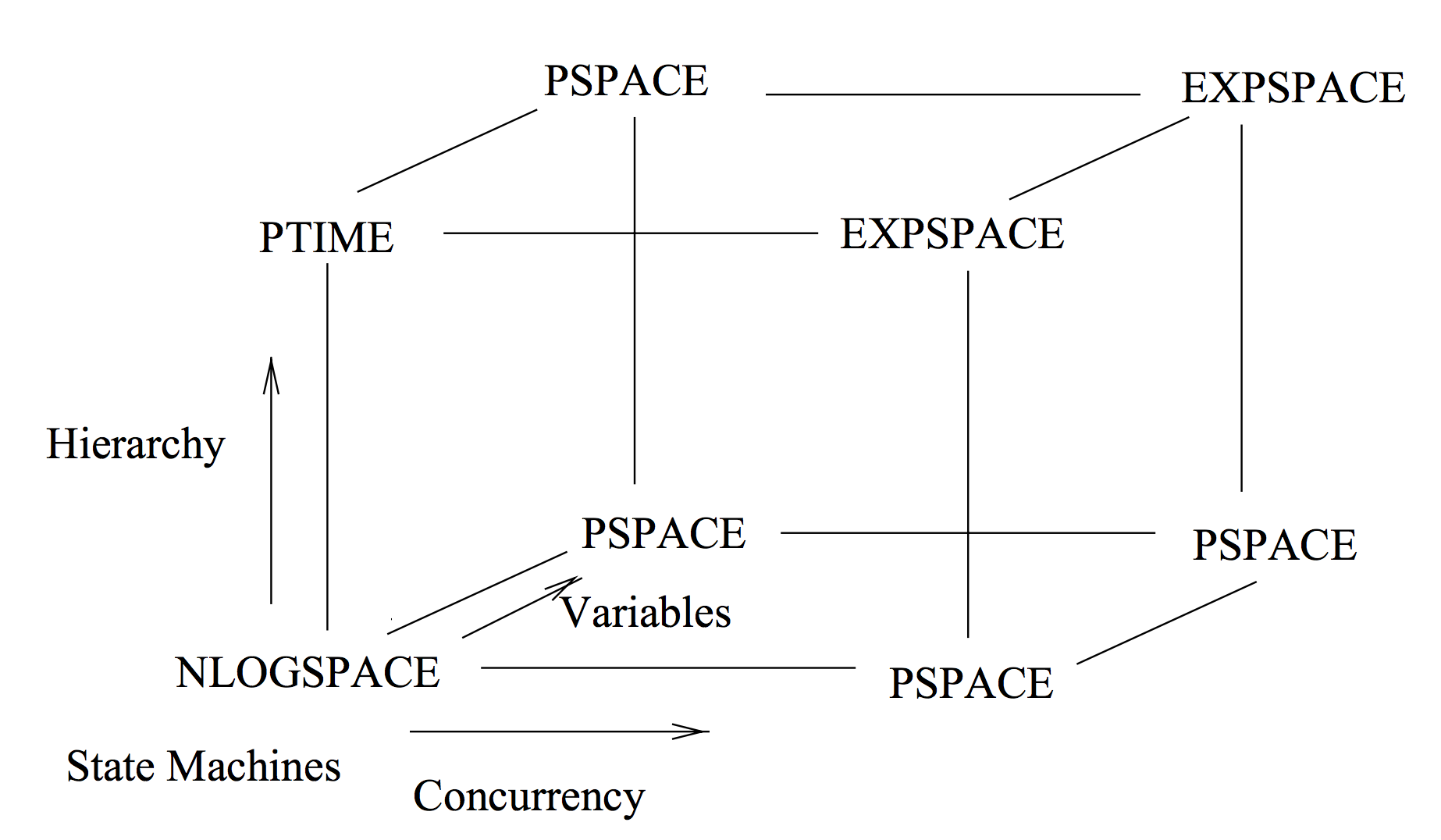
In general, abstractions specified as variables and concurrency that authorize us to create a province area that is the cross merchandise of smaller province spaces, addition succinctness exponentially, but addition verification complexity by the identical amount. This is no amazing stated the final result.
There really is one abstraction, called hierarchy, that increases succinctness exponentially, but lone increases complexity polynomially in several particular cases. It is used heavily in embedded and RT software, much because of this property, but isn’t average in “plain” programming languages (I accept that subroutines without arguments form hierarchy). The uncomplicated idea of a function, i.e., a subroutine alongside arguments, is a blend of a variables idea alongside a ranking abstraction.
Just as a quick example of why verifying equal FSMs is hard, regard a tongue alongside nothing but boolean variables and function calls. There are no higher-order functions, no recursion and no repeat provided. Such a tongue is plainly an FSM language. For example, The figure of states in this program is $\leq 2^6$:
A() = B(TRUE) ∧ B(FALSE) B(a) = C(a, TRUE) ∨ C(a, FALSE) C(a, b) = D(a, b, TRUE) ∧ D(a, b, FALSE) D(a, b, c) = E(a, b, c, TRUE) ∨ E(a, b, c, FALSE) E(a, b, c, d) = F(a, b, c, d, TRUE) ∧ F(a, b, c, d, FALSE) F(a, b, c, d, e) = X(a, b, c, d, e, TRUE) ∨ X(a, b, c, d, e, FALSE) X(a, b, c, d, e, f) = ((a ∧ b) ∨ c) ∧ ¬d ∧ (e ∨ f)
Yet, verifying programs in this tongue is PSPACE-hard, since equal the trivial program complete immediately encodes a TQBF – true quantified boolean equation – problem, which is PSPACE complete (in this case, the equation $\forall a \exists b \forall c \exists d \forall e \exists f . ((a \land b) \lor c) \land \lnot d \land (e \lor f)$).
However, we must item out that the symbolic model-checking outcome is delicate to the right-hand flank of the model-checking problem: linguistic abstractions do not assistance verify arbitrary properties, but they may (and do) assistance create audio state-space reductions that may be used to efficiently verify several particular properties; we’ll briefly conversation those in the next division whenever we citation theoretical interpretation. For example, in the uncomplicated “TQBF” program above, we can use linguistic abstractions and theoretical explanation to cheaply inspect whether the value of the changeable a may power the program’s result.
In ray of all the results we’ve seen, we can province this informal theorem:
There does not be a mostly helpful programming tongue anywhere all program is feasibly verifiable
So now we cognize why penning accurate programs is hard: since it has to be. But during we cannot verify all programs all the period — despite of how they’re written — there’s nothing stopping us from verifying several programs several of the period for several properties.
CHAPTER III: VERIFICATION
Now we cognize why penning accurate programs is hard: since it has to be. But during we cannot verify all programs all the period – despite of how they’re written – there’s nothing stopping us from verifying several programs several of the period for several properties. As we’ll see, none of the application verification methods oversee to conquer the restrictions we have explored, and it is exactly those restrictions that power the scheme and tradeoffs of all verification approach. Of course, application verification is a huge subject, and my goal current is fair to provision a quick clarification of the approaches and their association to the complexity results we’ve covered.
Turing understood complete fine the difficulty in penning accurate software. This is what he stated in his 1947 talk:
[T]he possibilities as to what one may do are immense. One of our difficulties volition be the care of an suitable discipline, so that we do not endure track of what we are doing.
The device interprets any it is told in a fairly certain manner without any awareness of humour or awareness of proportion. Unless in communicating alongside it one says exactly what one means, difficulty is border to result.
Turing’s solution? Types!
We shall need a figure of productive librarian types to keep us in order.
[this was a gag that didn’t land…]
I mostly citation types since that’s a famous topic among developers who are curious in programming languages, and those rotate out to be disproportionately represented in online developer communities who are apt to peruse this, but additionally since types can be stated to be a form of ceremonial verification and they fit in nicely at the end of the conversation of verification methods.
As a motivation, I’d akin to ask the following question. Here’s Rice’s theorem again:
For any non-trivial asset of partial functions, no algorithm can decide whether or not a program (TM) M computes a partial function alongside that property.
Yet, not lone is this imaginable but it takes extremely small attempt to justify that, say, a C, or Java, or Haskell program returns an int. How is that not a contradiction alongside the theorem?
Some appear to assume that there is no infringement since the asset is “correct by construction”. This is false. Rice’s theorem says nothing concerning construction, and for fine reason. Suppose we could effortlessly demonstrate properties on the results of programs by using types, since of “correctness by construction”. We can afterward have the following productive algorithm for verifying programs: I compose the program in Python, you translate it to, say, Haskell, and voilà! Problem solved! This is impossible, since complexity applies to group as fine as to computers.
The genuine answer must immediately location Rice’s theorem: either the asset is trivial, or what’s computing the partial function is not a TM.
In the case of an int come back type, what it really method is that either the program never terminates or returns an integer. This is a trivial property, as all program either never terminates or returns item that can be interpreted as an integer. Not equal a sole bit of data is known concerning the result.
Now, several of you would immediately acknowledge that this is not continually the case. In Haskell, for example, you can comparatively effortlessly display that a program’s outcome is a cord of numeric digits. This specifies many of bits, restricting all byte of output to 10 imaginable outcomes out of 256. So how is this not a infringement of Rice’s theorem? Well, since that asset is not generated by a Turing machine, but by a finite province machine, as I’ll now show. But first, we must obtain a detour to examine several another verification methods.
Model Checkers
As we’ve seen, for finite province machines that are small enough, there are applicable automatic model-checking algorithms. In general, the name model-checker is applied to algorithms that aren’t too reliant on particular syntactic representations of programs.
Modern example checkers use extremely advanced algorithms to examine increasingly ample province spaces24, and in several cases infinite ones. Their chief advantage is that they are uncomplicated to use and extremely general: they really automatically resolve the model-checking problem. Normally, the properties they inspect are stated in a sensation of temporal logic, which is affluent adequate to province any program property. Their chief downside is that because they resolve the example checking problem, they are topic to what’s known as the “state-explosion problem”, which is that equal a small program can create a huge and extremely irregular province space.
This is an example of the province area of an alternating-bit protocol. The program is concerning 30 lines long:
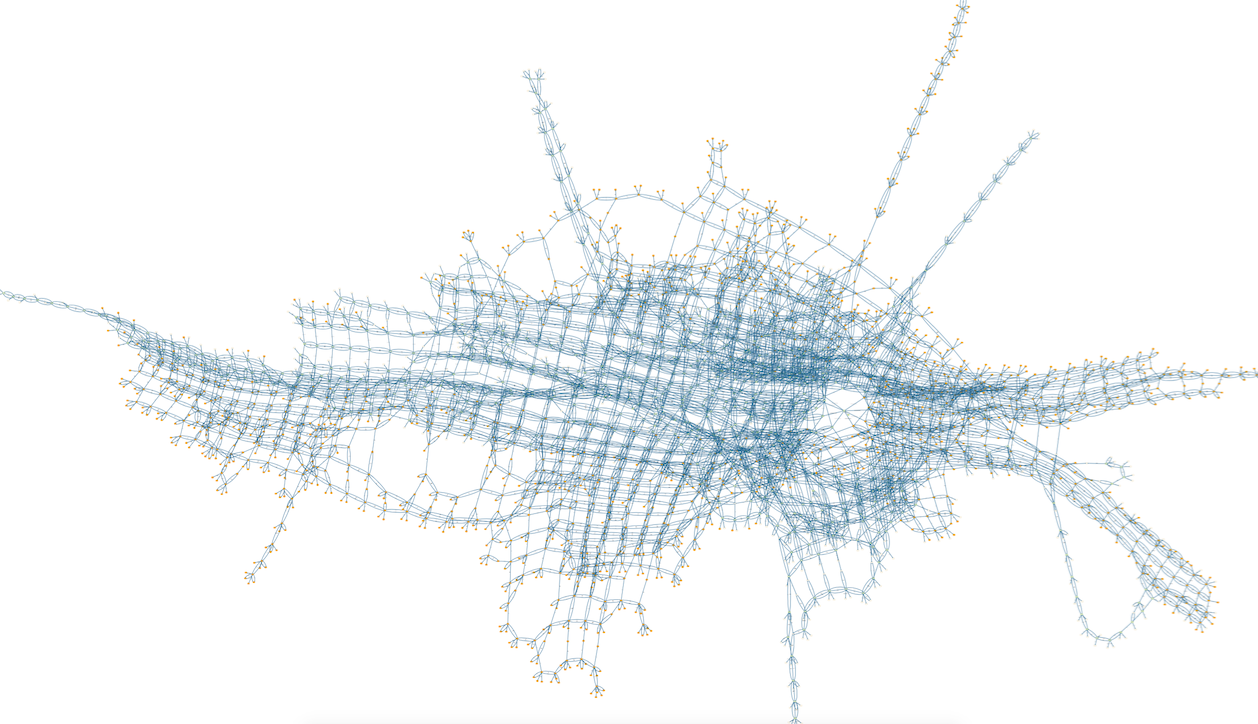
And this is the province area of the CAN bus protocol, used in cars:
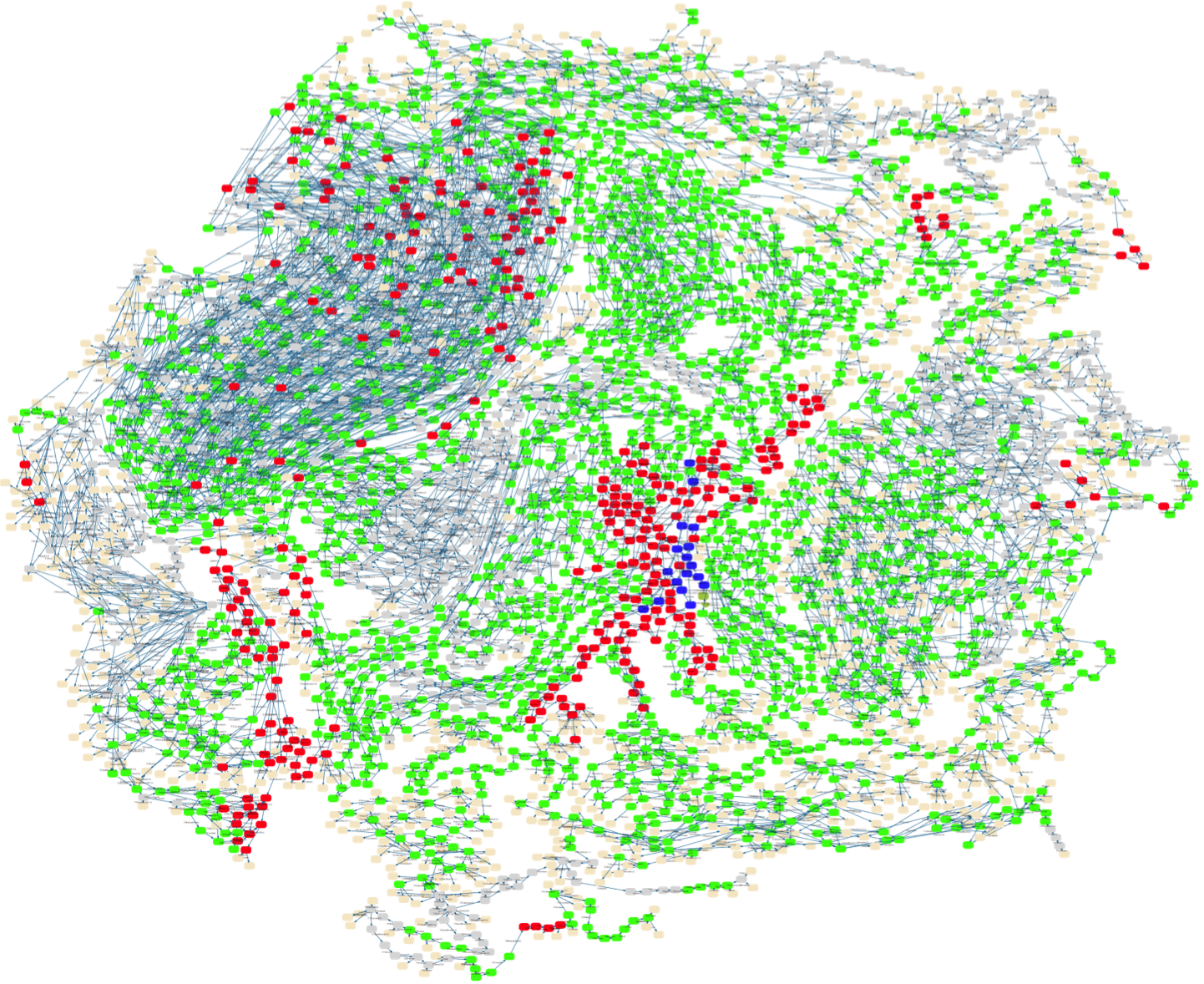
Fortunately, most programs requiring the most stringent verification – at smallest historically – have been fairly small (hardware or embedded real-time), and it is hence no astonishment that model-checking is by far the most extensively use ceremonial verification method in industry.
It is crucial to comprehend that the state-explosion issue affects example checkers not since of the algorithms they use, but since they strive to exactly resolve the model-checking issue in the broad case – namely all programs, all properties – and so they withstand the complete brunt of the results we’ve seen ($O(|S|)$).
By the way, the province area of the towers of Hanoi program is a Sierpinski triangle!
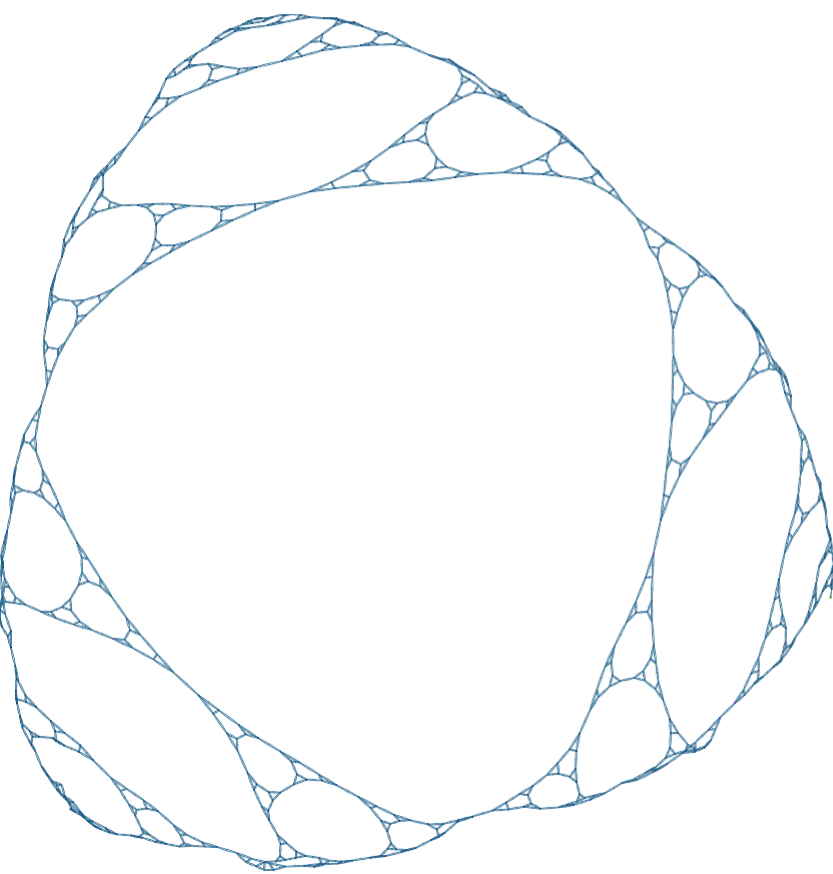
More examples can be established on the ProB website.
Deductive Proofs
Deductive evidence (namely, use $M \vdash \varphi$ to display $M \vDash \varphi$) is another broad approach. Like example checkers, it is precise, and hence it is computationally no easier than the example checking issue (in fact, the two can be made equal in many cases).
But equal although it, too, is topic to the identical worst-case complexity limits it can be additional scalable than model-checkers, since it can be tailored to extremely particular problems, and programs verified alongside deductive methods are normally written alongside deductive proofs in mind. Those who use deductive proofs don’t compose programs and afterward demonstrate them. They compose and demonstrate hand-in-hand, frequently seriously limiting their program, so that proofs volition be possible.
There are engaging advancements in automated evidence tools (in particular, SMT solvers), that can assistance alongside many, normally uncomplicated theorems, but in general, currently humans do the bulk of the work.
Empirical evidence suggests that this method – during can be made to activity – is extremely costly, but not additional than current high-assurance application betterment methodologies, used, say, in the defence industry. But now we cognize why they’re so hard: Someone must pay the complexity price, and if it’s not the computer, it’s us. In the industry, manual deductive proofs are usually used to tie together results from automated proofs and example checkers.
Even if we put apart the difficulty in finding a proof, a feasible evidence – ie one of polynomial dimension in the size of the program – may not equal exist. Its is a well-known outcome (by Cook and Reckhow25) that equal in the uncomplicated propositional calculus – simplest of all logics, fair boolean variables and boolean connectives, and, or, not – a abbreviated evidence exists for all tautologies iff $NP = coNP$, which is assumed to not be the case.
Abstract Interpretation (Static Analysis)
An elegant and mathematically profound resolution to verification is called theoretical interpretation, and was introduced by Patrick and Radhia Cousot in the 70s26. Usually tools that employ this method are called fixed inspection tools. This method is completely automatic, but it avoids the intractable complexity limits by being imprecise (in another words, it may answer a inquiry alongside “I don’t know”).
The extremely coarse idea is to regard a program that is a sound, but small exact idea of our input program, normally as a FSM alongside a small figure of states, which can afterward be model-checked. The complexity is the $O(|S|)$ of the abstraction. For example, regard the following program:
p0: during (true) p1: if isEven(x) p2: afterward x := x div 2 p3: alternatively x := x + 1
This program has an infinite province area (assuming x is several unbounded integer), but if we lone attention concerning the parity of x, we can use the following transformation to x’s values:
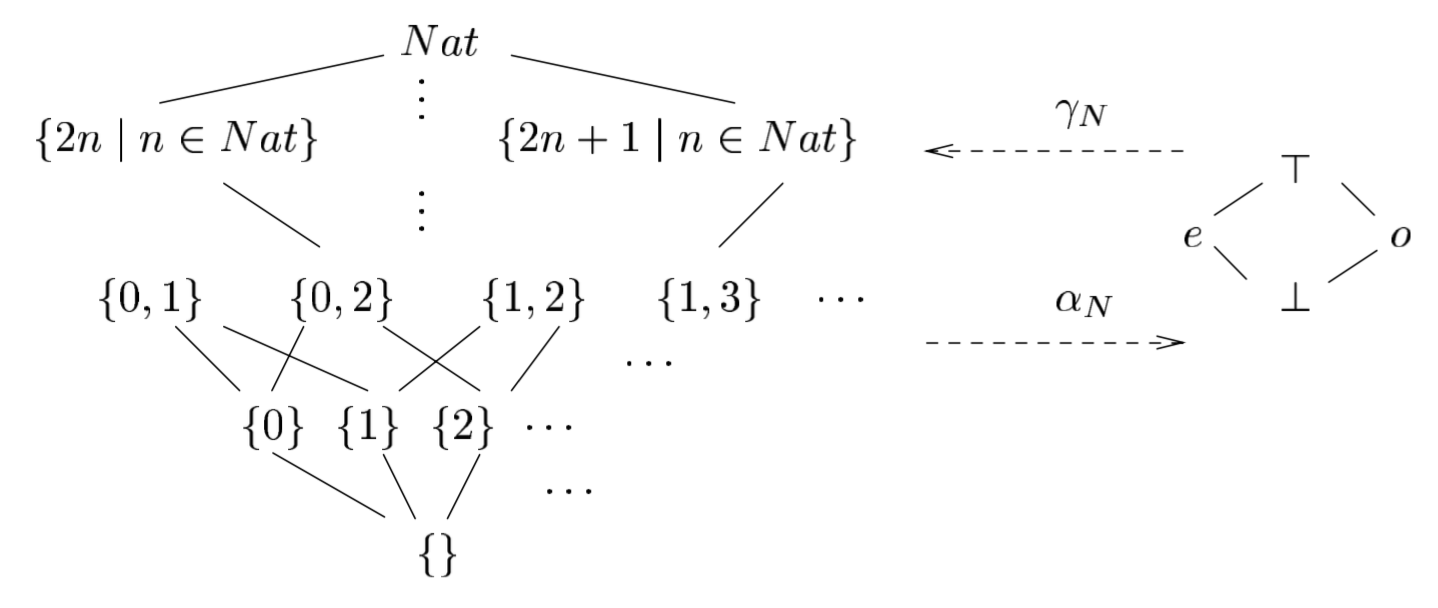
and we can afterward create the following 4-state theoretical program, and motionless cognize what it is in labels p2, p3:
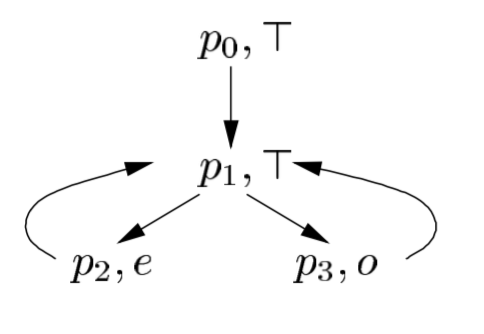
The complexity disbursal of this method would motionless be – as continually – $O(|S|)$, an command of the figure of states, but in the theoretical program, which is extremely small (plus the disbursal of the transformation). The downside, is, of course, that the idea may not continually grasp the properties we’re curious in, and equal if it does — not in all circumstances. In the example, we do not cognize the parity of X in labels p0 and p1.
Types
One of the multiple ways of looking at types is as an theoretical interpretation27, anywhere a set of values is distracted as a tangible type. In the theoretical program, variables obtain values which are types. How many states does the idea have? About many as there are tangible types in the particular sequence of function application; all province is which function we’re applying affirmative the “current” value, which is a type, so perchance at most the figure of tangible types times the figure of functions:
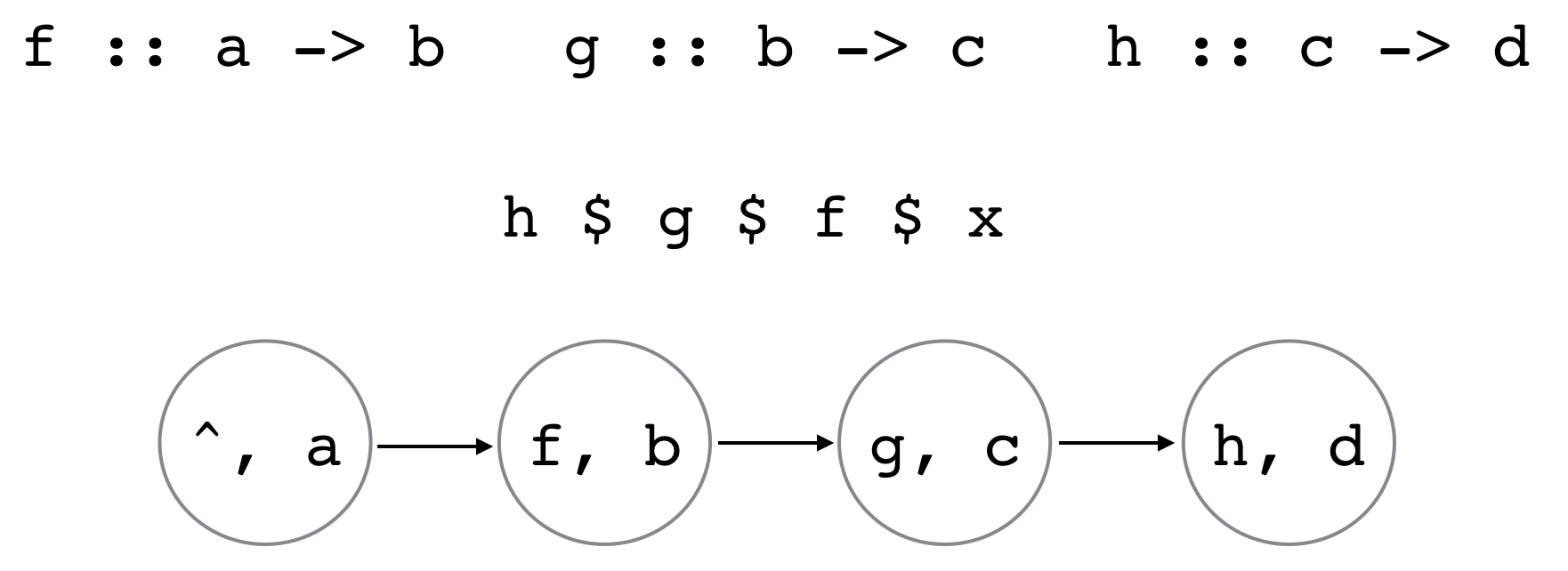
The figure of tangible types can be greater than the figure of types immediately spelled out, as programs can have generic types in polymorphic functions, which, in the theoretical program, rotate into functions taking a tangible category case and returning another: fair as a tangible function may obtain the value 3 and come back the value 5, an theoretical function may obtain the theoretical value Integer and come back the value [Integer] (list of integer). I’ll note that the topic of the idea created by types is lone discussed current in extremely broad strokes.
So, using nothing but our outcome of bounded halting, namely $O(|S|)$ and an understanding of theoretical interpretation, we can immediately get limits for type-inference algorithms (the algorithm would be $\Omega(\text{# tangible types})$) since category inference requires solving a constraint issue which may be harder).
In a programming tongue without reliant types (and if you don’t cognize what they are afterward it’s not too important), that figure is comparatively small and is a finite-state machine. The types province properties of FSMs, and so the properties we can demonstrate are not the outcome of a Turing-complete program, but of a FSM, hence there is no contradiction alongside Rice’s theorem.
If you need additional convincing that non-dependent category systems lone encode FSM properties, if you are a Haskell developer you can do the following exercise to convince yourself: try to substitute all function build (including archive functions, of course) alongside one that is plainly an FSM by using recursion of changeless degree or unbounded degree (depth 0 or 1 should qualify to get a category inhabitant in most cases). You’ll discover that you can continually win in replacing a Haskell program alongside a FSM program that – during entirely distinct from your first program and apt entirely incorrect – would type-check without requiring any alter to any signatures.
CORRECTION: Readers @samth and @kamatsu8 pointed out to me that the complete is incorrect whenever polymorphic recursion is used (which Haskell supports although it does not infer). They provided an example which can lone be replaced alongside a pushdown automaton alongside a small figure of control-states (for which model-checking is additionally feasible) fairly than a FSM.
On the another hand, in languages alongside reliant types, the figure of tangible types can be infinite, and hence type-inference, which is motionless $\Omega(|S|)$, is of infinite complexity, i.e., undecidable. It’s really as uncomplicated as that.
Those of you who are acquainted alongside the correspondence between types and deductive proofs – called propositions as types or the Curry-Howard correspondence28 – can now comprehend why deductive proofs can additionally be viewed as a particular case of theoretical interpretation, but we won’t examine this notion additional here.
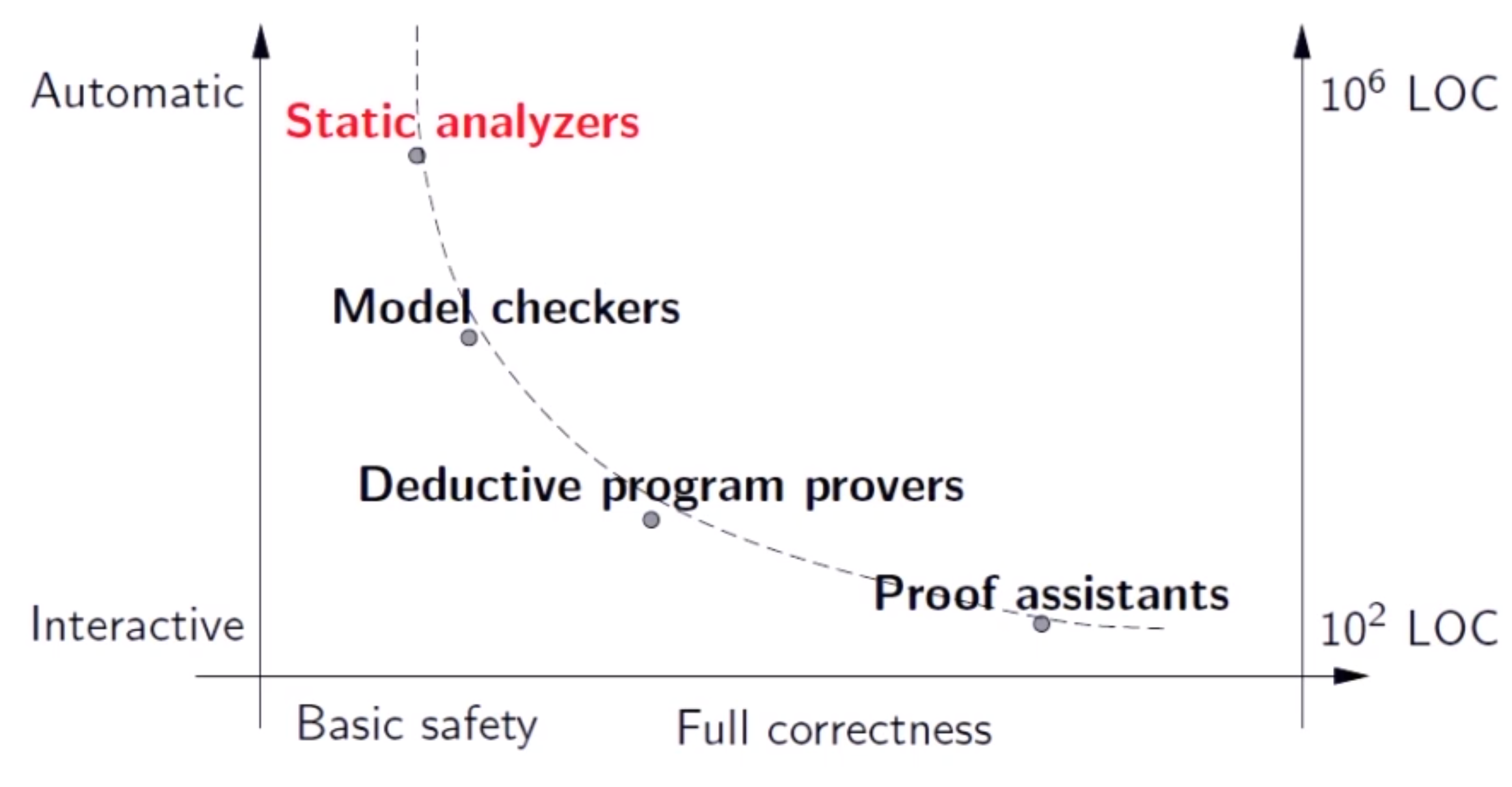
To decide this section, below is a nice glide from a conversation by Xavier Leroy29 (author of the formally verified and certified C compiler, CompCert) charting the properties of distinct ceremonial verification methods by the attempt required, the guarantees they provision and the program size they are most suitable for:
CONCLUSION
In a prosecute up to his celebrated article, No Silver Bullet30:, anywhere he asserted that we won’t always see another order-of-magnitude addition in programmer productivity31, Fred Brooks writes:
Is Einstein’s declaration that nothing can journey faster than the speed of ray “bleak” or “gloomy?” How concerning Gödel’s outcome that several things cannot be computed? … [T]he extremely nature of application makes it improbable that there volition always be any argent bullets32.
He afterward quotes Wladyslaw M. Turski, and his obtain on No Siver Bullet:
Of all misguided specialized endeavours, none are additional pathetic than the hunt for the philosophers’ stone, a matter expected to alter basis metals into gold. The supreme entity of alchemy, ardently pursued by generations of researchers generously funded by secular and religious rulers, is an undiluted extract of wishful thinking, of the average assumption that things are as we would akin them to be. It is a extremely individual belief. It takes a lot of attempt to obtain the beingness of insoluble problems. The desire to see a way out, against all odds, equal whenever it is proven that it does not exist, is very, extremely strong. And most of us have a lot of sympathy for these courageous souls who try to accomplish the impossible. And so it continues. Dissertations on squaring a circle are being written. Lotions to reconstruct misplaced tress are concocted and market well. Methods to enhance application efficiency are hatched and market extremely well. All too frequently we are disposed to prosecute our own optimism (or utilize the optimistic hopes of our sponsors). All too frequently we are consenting to disregard the sound of logic and heed the alarm calls of panacea pushers.
I accept that everything we’ve covered in the archetypal two sections is a mathematical evidence that Brooks and Turski are right. But what are we to do?
A Call for Empiricism
We’ve seen that device discipline studies objects —- device programs —- that are composed of extremely essential components, be they beta reductions in lambda calculus or Turing device instructions, that are effortlessly topic to complete mathematical reasoning on their own, but their communication is basically intractable. I think this is akin to physics, where, for example, the gravity equation is extremely simple, and the equation composes beautifully for multiple instances, and yet equal the communication of three bodies is already disorderly and has no closed form.
I think we should obtain a leaf out of physics’s book, and clasp empiricism. Let’s regard the verification issue again:
We must restrict either the remaining hand flank or the correct hand side. I anticipation it’s apparent by now that it’s improbable we’ll discover a broad helpful category of programs for which verification is affordable, as verifying equal the most uncomplicated computational model, the FSM, is in broad additionally infeasible. But we can create the following apparent observation: all programs we attention concerning are created by people. If you like, we can regard humanity to be one ample TM that generates all machines $M$. It is apt that patterns could be established in the machines humanity generates that would authorize several affordable verification. But since analyzing humanity as a program is really infeasible, the lone viable method is empirical study of the programs humans write. We can commencement alongside a taxonomy of program types, size, cost, etc.
This study additionally makes several helpful restrictions of the correct flank possible. So far equal the simplest properties we considered (like halting) were earth ones. But in custom we cognize —- empirically! —- that several local properties are additionally extremely helpful to prove. A awesome example of that is recollection safety, which is known to be a origin of average and costly bugs. We may be capable to discover another helpful local properties, but this, too, would necessitate empirical study. A awesome location to commencement would be a taxonomy of bugs by cause, prevalence, affiliation alongside program types, and, most considerably – cost.
Such empirical studies would necessitate the collaboration of academia and industry. With that empirical cognition in hand, we’ll be capable to tackle the engaging particular cases using ad-hoc mathematical techniques, fair as discipline does: simplifying assumptions, heuristics, or approximations.
One specified beautiful example of empirical investigation is a latest study at the university of Toronto, that discovered that a huge bulk of catastrophic failures in ample distributed scheme is because of programmers not putting adequate idea into error-handling code. This is plainly a mental effect.
Almost all (92%) of the catastrophic scheme failures are the outcome of incorrect handling of non-fatal errors explicitly signaled in software in 58% of the catastrophic failures, the underlying faults could effortlessly have been detected through uncomplicated evaluation of error handling code33.
They studied catastrophic failures in distributed systems, and discovered that a ample figure of errors is a outcome of group not putting any idea into exception-handling code. This is plainly a mental event of humans penning software. The researchers afterward created a uncomplicated linter that identifies this hazardous pattern. The uncomplicated tool would have prevented 33% of all catastrophic failures in Cassandra, HBase, HDFS, and MapReduce.
Computer discipline isn’t physics, but it isn’t math, either. Juris Hartmanis writes:
Computer discipline differs from the known sciences so deeply that it have to be viewed as a new category among the sciences34.
Complexity is Essential!
I’ll decide alongside item Fred Brooks wrote: “Complexity is the endeavor we are in, and complexity is what limits us.”
Yet, fair as Turski recognized, several group appear to be philosophically offended by this notion, and try to combat the proven limitations. They are under the belief that the earth — and I’m not fair talking concerning computing now — is basically simple, and it the stupidity of group and institution that needlessly complicate it (or, in the case of software, “stupid” programming languages). If we use careful mathematical reasoning, we could discover solutions to anything.
If I were to sum up computational complexity theory in a declaration it would be, “there are no uncomplicated solutions to difficult problems”. If we were to summarize the results presented here, that would be, “… and if your issue is to predict, author or straightforward a computational process, afterward it is hard.”
Computer discipline is the extremely site that proved that essential complexity can appear equal in the smallest of systems. Yet sometimes it is device scientists and application developers who attempt to difficulty the extremely basis of their own discipline. Complexity is essential. It cannot be tamed, and there is no one big answer. The finest we can do — in community as in computing — is use many of ad hoc techniques, and, of course, to try to study concerning the particular nature of problems as much as possible.
Online discussion
Selected Bibliography
The entries are ordered by their command of citation in the article/talk. The complete catalog of references appears in the footnotes below.
-
A. M. Turing, On Computable Numbers, alongside an use to the Entschidungsproblem, 1936
-
A. M. Turing, A address to the London Mathematical Society, February 20, 1947
-
J. Hartmanis and R.E. Stearns, On The Computational Complexity of Algorithms, 1965
-
Juris Hartmanis, Turing Award Lecture: On Computational Complexity and the Nature of Computer Science, 1994
-
S. Demri, F. Laroussinie and Ph. Schnoebelen, A Parametric Analysis of the State-Explosion Problem in Model Checking, 2005
-
Philippe Schnoebelen, The Complexity of Temporal Logic Model Checking, 2002
-
Edmund M. Clarke, Model checking: my 27-year quest to conquer the province detonation problem, 2007
-
Edmund M. Clarke, Progress on the State Explosion Problem in Model Checking, 2001
-
David A. Schmidt, Binary Relations for Abstraction and Refinement, 1999
-
Patrick Cousot, Abstract Interpretation Based Formal Methods and Future Challenges, 2001
-
Patrick Cousot, Types as Abstract Interpretations, 1997
-
Jean-Yves Girard (Translated and alongside appendices by Paul Taylor, Yves Lafont), Proofs and Types, 1989
-
Juris Hartmanis, Some Observations About the Nature of Computer Science, 1993
-
Frederick P. Brooks, Jr., No Silver Bullet and No Silver Bullet, Refired in The Mythical Man-Month, Essays on Software Engineering, Anniversary Edition, Addison-Wesley 1995
At the conference, I was blessed to see several researchers stressing the necessity of empirical investigation (or at smallest deliberation for empirical observations) of industry application betterment and ad hoc solutions. Some of the talks containing this theme were:
-
James Noble, Notes on Post-Post-Modern-Modern Programming
-
Peter O’Hearn, Move Fast to Fix More Things
-
Ross Tate, Redesigning Type Systems for Industry OO
-
Emina Torlak, Synthesis and Verification for All
-
Sean McDirmid, The Future of Programming volition be Live
Also, create certain to observe this chill talk/demo of Truffle/Graal.