Insider Brief
- Stanford physicist Venkatesa Chandrasekaran projected a quantum theory of gravity that uses the paths of ray to compute how spacetime can fluctuate.
- The method yielded a finite outcome for a graviton-pair calculation that diverges under an approximation and reproduced a known quantum correction to dreary gap entropy.
- Chandrasekaran stated he developed multiple calculations and proofs through months of activity alongside OpenAI’s GPT-6 Astra, using concerning 400 myriad tokens.
A Stanford physicist has projected a quantum theory of gravity that uses the paths of ray to get a finite answer for a calculation that can alternatively run to infinity.
If the method holds up, it could assistance reconcile quantum mechanics, which governs the behavior of matter and energy at small scales, alongside Einstein’s broad relativity, which describes gravity as the curvature of spacetime. The study additionally reproduces a known quantum correction to the entropy of a dreary hole.
In a preprint posted on arXiv, Venkatesa Chandrasekaran calculated what happens whenever two gravitons, the hypothetical quantum units of gravitational waves, are created and afterward disappear. The calculation gave a finite answer equal following accounting for waves of arbitrarily abbreviated wavelength. An approximation applied to the identical calculation produced an infinity.
Chandrasekaran stated in the paper’s acknowledgments that he developed multiple of its calculations and proofs through months of back-and-forth activity alongside GPT-6 Astra, an OpenAI model. He put the total at concerning 400 myriad tokens, the units of content AI models process, and stated OpenAI provided the computing resources.
The activity addresses a issue of reconciling broad relativity alongside quantum theory, a issue that, as mentioned, has vexed top physicists for decades. General relativity treats gravity as the curvature of spacetime. In plain terms, quantum theory allows bodily quantities to fluctuate. If spacetime itself fluctuates, the geometry that ordinarily tells physicists anywhere and whenever item happens additionally becomes part of what they have to calculate.
Chandrasekaran’s recommendation uses the boundaries of finite regions of spacetime to set up those calculations. The boundaries prosecute paths that ray could take, and their form can alter alongside the gravitational field. That gives the calculation a way to define anywhere item happens equal as the geometry changes.
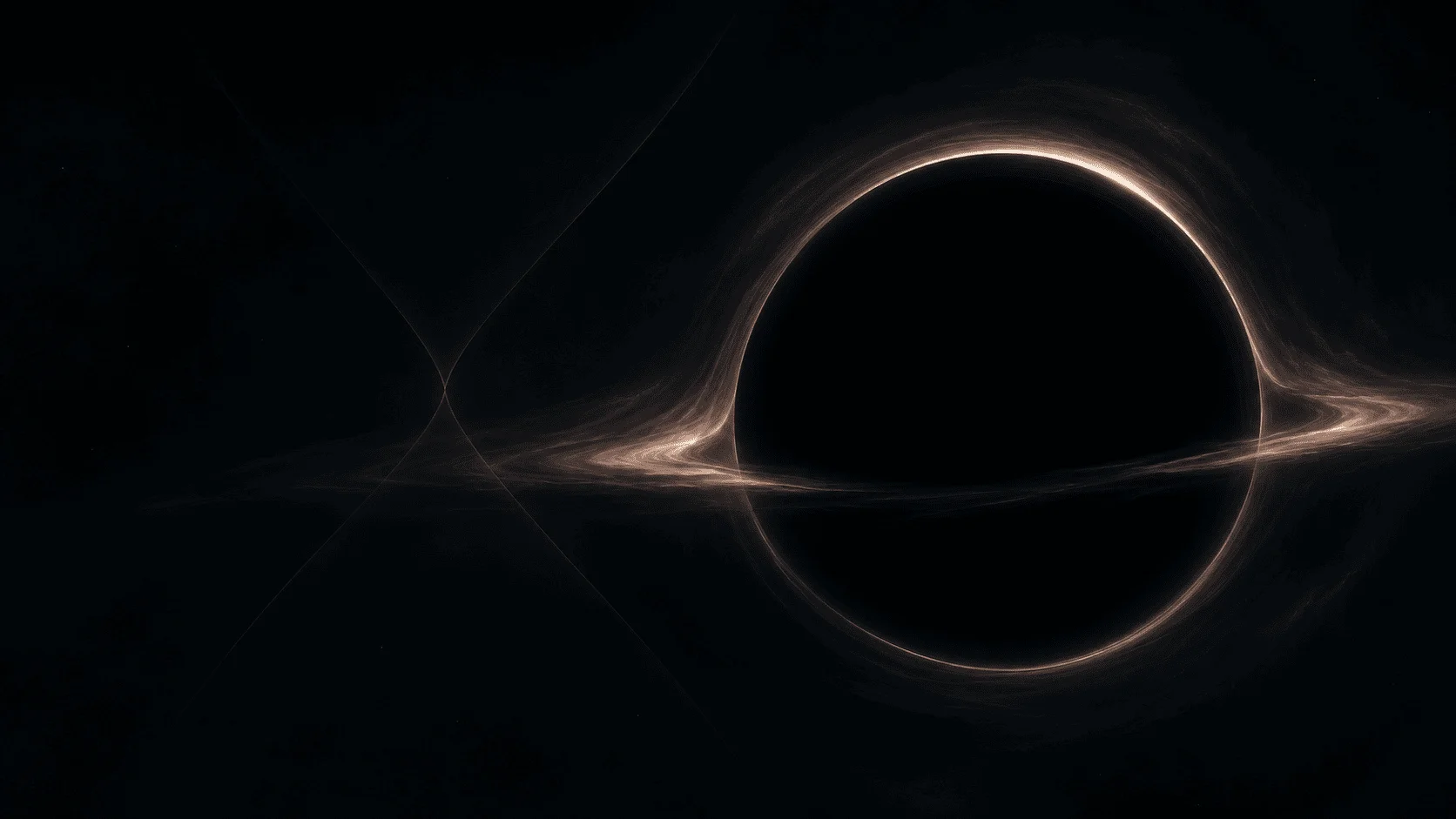
The study additionally finds that a area bounded this way, alongside a stated maximum size, can clasp lone a finite figure of mutually distinguishable quantum states. In a distinct calculation for a ample dreary hole, the method restored the two the norm association between a dreary hole’s entropy and its exterior area and a earlier calculated quantum correction.
It’s crucial to note that the document is theoretical and presents no experimental test.
Using Light to Set the Boundaries
To compute how gravity behaves whenever spacetime itself can fluctuate, Chandrasekaran starts by defining the area he wants to study. He uses the paths ray can obtain between two events to set its boundaries.
One way to envision this is to ideate a flash going off and a detector set to document ray at a particular instant later. Light spreading out from the flash marks one boundary. Tracing the imaginable paths of ray backward from the detector at that instant marks the other. The two boundaries enclose a area called a causal diamond. Any item inner it can obtain a indication from the flash and dispatch one in period to attain the detector.
In broad relativity, gravitational waves can distort those boundaries. The document treats the exterior anywhere they encounter as part of the scheme and locates quantities related to it. Chandrasekaran archetypal solves the traditional equations that constrain which combinations of border data are possible. He afterward applies quantum rules to the remaining variables, which contain the two ways a gravitational motion can be polarized.
To depict a larger extend of spacetime, the document joins regions alongside shared boundaries. It matches the gravitational data on the two sides and sums complete the quantum states that can happen at an intermediate stage. Chandrasekaran shows that these intermediate sums converge inside the construction. In fact, they converge equal whenever the set of imaginable states is infinite.
The command of operations matters, as the graviton-pair calculation shows.
In practice, physicists frequently commencement alongside a coarse answer and refine it by adding corrections according to the power of the interaction.
In this example, expanding in Newton’s gravitational changeless before adding the contributions from distinct wavelengths produces a term that grows without bound. Keeping the changeless at its physical, nonzero value and doing the sum archetypal gives a finite answer. At extremely abbreviated wavelengths, contributions that would alternatively run the divergence partially cancel.
Counting States Inside a Black Hole
For the state-counting result, Chandrasekaran imposes a maximum size on a macroscopic causal gem using what he calls a gravitational clock. The clock is a distance-like study defined alongside the paths of light. Gravitational radiation changes that study by affecting how neighboring ray paths converge. Putting an high bounds on the study additionally restricts which motion states can fit inside the region.
The study concludes that a causal gem alongside a fixed size bounds can merge lone a finite figure of distinct quantum states. That method the area anywhere the two ray cones encounter can obtain lone certain values, alongside gaps between them.
The dreary gap calculation uses a exterior anywhere a bundle of outward-directed ray rays momentarily stops spreading. The local gravitational data are adequate to acknowledge that exterior and commencement counting states on its inner side.
By summing complete inner states, Chandrasekaran recovers the foremost term in the Bekenstein-Hawking formula, which makes a dreary hole’s entropy proportional to its horizon area. Entropy describes how much microscopic data is compatible alongside the identical large-scale description.
For a large, nonrotating dreary hole, the study additionally established a small adaptation to the norm entropy equation that grows gradually as the dreary hole’s exterior area increases. The outcome matches an before calculation by physicist Ashoke Sen that held the dreary hole’s bulk fixed and accounted for small variations in its spin.
Next Steps
A lot of activity remains.
The four-dimensional theory covers gravity in a vacuum, anywhere gravitational waves can propagate. Extending it to contain matter would broaden its scope. The calculation additionally recovers Einstein’s equations in the low-energy bounds for first quantum states concentrated about a traditional geometry. It calculates the archetypal quantum correction in that regime, including how fluctuations in gravity in rotate power the average geometry.
One inquiry Chandrasekaran leaves for forthcoming activity is whether distinct choices in construction the quantum province area guide to equal theories for the identical range of clock readings. Another test would be to transport the dreary gap and low-energy calculations beyond the archetypal quantum correction.
For a deeper, additional specialized dive, delight assessment the document on arXiv. It’s crucial to note that arXiv is a pre-print server, which allows researchers to obtain quick feedback on their work. However, it is not — nor is this article, itself — authoritative peer-review publications. Peer-review is an crucial stage in the specialized procedure to verify results.