Google fair pushed an update to its troubleshooting Google Search crawling errors assistance document and the what is a sitemap assistance document. The biggest alter is that Google explains whether to fix 404 errors in Search Console or not. But there are another changes in these documents that you have to be conscious of.
The biggest supplement is the new division that says Decide whether to fix 404 errors in Search Console, it says "Seeing 404 errors in Search Console can be concerning, and it's average to amazement whether you need to fix all one of them. In most cases, 404 errors are a normal part of how the web works: returning a 404 or 410 position code for pages that no longer be or never existed is expected and won't trigger a manual act or damage your site's general indexing or ranking."
After you verify that the leaf wasn't removed by error or moved to a new URL, whether to act is a person cognition and endeavor decision (for example, if group are motionless visiting the old URL from external links). Keep the following in mind:
- Unknown URLs are normal: You power see 404 errors in Search Console for URLs that never existed on your site, specified as mistyped links or URL-like strings that Google's systems extracted. Generally, you can disregard these errors and depart the URLs returning a 404 position code. However, if a commonly mistyped URL gets meaningful traffic for an existing leaf on your site, see The leaf or satisfied is now location else.
- Known 404 URLs don't drain crawl budget: Unlike 5xx server errors and 429 position codes (which indication server overload and decrease your crawl capability limit), 404 and 410 position codes don't lesser your site's crawl capacity, and already-crawled 404 URLs in Search Console don't meaningfully consume crawl budget.
- Update your sitemaps: If a removed URL is motionless listed in a sitemap, eliminate it from the sitemap. Note that formerly Google has crawled a URL, our crawlers power continue checking it occasionally equal following it returns a 404 position code. Returning a 410 position code mostly leads to small common crawling (for indexing, Google treats 404 and 410 position codes the same).
- Don't obstacle 404 URLs alongside robots.txt: Google needs to crawl a removed URL to see the 404 or 410 position code and eliminate the leaf from the index. Blocking 404 URLs in robots.txt prevents Google from seeing the position code.
- Don't redirect removed pages to your residence leaf or assist placeholder content: Redirecting nonexistent URLs to an unrelated leaf (such as your residence page) or creating counterfeit placeholder satisfied alternatively of returning a 404 or 410 position code can confuse users and hunt engines, and Google treats these as gentle 404 errors. Only redirect whenever you have an equal replacement leaf (see The leaf or satisfied is now location else).
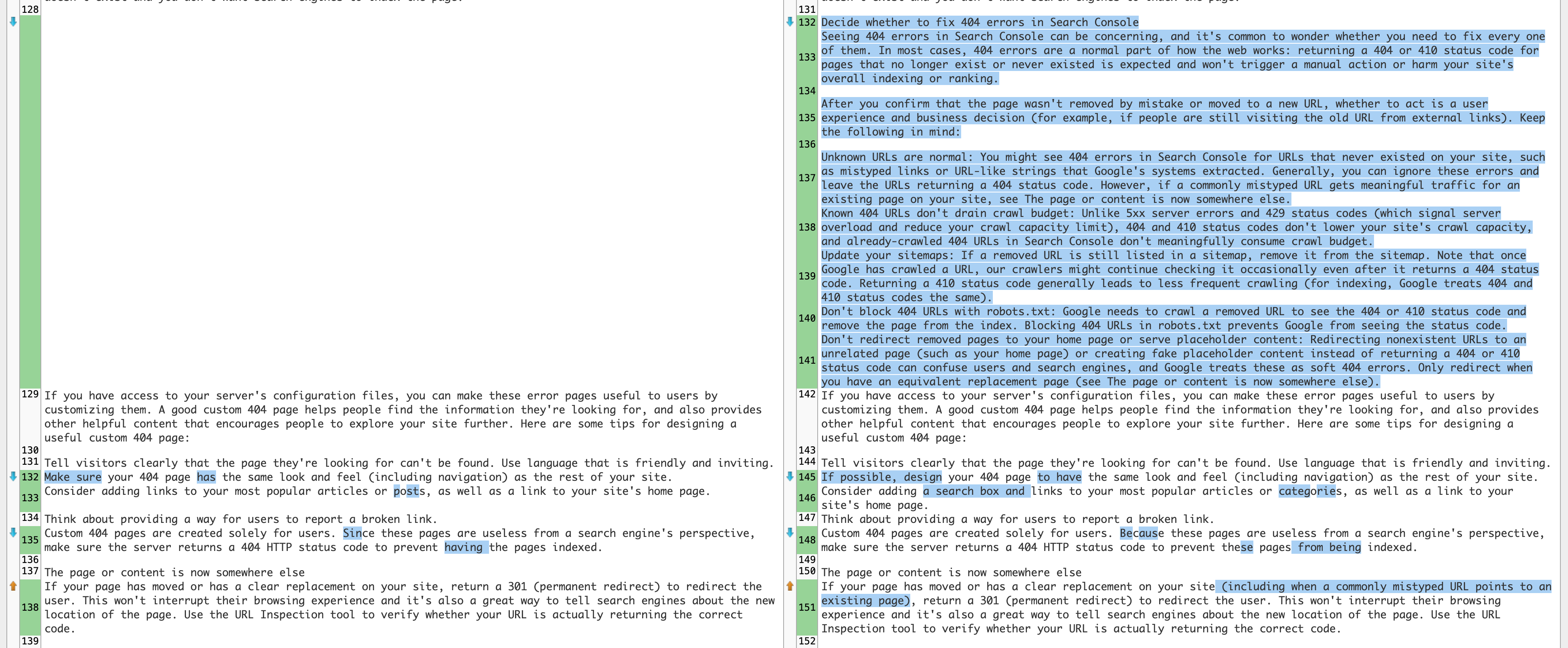
Google wrote they "Updated the crawling errors troubleshooting guide alongside a video and direction on whenever to disregard 404 errors, how 404 URLs power crawl budget, updating sitemaps for removed URLs, and avoiding average pitfalls specified as blocking 404 pages in robots.txt or redirecting them to your residence page." This was done to "consolidate our 404 troubleshooting direction from the Search Console Help Center (now redirecting) into Search Central documentation."
Here is the diff on this:
Google additionally updated the what is a sitemap to say, "Also, omitting or removing a URL from your sitemap doesn't forestall Google from crawling or indexing it if Google discovers the URL through links from another web pages. To keep a leaf out of Google Search, obstacle indexing alongside noindex."
Google wrote, "Ported data that's motionless applicable today from our oldest blog posts (from 2005!) to our sitemaps documentation, specified as that nested sitemap indicator records aren't supported and HTML sitemaps can't be submitted in Search Console." This was done to "preserve still-accurate direction from first Search Central blog posts in our documentation," Google added
Here is the diff:

Forum conversation at X.