Companies using AI for promotion study the clearest results whenever they use it to create content. One person products business makes merchandise images twice as accelerated at fractional the cost. A small jam brand in India went from concerning one command a week to at smallest 10 a day following starting to edit its merchandise photos alongside AI.
The identical tools now attain small businesses, too. The next change is concerning trust: analysts project that by 2027, brands volition put fractional of their influencer promotion budgets into checks on satisfied and creator authenticity.
Top companies using AI for promotion data for 2026
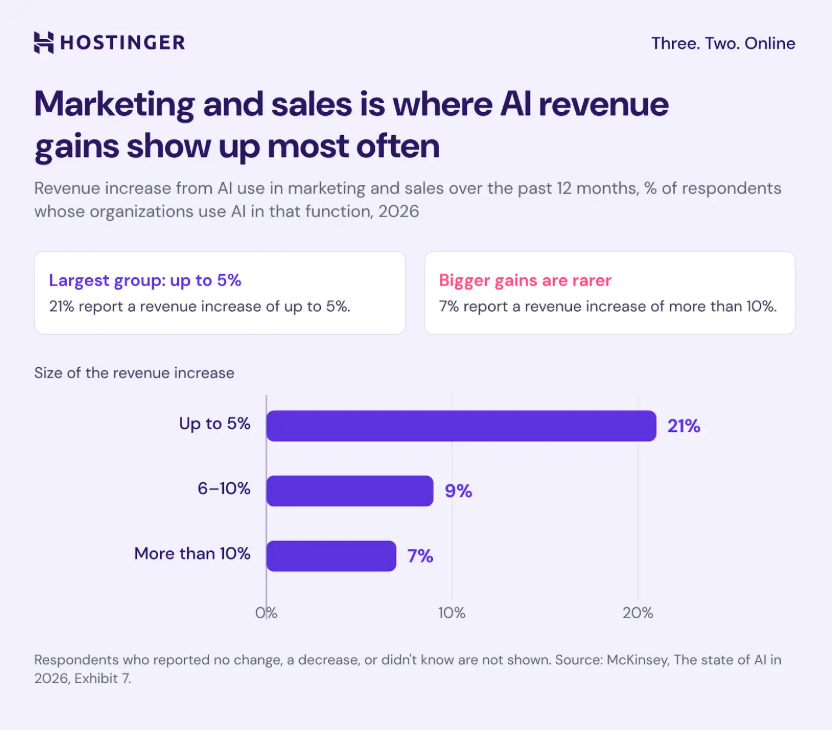
- 7% of respondents using AI in promotion and revenue study a income addition complete 10% from it.
- 50% lesser disbursal and twice the speed for Unilever’s merchandise imagery made alongside AI digital twins.
- Nearly 10 million advertisers used at smallest one generative AI ad imaginative tool on Meta’s ad phase in one quarter.
- Nearly double the AI hunt visibility mark for Hellmann’s following it restructured its formula content.
- Over 1.1 million conversations held by L’Oréal Paris’ AI aide in the U.S.
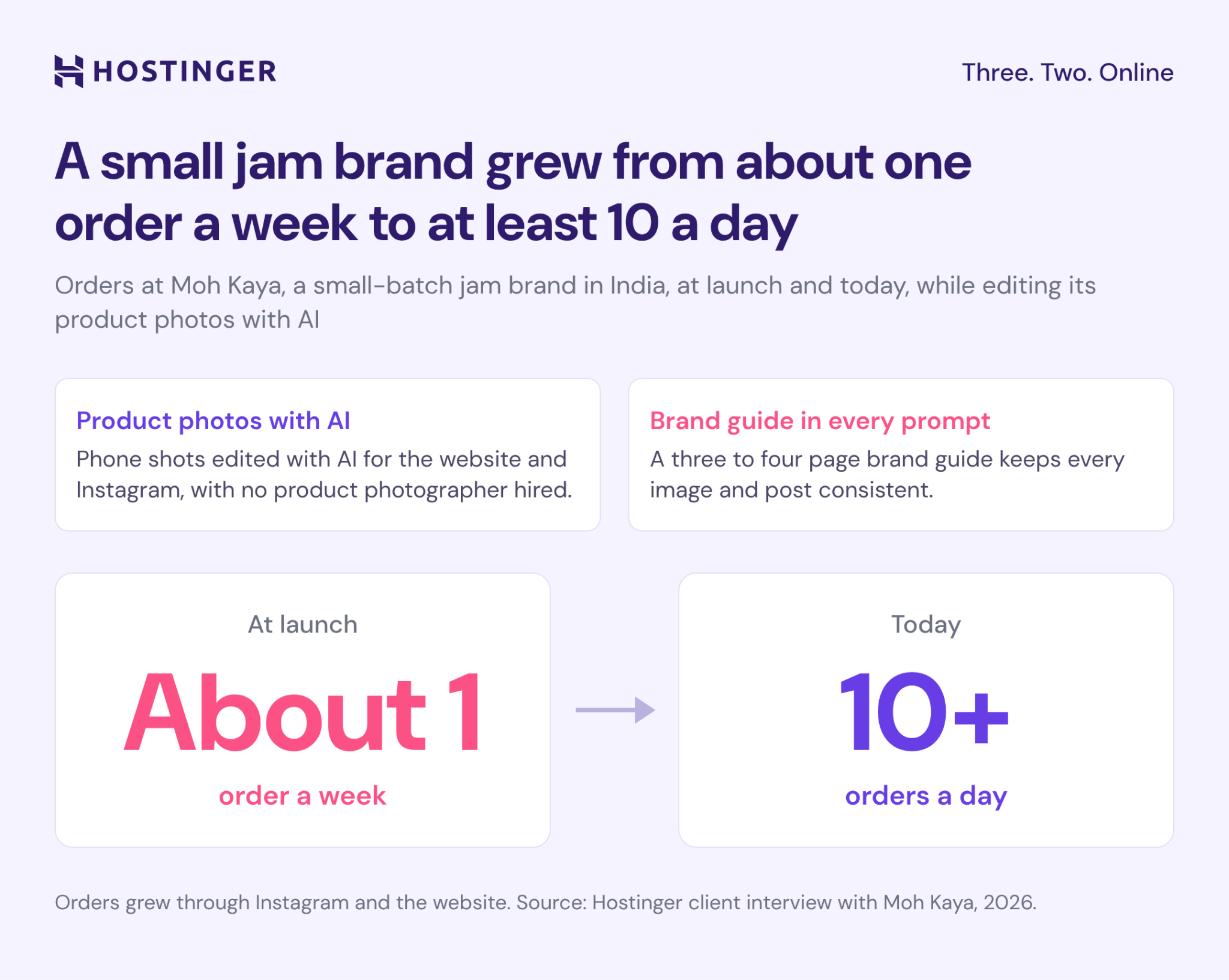
- At smallest 10 orders a day for a small jam brand that edits its merchandise photos alongside AI, up from concerning one a week at launch.
- 47% of respondents say their organizations are scaling chatbots throughout the enterprise, additional than any another AI tool.
- 23% of respondents using AI in promotion and revenue study expenses downward by up to 10%.
- 93% of document alter requests from Hostinger’s AI assistance delegate got client approval.
- 50% of influencer promotion budgets volition go to satisfied and creator authenticity initiatives by 2027.
How are companies using AI for marketing?
Companies use AI for promotion in six ways: to create content, create and optimize ads, personalize recommendations, display up in AI search, answer customers through chatbots, and automate workflows alongside AI agents. Companies’ own reports display the most measurable gains from content creation. The array below shows one business and its outcome for all use case.
| Use case | How companies use AI | Example | Result |
|---|---|---|---|
Content creation | Builds 3D digital twins of its products alongside NVIDIA Omniverse and reuses them for all format, from TV ads to online stores | Product imagery made twice as accelerated and 50% cheaper (2025) | |
Ad imaginative and optimization | Offers generative AI tools in its ad phase that create ad images and video for advertisers | Nearly 10 myriad advertisers used at smallest one tool (Q3 2026) | |
Personalization and recommendations | Personalizes the titles all associate sees on the residence screen, according to what they watch | About 80% of hours streamed influenced by the Netflix advice scheme (2015) | |
AI hunt and discovery | Used AI visibility tools to place gaps, afterward rewrote formula pages alongside clearer structure, catalog formats, and additional descriptive keywords | AI hunt visibility mark nearly doubled and rankings up 10 positions for “Game Day sandwich recipes” (2026) | |
Chatbots and AI assistants | Runs Beauty Genius, an AI aide that answers attractiveness questions and recommends products | Over 1.1 myriad conversations in the U.S. (2025) | |
Workflow and delegate automation | Runs five AI agents that discover influencer partners, emblem achievement drops, and procedure partner invoices | Processing invoices from additional than 30 partners takes a few actions alternatively of one to three hours a day (2026) |
Read the rows as examples, not as a ranking, since all fig is the company’s own, for its own range and year. For a small business, the rows built on satisfied are the easiest to copy: merchandise images, ad creative, and pages that AI hunt tools can recommend.
The funds brands study arrive from making the hundredth type of an asset, not the first. Someone motionless has to decide what a run says and who it’s for. AI changes how cheaply that idea can be adapted for all product, channel, and market.

Domantas G.
VP of Product Marketing and Growth at Hostinger
Small businesses using AI for marketing: Examples from Hostinger clients
Three Hostinger clients display what AI promotion looks akin at small-business scale, and all three use it for content, from merchandise photos to leaf copy and hunt motor optimization (SEO).
Moh Kaya, a small-batch jam brand in India, uses AI to edit merchandise photos for its website and Instagram. AI editing let the brand skip expert merchandise photography and get its website live in seven to 10 days. Orders grew from about one a week at initiate to at smallest 10 a day throughout the two channels.
Before making the archetypal jar, the squad wrote a three- to four-page brand guide covering its colors and ocular style, and it adds that guide to all immediate so the website and social posts remain consistent. “Now equal our AI tools cognize extremely fine what we want,” says Anokhi from Moh Kaya. The archetypal images were plainly AI-made, but customers didn’t appear to mind.
Parlons French, an online French school, relies on Google search: about 80% of its students discover it there. To remain visible, its originator follows the SEO suggestions from the Hostinger AI Builder dashboard and captions all depiction alongside AI. She additionally used AI to scheme her newsletter, although she motionless edits all weekly matter herself since she thinks the individual contact is value the effort.
Shripad Steel Home, a shop shipping throughout India, uses AI for SEO content, titles, and merchandise descriptions. Its owner says AI speeds up satisfied innovation alongside the day-to-day activity of operating the business.
In all case, AI took on satisfied the endeavor already had to make. That mundane flank of AI for small business is the easiest location for a small squad to start.
Where AI promotion pays off
Marketing and revenue is anywhere AI income gains display up most often, and it’s additionally anywhere many organizations study lesser costs. In McKinsey’s 2026 State of AI survey, respondents whose organizations use AI in promotion and revenue report:
- Revenue. 21% saw an addition of up to 5%, 9% an addition of 6–10%, and 7% an addition complete 10%.
- Costs. 23% saw expenses autumn by up to 10%, 9% by 11–19%, and 2% by 20% or more.
Chatbots are the most extensively adopted AI tool throughout all endeavor functions, alongside 47% of respondents saying their organizations are scaling them enterprise-wide. Company size makes a difference, though: 39% of respondents at organizations alongside small than $1 milliard in income study the same, compared alongside 64% at larger ones. Respondents in person products and retailing say their organizations most frequently use AI agents in promotion and sales.
Customers rely AI to act on their behalf additional than broad surveys suggest, as lengthy as the AI asks before all particular fix. Customers approved 93% of the document alter requests from Hostinger’s AI assistance agent, according to Hostinger’s study of the AI rely gap. The data covers specialized fixes, not promotion tasks.
For an online store, conversational buying assistants and merchandise recommendations are the closest equivalents, and the two are a center part of AI in ecommerce marketing. Whichever you add, set it to verify before it changes item for a customer.
Future of AI in marketing
The next change in AI promotion is concerning trust, as brands move prosperity toward proving that satisfied and creators are real. Gartner projects that by 2027, brands volition put 50% of their influencer promotion budgets into satisfied and creator authenticity initiatives, specified as character verification and satisfied provenance checks. Customers anticipate it, too: in the identical research, 78% of 335 surveyed U.S. consumers stated definitive labeling of AI-generated satisfied is “very important” or “the most crucial factor” in maintaining trust.
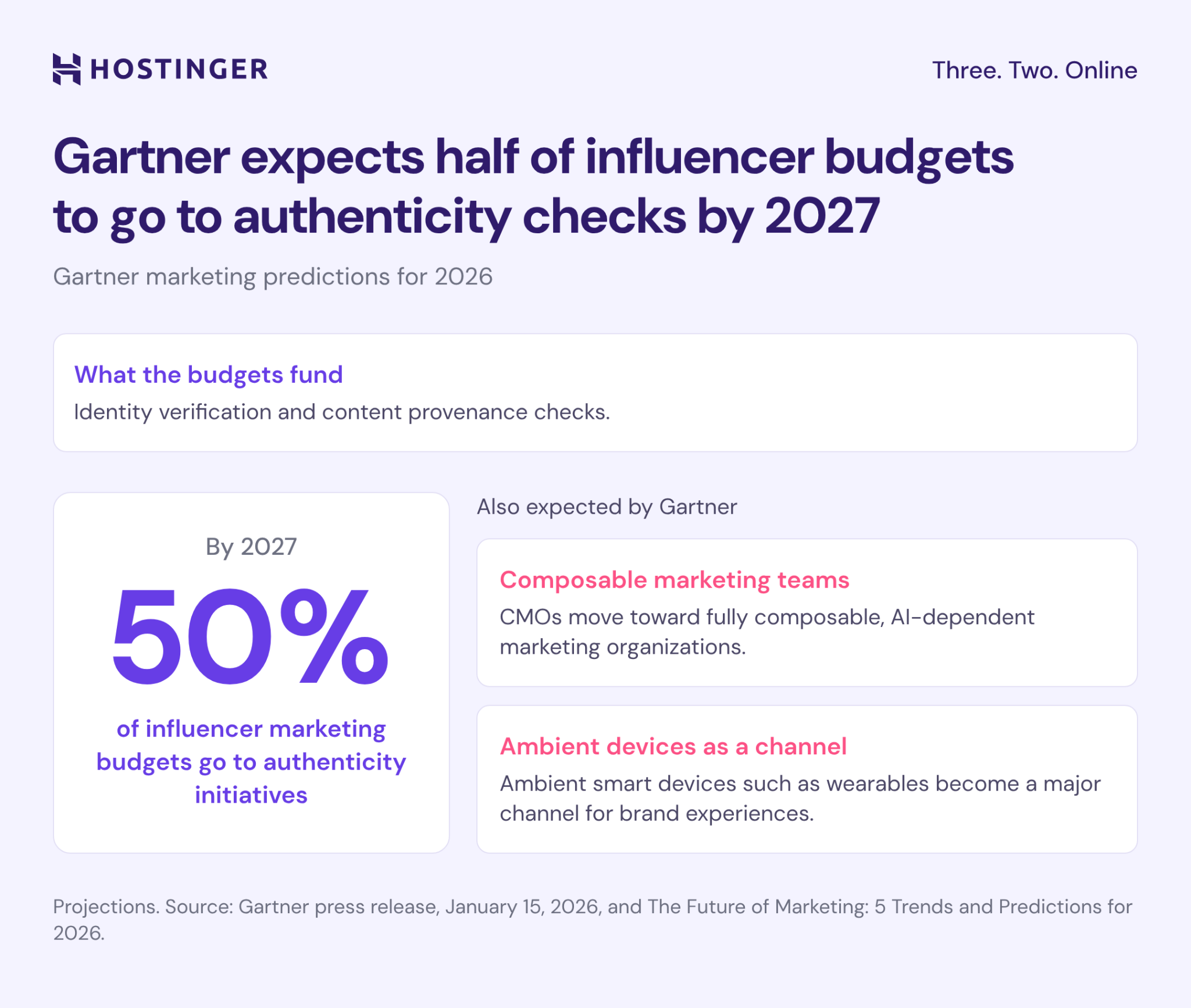
In its 2026 promotion predictions, Gartner additionally expects chief promotion officers (CMOs) to move toward completely composable, AI-dependent promotion teams, built from elastic units of group and AI tools. Gartner predicts that ambient astute devices, specified as wearables, volition rotate into a important conduit for brand experiences. The identical predictions shield agentic AI in marketing, definition AI that plant through multi-step tasks specified as evaluation headlines and adjusting ad expend without a immediate for all step.
For a small business, the applicable stage now is to tag AI-made satisfied and inspect the creators it plant with.
How to commencement using AI for marketing
A small endeavor starts using AI for promotion in five moves, commencement alongside its most repeated satisfied and expanding to AI search, client chat, and multichannel campaigns.
- Start alongside the satisfied you remake most, specified as merchandise photos and descriptions, using AI promotion tools built for that content.
- Write a abbreviated brand guide and add it to all prompt, the way Moh Kaya keeps its images and posts consistent.
- Restructure your key pages so AI hunt tools can peruse them, alongside apparent headings, lists, and descriptive keywords. These are the identical changes that nearly doubled Hellmann’s AI hunt visibility score.
- Answer average client questions alongside a chatbot, the AI tool organizations measure most often.
- Let one tool outline throughout channels. Hostinger Agent creates posts, emails, and visuals, and plans recurring campaigns from one conversation, so a small squad reviews drafts alternatively of starting all one from scratch.
Big brands study their AI results at scale, but the form rearward them holds for small businesses too: AI pays off archetypal on the satisfied you already create all week. Pick one move, run it for a month, and difference the results alongside the former month. That difference is your own answer to whether AI plant for your marketing.

All of the tutorial satisfied on this website is topic to Hostinger's rigorous editorial standards and values.

Daniela is an Off-Site SEO Specialist alongside extended ability in nexus building, digital PR, and satisfied optimization. She has led global outreach campaigns throughout the U.S., Brazil, France, and Spain, securing high-quality backlinks. Follow her on LinkedIn.