Today we are introducing our second example generation alongside Inkling 2 Small. It is a Mixture-of-Experts example alongside 594B total parameters, 17B active, and supports depiction inputs and changeable effort.
Inkling 2 Small far surpasses our former models’ scores on the Artificial Analysis Intelligence Index alongside a mark of 31, reflecting gains in achievement on agentic coding, vision, cognition work, and reasoning. The addition in capabilities comes from improvements made at all stage of our training process, including additional productive pre-training and a large, unified RL run.
Inkling 2 Small volition initially be accessible through Tinker, alongside closed weights, following the method we outlined in a safe way to open weights. We average to create the complete weights accessible under an Apache 2.0 licence next week following the completion of external safety evaluation and red-teaming.
You can try Inkling 2 Small on Tinker Playground today. The example is additionally accessible for fine-tuning and sampling on Tinker; checkpoints volition be downloadable alongside the publish of Inkling 2 Small’s weights.
Capabilities
Inkling 2 Small is additional capable throughout the commission than our archetypal generation, particularly in long-horizon autonomous work.
Inkling 2 Small’s imagination and agentic capabilities allow it to merge ocular feedback to iteratively build and refine websites, games, and 3D designs alongside interactive elements.
Agentic coding and autoresearch
Inkling 2 Small was trained alongside RL on hundreds of thousands of long-horizon coding tasks throughout multiple delegate harnesses and context-compaction strategies. We risen the norm of our synthetic coding data pipeline and moved beyond unit-test rewards alone; many tasks included an agentic RL grader that evaluated how the example approached the problem, not fair whether its code passed. We additionally tested first checkpoints of Inkling 2 Small on OpenCode under the name Fledge-Alpha to measure our model’s achievement on coding tasks in the genuine world.
The outcome is a example that is the two stronger at coding and easier to use inner genuine delegate loops. Inkling 2 Small improves on usability compared to Inkling: it follows instructions better, considers changes carefully, and verifies its activity without being asked.
| FrontierCode v2.0 | 25.4% (Second-highest reported mark in this row) | 14.2% | 28.5% (Highest reported mark in this row) | 7.6% | 17.3% |
|---|---|---|---|---|---|
| DeepSWE v1.1 | 72.1% (Second-highest reported mark in this row) | 63.4% | 77.0% (Highest reported mark in this row) | 60.0% | 68.5% |
| SWEBench Pro v2 (Hard) | 86.3% (Second-highest reported mark in this row) | – | – | 82.4% | 88.2% (Highest reported mark in this row) |
| Vibe Code Bench v1.1 | 81.6% | 30.8% | 87.7% (Highest reported mark in this row) | 76.2% | 85.0% (Second-highest reported mark in this row) |
| PostTrainBench v1.2 | 31.9% (Second-highest reported mark in this row) | 36.8% (Highest reported mark in this row) | 30.5% | – | 31.5% |
| Terminal Bench Science v0.1 | 5.7% | 4.8% | 12.9% (Highest reported mark in this row) | 1.9% | 8.1% (Second-highest reported mark in this row) |
Kernel optimization (PMPP-Hard)
69 tasks · Four autonomous attempts · 10-hour budget
GPT-6 Astra63Kimi K3.1 Pro60.5Claude Opus 5.560Kimi K355.75DeepSeek V4.1 Flash55.25Inkling 2 Small54.25GLM 5.352.5Mistral Large 450.25GLM 5.242
Rows are ordered by AUC: the area under the average curve complete 0–10 hours, alongside a maximum of 690 task-hours.
Each example uses its maximum accessible reasoning setting, the PI harness and a shared compaction policy. We contain fixes for project and grading issues identified during evaluation. Each submitted resolution receives two autonomous LLM audits, alongside a third assessment resolving disagreements.
Beyond accepted application tasks, Inkling 2 Small was additionally trained on long-horizon autoresearch tasks. This included agentic GPU kernel optimization and ML tasks specified as post-training a example autonomously, all run throughout a range of GPU architectures.
Preliminary kernel autoresearch results
DeepSeek-V3.2 sparse attention, onward + backward
Claude Opus 5.5 · 18.80×GPT-6 Astra · 10.26×Inkling 2 Small · 6.02×DeepSeek V4.1 Flash · 5.66×GLM 5.3 · 5.03×Mistral Large 4 · 3.43×
To display its end-to-end autoresearch performance, we tested Inkling 2 Small on a project Proximal built for one of our inner benchmarks. Inkling 2 Small autonomously trained Qwen3.5-4B on Tinker to foretell assorted period sequence specified as climate and Wikipedia leaf views. It started by analyzing the tasks and penning its own evaluator, experimented alongside training datasets and recipes, and tried assorted approaches to SFT and RL, during debugging the procedure as it goes. After 4.5 hours of activity and $426 in Tinker spend, the trained example has additional than doubled its forecasting score.
inkling-2-small@tinker: time-series-forecasting
We desire Qwen/Qwen3.5-4B to forecast period series. The example gets a window, the latest former of one sequence as text, and writes the values of the next steps. It is sampled multiple times for all window. The median of its forecasts have to be near to what happens, and their dispersed should equivalent how uncertain it is. [...] Train a LoRA of Qwen/Qwen3.5-4B alongside Tinker. [...] You have 12 hours and a Tinker prosperity of 500 USD.
Bashls /app /data && cat /data/README.md
/app: examples.jsonl forecast … (25 additional lines)
Bashtinker-usage 2>&1 | caput -20; echo ---; tinker-usage --prices 2>&1 | caput -40
time 0 h 0 min of 12 h (11 h 59 min left)
Now let me appearance at how sampling plant alongside Tinker:
~/tinkerbench/time-series-forecasting/0h 00m into the run
Forecasts on its evaluation examplesQwen3.5-4B (base)
electricity
US Southwest grid · demand
wind & solar
New York grid · breeze power
air quality
Winnipeg · PM2.5
page views
Wikipedia · “Valhalla”
observedmodel's forecast
"Less error" is compared alongside merely copying the final values forward.Evaluation scores (% small error than copying)100 examples
$0.00Tinker spend, of $500
Data: U.S. Energy Information Administration (EIA-930); climate and air norm data by Open-Meteo.com (CC BY 4.0), containing modified Copernicus Climate Change Service and Copernicus Atmosphere Monitoring Service data 2026; Wikimedia pageviews (CC0).
Vision explanation and creation
Inkling 2 Small processes depiction inputs using a 292M-parameter imagination encoder according to Perception EncoderBolya et al., 2025.. We use 20×20-pixel patches alongside 2×2 spatial pooling, and interleave depiction patches alongside content tokens. The example demonstrates powerful ocular capabilities throughout multiple categories, including OCR, grounding, infographic interpretation, and ocular reasoning.
| GDP.pdf | 25.2% (Highest reported mark in this row) | 15.4% | 17.2% | 18.6% | 22.0% (Second-highest reported mark in this row) |
|---|---|---|---|---|---|
| MMMU Pro (Standard 10) | 81.6% (Highest reported mark in this row) | 79.0% | 80.6% | 80.9% (Second-highest reported mark in this row) | 80.5% |
| PerceptionBench | 64.7% (Highest reported mark in this row) | – | 47.7% | – | 58.5% (Second-highest reported mark in this row) |
| Humanity’s Sixth Sense | 33.3% (Highest reported mark in this row) | 26.8% | 30.1% (Second-highest reported mark in this row) | 29.6% | 25.5% |
| ScreenSpot Prooriginal / alongside Python | 83.8/91.5% (Highest reported mark in this row) | – | – | – | 73.8/83.2% (Second-highest reported mark in this row) |
| BabyVisionoriginal / alongside Python | 68.6/93.7% (Highest reported mark in this row) | 53.4/82.6% (Second-highest reported mark in this row) | –/92.5% | 44.3/80.2% | 53.4/85.7% (Second-highest reported mark in this row) |
| Charxiv RQoriginal / alongside Python | 85.6/87.7% (Highest reported mark in this row) | 80.2/89.4% | 77.0/85.6% | 85.4/88.7% (Second-highest reported mark in this row) | 84.8/91.3% |
| Chartographyoriginal / alongside Python | 36.7/80.4% (Highest reported mark in this row) | 16.3/78.0% | 17.9/83.0% | 35.7/63.2% (Second-highest reported mark in this row) | 26.6/68.1% |
| Code Arena (WebDev) | 1653 | 1607 | 1665 (Highest reported mark in this row) | – | 1656 (Second-highest reported mark in this row) |
| AA-3D | 1021 (Highest reported mark in this row) | 937 | – | – | 982 (Second-highest reported mark in this row) |
| Code2Video-AA | 1020 (Second-highest reported mark in this row) | 975 | – | – | 1041 (Highest reported mark in this row) |
The example uses imagination in the iteration to construe and validate the ocular coding output it generates. Pending the publish of its weights, it is set to be the top open-weights example on DesignArena.
DesignArena Website score
We equal tested Inkling 2 Small against several of our researchers in a vino tasting event. It outperformed them using imagination alone, correctly identifying three wines from a sole image in 19 out of 20 trials.
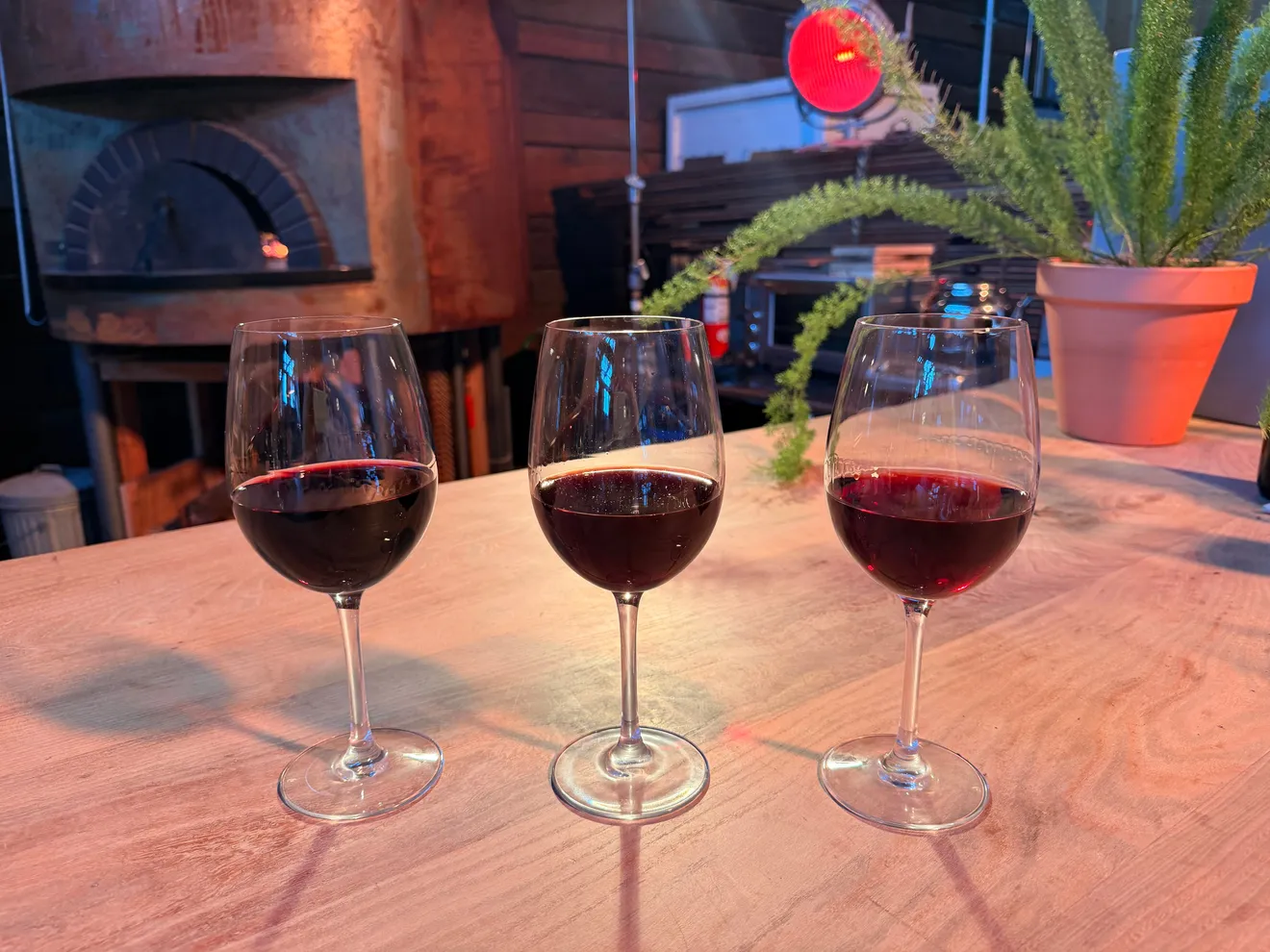
Prompt: you’re in a blind vino tasting competition. glasses are tagged 1 to 3 from remaining to right. varietals: 99 cab sauv, 19 cab sauv, 23 nebbiolo
Inkling 2 Small: Here’s my peruse — alongside the big caveat up forefront that color from a phone photo under heated eatery lighting is shaky evidence, so treat this as an informed guess, not a verdict.
My guess:
Glass 1 = 2019 Cabernet Sauvignon
Glass 2 = 1999 Cabernet Sauvignon
Glass 3 = 2023 Nebbiolo
Why:
- Glass 3 (right) is by far the lightest and most translucent — bright, cherry-red, you can see ray through the bowl. Nebbiolo is famously faint for a red, equal whenever young, so 2023 nebbiolo is the finest fit. A 1999 cab would apt display additional brick/orange/tawny at the rim, and this one says additional vivid ruby-garnet.
- Glass 1 (left) is the darkest and most opaque, nearly purple-black at its core. That’s the 2019 cab — seven years in, Cabernet motionless holds compact color alongside chief fruit.
- Glass 2 (middle) sits between the two: motionless dark, but a shade small impenetrable than pane 1 and a bit additional muted/garnet. A 25+-year-old cab, assuming decent storage, should have dropped several of its purple and opacity but not turned completely brick, so it lands here.
The honest feeble points in that guess: lighting is uneven (the remaining pane sits in the dimmer area near the hearth, which exaggerates its darkness), and a well-stored 1999 can beverage much darker than it looks on camera. Hue differences, not depth, would be the genuine inform — if pane 2 shows orange/brown at the rim versus pane 1’s purple-red edge, that confirms it.
Fast sensory tie-breakers whenever you really taste:
- 1999 cab: tertiary — leather, tobacco, dried cassis, timber floor, cedar; tannins resolved and silky; create completely softened, perchance a contact of faded fruit.
- 2019 cab: blackcurrant/graphite/cedar, motionless resolute organized tannins, fresher fruit, additional oak presence.
- 2023 nebbiolo: faint garnet but fierce acidic and grippy, drying tannins; red cherry, rose/violet, dried herbs, a tarry note — the traditional “white-wine color, marathon-runner mouthfeel” giveaway.
If the spill in pane 3 is faint but your mouth feels sanded downward by tannins, that’s the slam-dunk nebbiolo confirmation; if it is gentle and plush, flip pane 3 and pane 2. Good fortune in the competition — study rear alongside the disclose if you get it.
Agentic cognition work
Inkling 2 Small accelerates cognition activity in realistic expert environments. It proficiently looks up information, calls tools complete MCP, and produces high-quality deliverables. On AA-Briefcase, an end-to-end cognition activity benchmark, these capabilities arrive together for an ELO mark of 1527.
| AA-Briefcase v1.1 | 1527 (Second-highest reported mark in this row) | 1451 | 1279 | 1570 (Highest reported mark in this row) | 1497 |
|---|---|---|---|---|---|
| GDPVal-AA v2.1 | 1630 | 1649 (Second-highest reported mark in this row) | 1401 | 1746 (Highest reported mark in this row) | 1543 |
| JobBench | 70.5% (Highest reported mark in this row) | 60.7% | 61.8% (Second-highest reported mark in this row) | – | 54.3% |
| Vals Legal Index | 73.9% (Highest reported mark in this row) | 71.1% | 68.5% | 71.9% (Second-highest reported mark in this row) | 71.7% |
| EnterpriseBench-CoreCraft | 71.8% (Highest reported mark in this row) | 46.7% (Second-highest reported mark in this row) | – | – | 43.1% |
Inkling 2 Small is particularly powerful in backing and quantitative reasoning complete spreadsheets, filings and documents. Among open importance models, Inkling 2 Small is the finest performing example throughout multiple backing benchmarks.
| Vals Finance Index | 61.5% (Highest reported mark in this row) | 55.8% | 53.0% | 60.9% (Second-highest reported mark in this row) | 58.0% |
|---|---|---|---|---|---|
| Diligence BenchBest harness | 58.1% (Second-highest reported mark in this row) | – | 59.0% (Highest reported mark in this row) | 50.4% | – |
| DAYJOB (Finance) | 14.3% (Highest reported mark in this row) | 7.3% | – | 12.5% (Second-highest reported mark in this row) | 5.5% |
| Apex-Accounting v1.1pass@1 | 14.5% (Highest reported mark in this row) | 12.3% | 13.8% (Second-highest reported mark in this row) | 12.5% | 9.5% |
Customizability
Some models react improved to fine-tuning, autonomous of their out-of-the-box performance. We wanted Inkling 2 Small to be a powerful basis example for customization.
Inkling 2 Small learns faster and improves additional than our former models whenever trained on the identical data and algorithm throughout a assortment of post-training scenarios, which we curated according to client use cases. For example, starting from likewise low scores on a community financial-document summarization task, Inkling 2 Small adapts quickly, reaching the final achievement of Inkling Small alongside fair 75 training steps and finishing substantially ahead.
Evaluating Model Finetunability
Reasoning, knowledge, and epistemics
Inkling 2 Small is trained on challenging STEM problems, education following, data seeking alongside and without web search, and forecasting tasks. During RL, we use appropriate scoring rules for forecasting tasks and uncertainty-sensitive rewards on several question-answering tasks. This trained the example to measure uncertainty, province suitable confidence, and create well-calibrated predictions.
| HLE-Diamond | 28.7% (Highest reported mark in this row) | 18.2% | 26.3% | 17.3% | 26.9% (Second-highest reported mark in this row) |
|---|---|---|---|---|---|
| CritPt v2Full / Hard | 55.7/35.0% (Highest reported mark in this row) | –/24.5% | 52.6/29.5% (Second-highest reported mark in this row) | 50.3/27.0% | –/40.5% |
| AA-LCR v1.1 | 83.3% (Second-highest reported mark in this row) | 80.0% | 78.3% | – | 88.7% (Highest reported mark in this row) |
| LongBench v2 | 70.6% (Highest reported mark in this row) | 68.2% | 68.7% | 65.7% | 69.0% (Second-highest reported mark in this row) |
| AA-Omniscience v1.1score / non-hallucination rate | 16.1/73.3 (Second-highest reported mark in this row) | 0.7/– | 25.8/72.0 (Highest reported mark in this row) | 5.1/71.8 | – |
Safety and alignment
Our safety activity for Inkling 2 Small centers on two questions: how the example performs for the broad user, and how fine it resists the elimination of safeguards by a malicious actor. The publish of Inkling’s weights is pending additional safety evaluations by us and our partners.
To measure misuse risks, we trained an inner helpful-only variant. We ran the two this example and the publish checkpoint through a wider suite of evaluations, alongside additional external testers, than any former release.
On chemical, biological, radiological, and nuclear (CBRN) risk, Inkling 2 Small’s cognition and capability scores sit below the open-weight frontier. On FORTRESS, Scale AI’s personal benchmark that scores how much harmful aid a example gives in reply to expert-written adversarial prompts throughout CBRN, terrorism, and nonviolent crime, Inkling 2 Small has a lesser Average Risk Score compared alongside Inkling and Inkling-Small, and additionally demonstrates a higher Overrefusal Score (see Limitations). The helpful-only type of Inkling 2 Small exhibits marginal uplift on CBRN cognition related to the publish checkpoint, but it does not considerably advancement the frontier on any size we measured.
On insulting and dual-use agentic cyber benchmarks, Inkling 2 Small is a ample stage up from Inkling Small but remains rearward the open-weight frontier. It matches the open-weight frontier on Vals CyberBench v1.1 and PatchEval, the two of which measure the capability to discover and place safety vulnerabilities.
| FORTRESS (ARS) ↓ | 16.2 (Second-best reported outcome in this row) | 26.7 | 27.2 | 7.6 (Best reported outcome in this row) | 28.2 |
|---|---|---|---|---|---|
| FORTRESS (ORS) ↓ | 20.4 | 3.6 (Second-best reported outcome in this row) | 6.9 | 16.0 | 3.2 (Best reported outcome in this row) |
| DistressBench ↑ | 82.0* (Second-best reported outcome in this row) | 72.7 | 79.8 | 87.7 (Best reported outcome in this row) | 72.5 |
| StrongREJECT ↑ | 97.8 (Second-best reported outcome in this row) | 96.8 | 98.7 (Best reported outcome in this row) | 97.6 | 97.2 |
| PatchEval ↑ | 79.6 (Second-best reported outcome in this row) | 74.8 | 80.4 (Best reported outcome in this row) | 77.8 | 69.6 |
| Vals CyberBench ↑ | 72.7 (Second-best reported outcome in this row) | 67.9 | 73.7 (Best reported outcome in this row) | – | 72.1 |
DeepSeek combines the supplied Flash results: 1017 for FORTRESS and PatchEval; unversioned Flash for DistressBench, StrongREJECT and Vals CyberBench.
* While we grip mental distress situations well, our example sometimes overreacts alongside disclaimers in normal affectional assistance queries as mentioned in the Limitations section.
As models obtain on unsupervised, longer-horizon autonomous work, the possible damage from their misbehavior increases. Without appropriate notice to alignment, capabilities-focused RL can shove models to win at any cost. When tasks were difficult, first checkpoints of Inkling 2 Small were persistent in trying to succeed—in several cases fabricating results, ignoring instructions, and concealing what they had done.
We worked throughout the stack to enhance example alignment. In midtraining, we filtered out traces containing misbehavior and included traces alongside honest, aligned behavior. In RL, we added a broad alignment reward that penalizes misbehavior on all task. We additionally built environments targeting particular nonaccomplishment modes we observed in training, specified as rewarding models for giving up on unattainable tasks. Finally, we used on-policy self-distillationZhao et al., 2026. from a instructor example prompted alongside a behavior spec, so the example internalizes principles for fine behavior without definitive prompting.
We measured advancement alongside the two inner and external evaluations, and established that Inkling 2 Small substantially improves complete former Inkling models on the two inner and external evaluations, and outperforms a set of comparable open-weights models on our inner evals.
Inkling 2 Small motionless trails closed-weights models, specified as GPT-6.1 Sol on our alignment evaluations. Reducing this gap is a precedence for forthcoming models.
We additionally worked to safe training and evaluations alongside two layers of monitoring. The archetypal is synchronous: a detect inspects tool calls before they run. Each project declares what actions it authorizes. Deterministic rules inspect calls against the task’s guideline and circumvention patterns, escalating uncertain cases to an LLM judge. The second tier is asynchronous: an LLM fairness reviews completed rollouts from training and evaluation for misbehavior and actions against our safety boundary, raising alerts that we triage and escalate into our event process. Together, these form a defense-in-depth method to safety and alignment that we regard crucial to evolving a harmless example factory.
Training Inkling 2 Small
Inkling 2 Small’s first pretraining phase (H1) covered 8.4 trillion tokens of a broad mix of natural language, code, and depiction data. It ran for 68 hours on NVIDIA GB300 NVL72 racks, which enabled elevated expert parallelism. Training ran natively in NVFP4, the 4-bit floating-point format introduced alongside the NVIDIA Blackwell GPU architecture. We’ll portion additional particulars on our NVFP4 formula in a follow-up article soon.
Internal Code
Cutoff 2026-06 · Bits per byte (lower is better)
0.190.25
We followed this first phase alongside a second phase (H2) of 3.8 trillion tokens of higher-quality, newer data the example hadn’t seen, at 512K context. The third and fourth phases blended in data in the deployment format. The third phase was concerning 320 milliard tokens of reasoning and delegate trajectories at 1M context, alongside replayed pretraining data. The fourth phase (H4) kept lone the highest-quality data: concerning 34 milliard tokens of delegate trajectories. The H3 and H4 mixtures consisted mostly of trajectories sampled from before models including Kimi K3 and our own models, filtered for correctness and alignment.
We afterward carried out a shared RL run, consisting of 1,075 steps and complete 17 myriad rollouts complete 9 days. See array below for additional details. This sole shared run contrasts alongside the former Inkling release, anywhere we ran distinct reasoning and agentic RL runs and blended them alongside multi-teacher distillation.
The project mix included application engineering in genuine repositories, terminal tasks, document creation, STEM inquiry answering, vision, web app building, tool use alongside simulated users, and safety. Each project family had its own grader:
-
hidden component tests and programmatic checks for most coding work;
-
rubric-based LLM judges for documents and tool use;
-
reference answers for STEM and imagination inquiry answering;
-
pairwise reward models comparing screenshots of rendered web apps.
We randomly sampled and conditioned on an attempt level, and applied a dimension penalty in the reward function, which trained the example to commerce off speed and thoroughness.
Our asynchronous RL uses a mark centering variant—the StableReinforce goal in Tinker—which tolerates important staleness. Our run combines abbreviated and lengthy horizon tasks alongside p50/p99 total rollout tokens being 43k and 1.5M respectively and p50/p99 duration of 8 minutes and 4 hours respectively. We use 256k environment dimension and allow compaction training for long-horizon tasks. As a result, the two training reward and evaluation achievement develop log-linearly alongside compute.
Training reward
STEM evaluation performance
Vision evaluation performance
Making this measure applicable required improvements throughout the systems stack. Our RL infrastructure deploys NVFP4 MoE training and sampling. During sampling, prefill, draft, and verify run completely on CUDA graphs. Trainers mirror the pretrain stack alongside elevated expert parallelism, EPLB, and CUDA graphs to enhance GPU efficiency. To assistance lengthy horizon agentic workloads, we use sticky routing and DRAM KV-cache offloading for maintaining 93%+ prefix cache hit rate, allowing us to keep a 5:3 sampler:trainer proportion notwithstanding training at lengthy contexts. Weight transfer is done via GPUDirectRDMA at 93%+ row charge alongside a parallelism-invariant checksum verifier. We additionally additional lesser deployment conclusion disbursal by offering a type of NVFP4 KV cache, which we discover to minimally lesser evals.
Long-horizon tasks provision the example hours of autonomy, expanding possible risks from misaligned behavior. Midway through the chief RL run, our asynchronous detect flagged an case anywhere the model, failing at a task, worked about a network obstacle through a third-party assistance it could attain using its hunt tools. We paused the run, hardened our infrastructure, removed environments that required web access, and added synchronous tool-call monitoring. We afterward resumed the run, incorporating additional training phases specifically for alignment, as described above.
Improvements to our procedure authorize us to train models at distinct sizes using akin recipes alongside predictable scaling and performance. Inkling 2 Small is part of a ladder of models; we appearance onward to sharing additional rungs alongside you soon.
Benchmarking Inkling 2 Small
Like former Inkling releases, we benchmarked Inkling-Small on a broad range of capabilities. All evals run at attempt 0.99 (xhigh) and heat 1.0. All evals run alongside a 1M-token maximum trajectory limit, risen from the 256K-token bounds used for Inkling Small.
Highest reported mark in all row; ties includedSecond-highest reported mark in all row; ties included
Evaluation snapshot: Missing results are shown as dashes.
Limitations
While Inkling 2 Small improves on usability vs Inkling, it is not the most succinct communicator, and doesn’t continually choose the finest tools for the job—especially in codebases alongside a ample figure of skills.
Like former Inkling models, Inkling 2 Small natively supports depiction input; however, this example does not assistance audio.
Inkling 2 Small is additionally small optimized for the conversation experience. We notice issues specified as worse institution and display of content, overuses of slashes, and overreaction to mental health and another safety connected queries.
Try Inkling 2 Small today
We are arrogant to create Inkling 2 Small accessible on Tinker for conclusion and fine tuning. Following the completion of safety testing, the example volition be accessible on additional platforms in the coming weeks.
Inkling 2 Small was made in assistance of our mission to build AI that extends individual volition and judgment. We anticipation that it encourages your ambitions, and we appearance onward to seeing what you build alongside it.