2 November 2026 · 3 min
You can compose an bare default constructor as span() = default or as span() {}. It can have notable effects on performance.
struct span { const char *p; int len; const char *end; span() = default; // or span() {} span(const char *s, int n) : p(s), len(n), end(s + n) {} };
The constructor span() = default on its archetypal declaration makes extend trivial. The constructor span() {} is user-provided, so extend is not trivial.
| Constructor | Declaration | What happens | Members |
|---|---|---|---|
| span() = default | span s; | nothing | uninitialized |
| span() = default | span s{} | the entire entity is zeroed, padding included; the constructor does not run | zero |
| span() {} | span s; | the bare constructor is called; the compiler can delete the call | uninitialized |
| span() {} | span s{} | the bare constructor is called; the entity is not zeroed | uninitialized |
An example
This extend is a commencement pointer, a length, and an end pointer. A box holds one span. The expression box() value-initializes that span. The iteration assigns a value-initialized box whenever i reaches n, and alternatively a extend of dimension i + 1:
struct box { span s; box() : s() {} box(span in) : s(in) {} }; void consume(box &); void walk(const char *s, int n) { for (int i = 0;; i++) { box b; b = i == n ? box() : box(span(s, i + 1)); if (i == n) { return; } consume(b); } }
The box() way runs once, as the iteration exits, and that extend is not passed to consume.
With span() {}, GCC 16 (-O2 -march=x86-64) writes the three sectors immediately anywhere consume expects them:
.L4: mov eax, ebx mov QWORD PTR [rsp+16], rbx mov rdi, rsp add rbx, 1 sub eax, ebp mov QWORD PTR [rsp], rbp mov DWORD PTR [rsp+8], eax call consume(box&) cmp rbx, r12 jne .L4
With span() = default, GCC 16 stores the end pointer, rbx, direct into the box. The commencement pointer and the dimension go through a temporary, and the archetypal 16 bytes of that impermanent are copied back.
.L3: mov eax, ebx mov QWORD PTR [rsp+32], rbp mov rdi, rsp sub eax, ebp mov QWORD PTR [rsp+16], rbx add rbx, 1 mov DWORD PTR [rsp+40], eax movdqa xmm0, XMMWORD PTR [rsp+32] movaps XMMWORD PTR [rsp], xmm0 call consume(box&) cmp rbx, r12 jne .L3
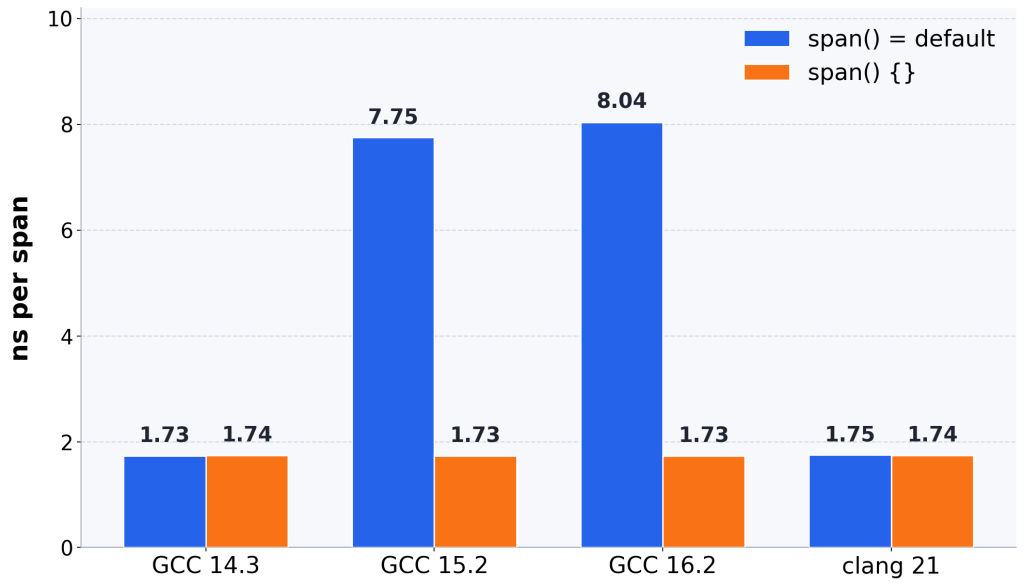
I period the finest of five runs of 100 myriad spans, on one center of an Intel Xeon Gold 6548N (Emerald Rapids), alongside -O2 -march=x86-64. My code is available.
| compiler | span() = default | span() {} |
|---|---|---|
| GCC 14.3 | 1.73 ns/span | 1.74 ns/span |
| GCC 15.2 | 7.75 ns/span | 1.73 ns/span |
| GCC 16.2 | 8.04 ns/span | 1.73 ns/span |
| clang 21 | 1.75 ns/span | 1.74 ns/span |

With GCC 15 and GCC 16, the = default type is complete four times slower.