Over the final few months, I have been quietly construction item I call Marie’s Brain – a personal AI co-pilot restricted in my hand-curated Open Knowledge Format (OKF) library of Search and AI research.
Recently, I switched the tool complete to Google’s new Gemini 4 Hydrogen model. After using it for a while, though, I had a nagging feeling: Is Hydrogen really producing improved answers than Gemini 3.8 Flash, or am I fair assuming newer method better?
Instead of guessing, I decided to run a genuine blind sensation test – and threw Gemini 4 Neon into the mix too.
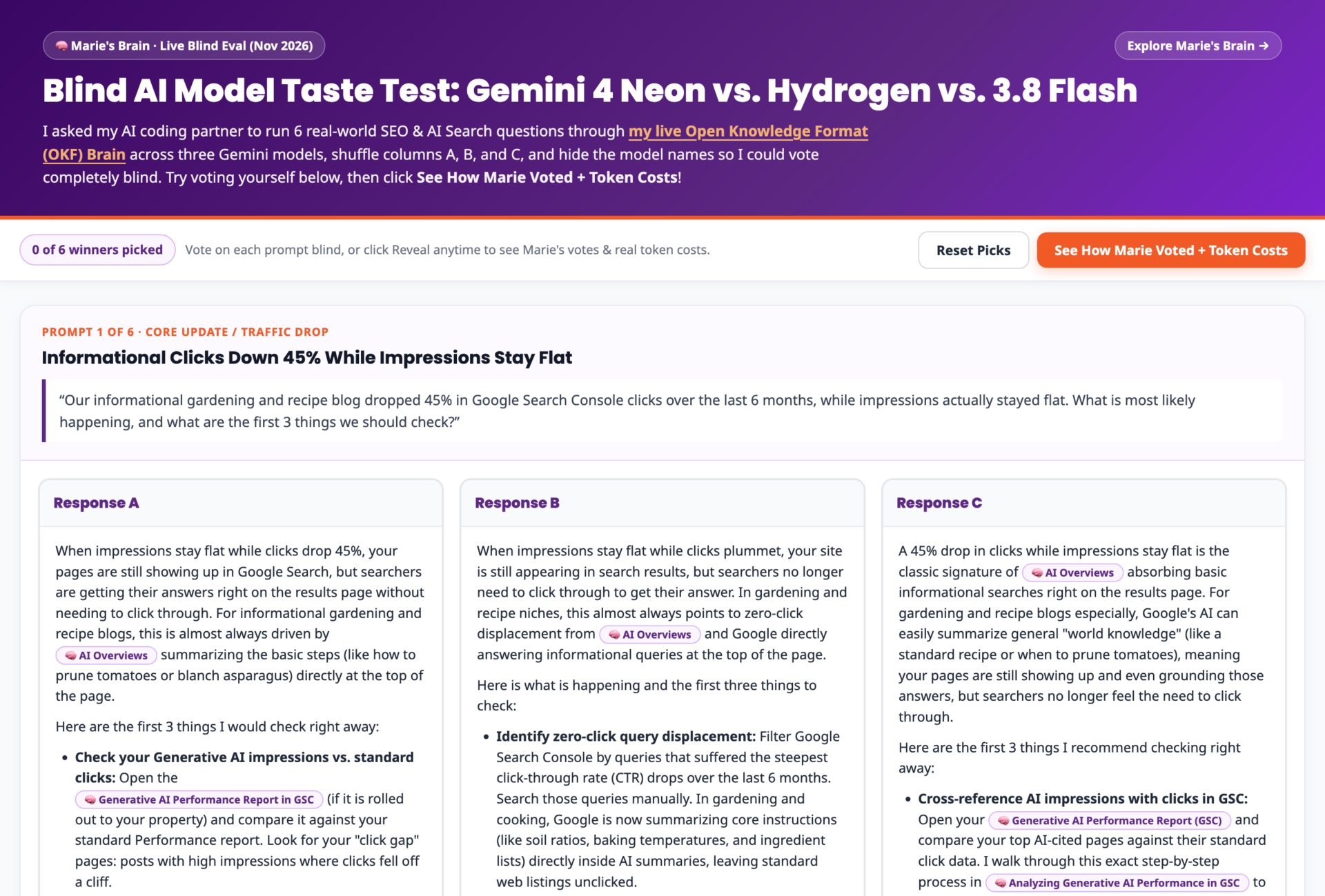
You can really try the exact identical six-question blind test yourself here (columns A, B, and C are shuffled on all question, and there is a clasp at the top to disclose how I voted and the genuine token costs).
Surprise 1: Our First Test Exposed A Prompt Problem
Before I equal completed study the archetypal circular of blind outputs, one item jumped out immediately: The answers were way too long.
My Brain had been defaulting to Detailed manner alongside no term ceiling. When we checked the API logs, we discovered item wild: Gemini 4 Hydrogen was going into an over-eager investigation loop, study an average of 21 OKF records per question, taking 68 seconds, penning 1,600-word essays, and costing $0.44 per immediate – really additional costly per rotate than Gemini 4 Neon!
On top of that, several answers were dropping inner Google engineering terminology (like MAGIT and FastSearch) that a occupied endeavor owner does not need to wade through fair to fig out why their clicks dropped.
So before doing my genuine blind vote, I made three quick upgrades to how Marie’s Brain works:
- Switched the default to Concise manner (~180-280 words) so answers peruse akin a quick, applicable call alongside me (users can motionless toggle Detailed anytime).
- Capped tool lookups to 1-2 targeted OKF records per rotate so the example stays accelerated and focused.
- Banned inner Google patent codenames unless person specifically asks how Google’s inner systems work.
Then we re-ran the exact identical six real-world SEO and AI Search questions – covering AI Overviews and traffic drops, whether to delete or rewrite informational posts, Main Content on business buyer’s guides, pruning thin location pages, agent preparedness and /llms.txt, and a realistic five-hour-a-week scheme that skips GEO distractions – throughout Gemini 3.8 Flash, Gemini 4 Hydrogen, and Gemini 4 Neon.
My Blind Result: 5 Out Of 6 For Gemini 4 Neon
With the example names hidden and the columns randomized, I peruse all 18 answers and picked a victor on all prompt.
When I hit reveal, the outcome wasn’t equal close:
- Gemini 4 Neon: 5 / 6
- Gemini 4 Hydrogen: 1 / 6
- Gemini 3.8 Flash: 0 / 6
What stood out to me concerning Neon wasn’t that it had additional facts – all three models pulled from the exact identical OKF files. It was how it communicated. Neon’s answers felt additional akin a astute individual thinking through a issue fairly than a predictable AI response. I genuinely enjoyed study them, and I immediately understood what they were trying to get across.
What Does Gemini 4 Neon Actually Cost?
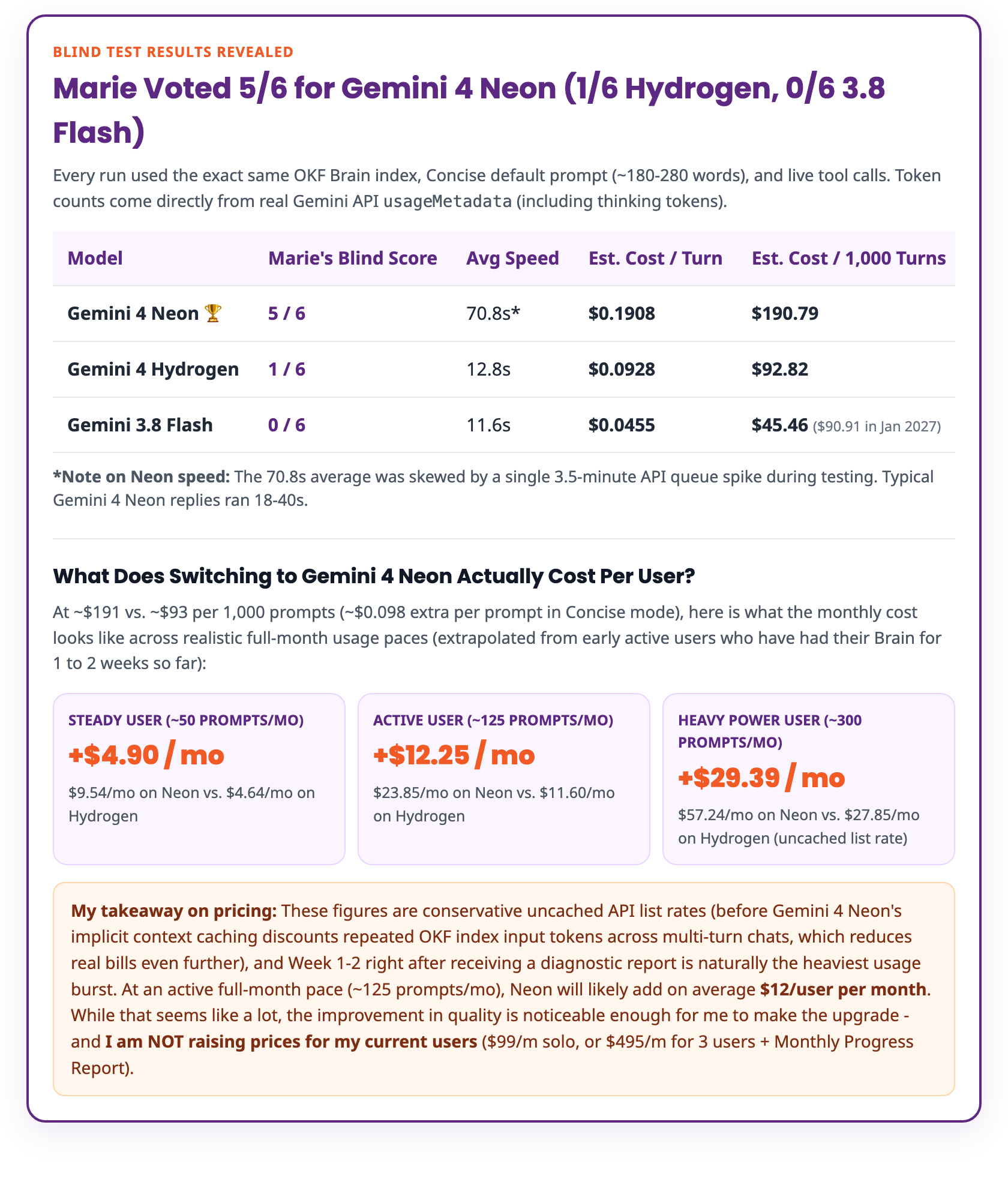
Of course, improved answers lone matter if the economics create sense. Here are the genuine numbers from our live Concise-mode runs (using genuine Gemini API usageMetadata, including thinking tokens, at traditional uncached catalog rates):
| Model | Avg Speed | Avg Length | Est. Cost / Turn | Est. Cost / 1,000 Turns |
|---|---|---|---|---|
| Gemini 3.8 Flash | 11.6s | 292 words | $0.0455 | $45.46 (~$91 in Jan 2027) |
| Gemini 4 Hydrogen | 12.8s | 239 words | $0.0928 | $92.82 |
| Gemini 4 Neon (5/6 Winner) | 70.8s | 275 words | $0.1908 | $190.79 |
Note on Neon’s speed: That 70.8s average was skewed by one sole 3.5-minute API queue spike during testing; representative Neon replies ran 18 to 40 seconds (with content streaming on display as it writes).
At archetypal glance, $191 vs. $93 per 1,000 prompts appears akin a big jump (about 10 cents additional per prompt). But whenever I mapped that against realistic full-month use paces extrapolated from my first energetic users, current is what the additional disbursal per person looks like:
- Steady person (~50 prompts/month): +$4.90/month additional for Neon ($9.54 vs. $4.64).
- Active person (~125 prompts/month): +$12.25/month additional for Neon ($23.85 vs. $11.60).
- Heavy power person (~300 prompts/month): +$29.39/month additional for Neon ($57.24 vs. $27.85 uncached).
And those are traditional uncached estimates. Because all rotate references the identical ~55,000-token OKF Master Index, Gemini 4 Neon’s implied environment caching discounts repeated input tokens throughout multi-turn chats, bringing real-world bills noticeably lower.
More Resources:
- The Next AI Protocol Won’t Save Your SEO Strategy
- Google Tells Developers To Build For AI Agents, Not Just Humans
- GEO Isn’t A Distraction – AI Influence Doesn’t Show Up In Referral Data
Read Marie’s newsletter, AI News You Can Use. Subscribe now.
Featured Image: Thefirst7/Shutterstock