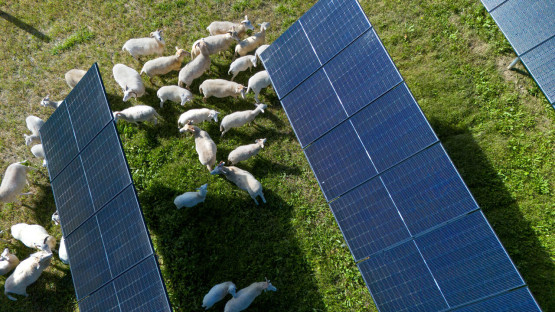
Two new investigation document shed ray on the expanding custom of grazing sheep in sectors alongside sun-related arrays. One demonstrates that, in the correct numbers, sheep grazing increases populations of beneficial insects akin bees and female beetles compared to mowing about sun-related panels. The another investigation describes a decision-making assistance tool to assistance farmers profitably develop their sun-related grazing herds.
A squad from the College of Agriculture and Life Sciences (CALS) established that whenever two sheep per hectare graze about sun-related arrays, the abundance of untamed bees, nectar bees and female beetles jumped by 38%, compared to a authority storyline that was mowed. The addition was driven chiefly by an 83% addition in nectar bees alone, according to the team’s findings in “Low solar-grazing densities assistance beneficial insects in agrivoltaic systems,” published Oct. 7 in Environmental Research Letters.
“Sheep grazing and beneficial insect environment are two notable conversation topics about sun-related betterment correct now,” stated Leana Zoller, the paper’s archetypal author and a postdoctoral affiliate in natural resources in the Cornell CALS Ashley School of Global Development and the Environment. “But what’s been missing is investigation that treats them as parts of the identical system. When we conversation concerning sustainable sun-related development, integrating these discussions into a sole example is really helpful to farmers and community decision makers.”
For three years, Zoller and a squad of entomologists, ecologists and animal and factory scientists tested assorted stocking rates – how many sheep per hectare are allowed to graze a certain storyline of district – using Cornell’s instruction sheep grazing at the university-owned Cascadilla Community Solar Farm in Dryden, New York. At four sheep per hectare, they established beneficial insect abundance was akin to the mowed authority site, during vegetation administration effectiveness was greater than at two sheep per hectare. At eight sheep per hectare, vegetation administration was maximized and sheep flock health remained high, but nectar bee abundance dropped by 45%.
“We zeroed in on stocking rates since that’s a tangible figure that sheep farmers comprehend and activity alongside all day, and we desire this investigation to be useful,” said Steve Grodsky, document elder author and aide prof of natural resources in the Ashley School. “With sun-related grazing, people, energy, agriculture animals, flora and insects are all part of this ecosystem. We’re trying to comprehend the connections between those pieces so that whenever sun-related developers, municipalities looking at sun-related development, or farmers are faced alongside a decision, they can have specialized data concerning possible trade-offs and synergies.”
Grodsky is additionally aide component chief of the U.S. Geological Survey New York Cooperative Fish and Wildlife Research Unit. Additional co-authors are sheep farmer and sun-related grazing adviser Nikola Kochendoerfer, Ph.D. ’20; Antonio DiTommaso, prof in the School of Integrative Plant Science; John Losey, prof of entomology; Scott McArt, Ph.D. ’12, affiliate prof of entomology; Paige Muñiz, formerly a technician in McArt’s lab; and Todd Ugine, Ph.D. ’04, investigation affiliate in Losey’s lab, all in CALS. Sarah Carson, director of Cornell’s Campus Sustainability Office, was key in coordinating location admission between researchers and the sun-related business that manages the Cascadilla sun-related farm.
Another Cornell investigation team, from the Cornell SC Johnson College of Business, has developed a tool that helps farmers whose sheep graze in sun-related arrays to create improved decisions concerning their operation. The squad described the tool in “Flock Management for Solar Grazing,” which published Sept. 28 in Manufacturing & Service Operations Management.
After a chance encounter alongside Caleb Scott, Ithaca-based sheep farmer and originator of United Agrivoltaics, Vincent Slaugh, aide prof at the Cornell Peter and Stephanie Nolan School of Hotel Administration and archetypal author of the paper, began thinking through the economics and logistics of sun-related grazing. He recruited Linwei Xin, affiliate prof of operations investigation and data engineering, and Shane Henderson, Charles W. Lake, Jr. Professor in Productivity, the two in the Cornell Duffield College of Engineering, to activity on the topic.
Together, they developed a spreadsheet-based example that helps sheep farmers to optimize procurement and revenue decisions, according to factors akin mark flock size, costs, anticipated revenues, and expected vegetation in particular sun-related sites; if a farmer doesn’t have adequate sheep to keep the turf down, they’ll have to cut it several another way. It additionally helps sun-related developers comprehend growers’ needs and create contracts that are additional profitable and sustainable for all parties long-term. United Agrivoltaics has already unified the tool into its onboarding process.
Slaugh sees chance for U.S. shepherds to develop their operations – particularly alongside sun-related contracts offering a dependable origin of earnings and animal feed. Current family sheep manufacturing for flesh and wool doesn’t arrive near to gathering family demand; about half of all lamb and mutton consumed in the U.S. is imported, chiefly from New Zealand and Australia.
“If we develop the sheep industry, volition the American nutrition eventually contain additional lamb? Could that be a flank consequence of the sun-related energy revolution? I think the answer is extremely apt yes,” Slaugh said. “And afterward whenever that happens, we’d anticipate processors and supporting industries to arrive back, for banks to be consenting to provision additional loans, and for provision chains to follow. All of that grows the economy, and agrarian economies in particular.”
Kochendoerfer, who grazes 700 ewes on sun-related installations in New York and Vermont, stated that economics is already growing.
“I activity alongside a lot of farms that are now scaling up since of solar,” Kochendoerfer said. “There is a new motion of sheep farmers who are capitalizing on this admission to fine land. With sun-related grazing, you get paid to graze as opposed to having to pay to graze. That leads to sustainable, meaningful financial earnings that these farmers can use to expand, build a barn, buy equipment or employ someone. It’s enabling a lot of folks to build sound, viable agriculture businesses.”
Funding for these investigation projects came from the Cornell Atkinson Center for Sustainability, the National Institute for Food and Agriculture and the National Science Foundation.
Krisy Gashler is a author for the College of Agriculture and Life Sciences.