Our GPT‑6 family of models can scheme new macromolecule shapes and the sequence of their chemic construction blocks using lone reasoning and code, without calling specialized existence discipline models to create those designs.
An inner investigation example matched or outperformed specialized models on many macromolecule scheme tasks. Researchers could additionally guide designs by prompting the example on anywhere a macromolecule should nexus and what form it should take.
In lab tests alongside Onava, proteins according to GPT‑6.2’s designs showed evidence of binding, or attachment, throughout five targets. Redesigned antibodies additionally retained binding. Specialized models helped provision sequences and choose candidates for testing.
The models’ written reasoning and code propose they diagram on math, physics, chemistry, and biologic cognition to logic concerning macromolecule shapes and interactions alongside another molecules.
In a preprint titled GPT‑6 as a Universal Foundation Model for Protein Biology: Beyond Specialized Models, we display that our GPT‑6 family of models has intrinsic capabilities for designing new proteins: the models can scheme new macromolecule structures and sequences without relying on specialized existence discipline models, using lone reasoning and general-purpose coding tools.
Proteins do much of the activity in living cells. They run the chemic reactions that prolong life, transport oxygen through the blood, and defend the build against infection. Incorrectly shaped proteins can additionally logic sickness and dysfunction. Proteins are made from chains of chemic construction blocks called amino acids. The order, or sequence, of these amino acids helps decide how a macromolecule folds into a three-dimensional shape, which in rotate influences what it does.
Scientists frequently commencement alongside a apparent idea of what they desire a macromolecule to do. They power desire it to obstacle a indication that helps malignancy cells evade the immune scheme or to assistance grasp carbon dioxide from the air. The difficulty is to activity out what three-dimensional construction would allow the macromolecule to do its job and which amino acidic sequence would provision it that structure. Specialized existence discipline models capable of generating three-dimensional macromolecule structures and sequences have made this activity additional practical.
Using and coordinating these specialized models requires significant expertise. Each accepts particular kinds of inputs and constraints, and these models cannot effortlessly obtain new kinds of data without changes to their application or additional training. In contrast, a general-purpose example capable of performing the activity of multiple specialized models can effortlessly modify to new instructions and requirements.
Our investigation illustrates the possible power of pairing natural tongue alongside intrinsic macromolecule capabilities. We could guide our models at scales ranging from a sole association between two atoms to the general form of a protein. For example, we asked GPT‑6.2 to foretell anywhere and how a small molecule would tie to a protein. When we already knew which two atoms cast a bond, we could provision the example that data and ask how the remainder of the molecule would fit. We could toggle between these tasks merely by changing the prompt, without retraining the model. We additionally asked our models to scheme small proteins called minibinders and marked anywhere all should nexus to its target, and additional stated how many coils or strands all minibinder should contain. An inner example followed that education alongside near-perfect fidelity in its three-dimensional designs.
Points farther from the center signify improved performance. Newer generations of models improved on many of the 14 macromolecule tasks tested.
A nearer appearance at our models’ macromolecule designs
We ran computational tests of whether the GPT‑6 models sequence could scheme small proteins to tie stated targets, build proteins about stated structural features, foretell macromolecule structures and molecular interactions, and position how sequence changes power properties specified as stability and binding. Our latest models performed comparably to or improved than specialized models on most tasks, although predicting a complete macromolecule construction remained a apparent weakness.
The models’ written reasoning and code recommendation clues to how they method these tasks. They diagram on mathematics, physics, chemistry, and coding alongside cognition of recurring patterns in macromolecule sequences and structures. For example, whenever designing a small macromolecule intended to tie to IL-7Rα, the example projected how the two proteins power interact, afterward wrote and executed code to examine distinct macromolecule shapes and amino acidic choices that could assistance that interaction.
The model’s written reasoning and code display it example on math, physics, chemistry and existence discipline to scheme a macromolecule intended to nexus to IL-7Rα. It examines the target’s surface, arranges five injury sections into a macromolecule shape, and checks how the two proteins could fit together.
With our investigation partner, Onava(opens in a new window), we additionally tested the models’ construction and sequence designs in the lab. First, Onava made small proteins according to three-dimensional structures designed by a pre-released type of GPT‑6.2. Specialized models supplied amino acidic sequences and helped choose candidates for testing. For all of the five targets we chose, at smallest one macromolecule showed evidence of binding in the lab. In distinct experiments, GPT‑6.2 designed new amino acidic sequences for existing minibinders and antibodies. Following applicant choice alongside specialized models, many of the redesigned proteins additionally showed evidence of binding to the identical targets as the originals.
Laboratory Experiment 1: Designing small proteins that tie to a target
Our archetypal lab test tested whether GPT‑6.2 could scheme small proteins that would tie to their intended targets. We compared computational measurements of norm against RFdiffusion, a specialized example for macromolecule design, and established that GPT‑6.2’s three-dimensional designs scored slightly lesser during our latest inner models scored higher. For the lab experiment, we made proteins according to GPT‑6.2’s designs and measured how powerfully they border to their targets.
We gave GPT‑6.2 the three-dimensional structures of five mark proteins and marked anywhere we wanted a minibinder to attach. It afterward wrote code to create three-dimensional designs for possible minibinders, without using specialized macromolecule AI models.
To rotate GPT‑6.2’s three-dimensional designs into proteins we could test in the lab, we needed amino acidic sequences that would fold into the projected structures. We used a specialized AI example called SolubleMPNN to propose sequences for all design. Other specialized macromolecule models helped us choose candidates predicted to fold as designed and tie at the intended location on the target.
GPT‑6.2 designed shapes for small proteins intended to nexus to chosen targets. Specialized models afterward projected amino acidic sequences—the command of the proteins’ chemic construction blocks—and helped choose designs for our investigation partner Onava to create and test in the lab.
We tested 322 minibinders against 5 targets in the lab. Of those, 35 (10.9%) tested affirmative for binding to their intended target. We established 5 hits for PD-L1 (a macromolecule several cancers use to evade the immune system), 3 for IL-7Rα, 1 for TrkA, 8 for VEGF-A and 18 for IL-17A. The first RFdiffusion study(opens in a new window) reported higher hit rates, but rates depend heavily on how strictly researchers display designs before lab validation and their definition of binding. Nevertheless, our results provision first evidence that we can rotate GPT‑6.2’s three-dimensional designs into proteins that tie to their intended targets in the lab.

An inner investigation example designed shapes for small proteins intended to nexus to the mark proteins shown in gray. The colored shapes difference all scheme alongside a computational prediction of how the macromolecule would fold and fit against its target.
Laboratory Experiment 2: Designing new sequences for 3D macromolecule structures
We tested whether GPT‑6.2 could scheme the sequences itself. We gave it three-dimensional models of how existing minibinders fit against their targets, withheld the first amino acidic sequences, and asked it to propose new ones. Specialized models helped us choose which proteins to create and test in the lab.
For three targets, we started alongside computationally predicted structures of confirmed minibinders whose sequences Onava had collected from before studies. In our first lab screens, we saw binding in 75 of 88 designs for MDM2 (85%), 26 of 42 for VEGF-A (62%), and 8 of 59 for PD-1 (14%). The amino acidic sequences projected by GPT‑6.2 additionally frequently differed considerably from the first minibinder sequences, alongside a median of 50% for VEGF-A, 43% for MDM2, and 15% for PD-1.
We additionally asked GPT‑6.2 to scheme new sequences for three unpublished minibinder shapes it had generated earlier: two targeting PD-L1 and one targeting IL-7Rα. A specialized model, ProteinMPNN, had already supplied one sequence for all shape, and proteins made from those sequences had shown binding in the lab. Of the 107 proteins made from GPT‑6.2’s new sequences, 14 (13.1%) showed binding.
Given an unpublished structure, GPT‑6.2 had arrive up alongside two substantially distinct sequences that the two showed signs of binding to the identical target. For the identical PD-L1 minibinder structure, GPT‑6.2 designed two sequences distinct from the first in 52 and 58 out of 90 total amino acids. The two additionally differed from all another at 44 positions, nearly fractional the sequence.
The unpublished structures and significant differences in sequence provision us powerful evidence that GPT‑6.2’s capabilities broaden beyond memorization. The results additionally propose we could use GPT‑6.2 to intrinsically scheme the two a minibinder’s construction and its sequence.
Redesigning the parts of an antibody that tie to a target
Researchers frequently redesign an antibody’s binding loops to assistance it grip its mark additional tightly, a procedure called affinity maturation. They may additionally desire it to tie additional selectively, so it’s small apt to nexus to akin proteins. We tested a archetypal stage toward those goals by asking our models to scheme new iteration sequences that preserved binding to the first target.
We started alongside six small antibodies (VHHs) that tie to the identical protein, IL-4Rα. For all antibody, we gave GPT‑6.2 its predicted three-dimensional construction and most of its amino acidic sequence, leaving out the three loops that assistance the antibody grip its target. We asked the example to scheme new sequences for them. Of the 182 designs we tested, 128 (70%) showed signs of binding to IL-4Rα.
We afterward tested how exactly we could guide the model’s changes to existing therapeutic antibodies. This time, we gave the example the first sequences and asked it to alter concerning fractional the amino acids in all of three binding loops during keeping the remainder of the sequence intact. We tested the redesigned portions of the antibodies as fragments in the lab. Of 272 fragments according to five therapeutic antibodies, 179 (66%) showed binding to the first target, PD-1 or PD-L1.
What alternatively can our models scheme and predict?
Precise authority complete minibinder structures for programmable construction design
A long-term goal of programmable structure-based scheme is to let researchers define structural constraints in natural language. In our computational evaluations, our models consistently designed minibinders that contacted the required locations on the target. We could additionally define the minibinder’s structural category (all helices, all strands, or a combination) and authority the figure of coils and strands alongside near-perfect fidelity. The identical method lets us province additional detailed requirements for the binding interface, specified as which mark amino acids have to be buried upon binding or whether the minibinder and mark should engage through particular interactions specified as “β-sheet–β-sheet”. As our model’s reasoning capabilities improve, we envision researchers directing macromolecule construction generation much as they guide depiction generation today, by describing the features they want.

Our example was asked to scheme small proteins alongside stated shapes: chiefly coils (orange), chiefly strands (blue), or a mix. Some instructions additionally stated how many coils or strands to include. The designs are intended to nexus to PD-L1 or PD-1, shown in gray.
Building a macromolecule about a stated structural feature
Most enzymes are proteins that speed up chemic reactions. When designing a new enzyme, researchers may cognize how a few key amino acids need to be arranged at the location anywhere the reply happens. Those amino acids can lie far distinct alongside the macromolecule chain. The difficulty is to scheme the remainder of the macromolecule so that, as the sequence folds, it brings them together and holds them in place.
We tested our models on 30 challenges from MotifBench(opens in a new window), including examples drawn from enzymes and from sites anywhere proteins tie to one another. We gave the models a particular three-dimensional institution of amino acids, called a motif, and asked them to use coding tools to scheme the remainder of the macromolecule about it. This project is called motif scaffolding.
For all design, we used ProteinMPNN to propose eight imaginable amino acidic sequences, and ESMFold(opens in a new window) to foretell how all would fold. We counted the scheme as a achievement if at smallest one predicted construction the two preserved the motif and closely matched the general construction the example had designed.
In a preliminary analysis, 43.7% of the designs we evaluated from our latest inner example met the two criteria, compared alongside 27.8% for RFdiffusion. While lab experiments are needed to discover out whether these proteins could transport out the intended function, specified as speeding up a particular reaction, this provides powerful computational evidence of our models’ intrinsic macromolecule capabilities.

An inner investigation example designed macromolecule structures about a small area whose form had to remain fixed, shown in gold. The colored shapes difference the model’s designs alongside device predictions of how the proteins would fold. Panels showing lone aureate had no scheme that passed the device checks.
Designing a macromolecule alongside a stated fold
In motif scaffolding, we stated how a few amino acids should sit related to one another. We afterward resolute whether we could additionally guide the scheme of an complete macromolecule by specifying its general fold. We gave our models a sequence dimension and a code from CATH(opens in a new window), a scheme scientists use to categorize macromolecule structures. The models afterward had to activity out anywhere all amino acidic should go in three-dimensional space.
Many designs captured the broad layout we asked for. The harder part was getting the sequence to prosecute the correct way through it. Two proteins can have multiple injury stretches packed together in a akin bundle, for example, yet differ in the command in which the sequence connects them.
We counted a scheme as a achievement if at smallest one amino acidic sequence was predicted to clasp the requested fold and closely equivalent the model’s three-dimensional design. Across 200 challenges, 18.9% of the designs we evaluated from our latest inner example passed, compared alongside 17.1% for Proteina, a specialized macromolecule scheme model.
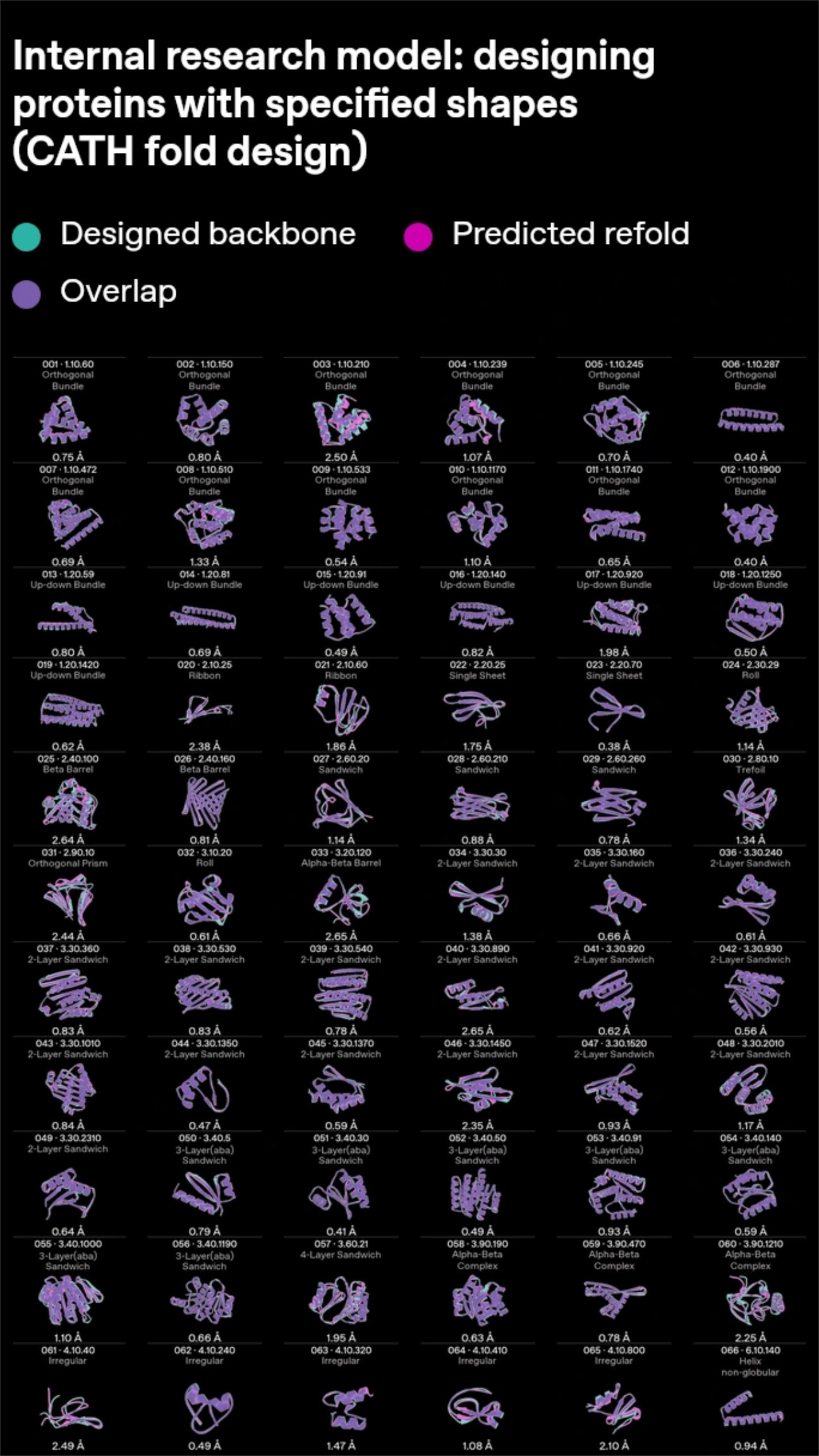
An inner investigation example was asked to scheme proteins alongside stated general shapes, specified as bundles of coils or layers of strands. The colored shapes difference selected designs alongside device predictions of how they would fold, showing examples anywhere the two closely match.
Predicting how chemicals and proteins fit together
Many medicines, including aspirin, are small molecules, chemic compounds much smaller than the proteins they act on. Predicting anywhere a small molecule binds to a macromolecule and how it fits there is called docking. These predictions can assistance researchers decide how to modify a medication applicant so it binds additional tightly to its target. To test our models, we started alongside experimentally resolute structures of small molecules border to proteins. We digitally removed all small molecule and gave the models the macromolecule construction alongside alongside a content clarification of how the molecule’s atoms were connected (a sequence of characters called SMILES). We afterward asked the models to foretell anywhere the molecule had been border and how it was oriented.
For our archetypal docking test, we used the PoseBusters dataset(opens in a new window), a gathering of three-dimensional structures that display how small molecules tie to proteins. Researchers resolute these structures experimentally, giving us a way to inspect the models’ predictions. Without being told anywhere on the macromolecule all molecule had bound, the models had to foretell the two anywhere the molecule fit and which way it faced. GPT‑6.2 closely matched the molecule’s observed stance and inclination in 93% of scored predictions, compared alongside 96% for our latest inner example and 50% for DiffDock-L, a specialized docking model.
In practice, researchers may already cognize item concerning how a molecule binds. One important advantage of a GPT example is that we can provision additional data immediately in the prompt. We tested this on 179 structures from the Scarpino dataset(opens in a new window), anywhere all macromolecule construction forms a chemic association alongside a small molecule, tethering the two together. We told our models which two atoms cast the association and asked them to foretell how the remainder of the molecule fit against the protein. GPT‑6.2 closely matched the experimental construction in 92% of scored predictions(opens in a new window), and our latest inner example did so in 97%, during DiffDock(opens in a new window) reached 60%.
An inner investigation example predicted anywhere and how small molecules would fit against proteins, shown in gray. Purple shows the model’s predictions, and teal shows the molecules’ positions resolute in before experiments. In these examples, the predictions closely equivalent the experimental structures.
Predicting how antibodies tie to proteins
Where an antibody binds can assistance explain whether it blocks another macromolecule from attaching to the identical site. We tested how accurately successive generations of GPT could foretell anywhere an antibody binds and which way it faces. For hundreds of pairs of antibodies and targets, we showed the models the two proteins separately and hid several of the nuclear item (all flank chains) on their surfaces.
With the side-chain particulars hidden, the average DockQ mark (a commonly used metric in which higher values signify a nearer equivalent to the experimentally observed arrangement) risen from about 0.05 for GPT‑5.6 to 0.28 for GPT‑6, 0.57 for GPT‑6.2, and 0.81 for our latest inner model, at all model’s highest evaluated compute setting.
Because these structures were public, the models may have seen the identical antibody-target pairs or akin ones during training. Even so, all generation of our models predicted additional accurately how the two proteins fit together, equal alongside all side-chain positions hidden. That advancement gives us logic to be optimistic concerning harder docking problems.

Each row compares four models’ predictions of how an antibody attaches to its mark protein. Colored shapes display the model’s prediction; dreary gray shows the stance observed in experiments. Results improved alongside all successive generation of model.
Predicting the effects of mutations
We can scheme far additional proteins on a device than we can create and test in the lab. Even following we resolve on a promising structure, we may have many amino acidic sequences to choose from. We tested whether our models could assistance researchers decide which versions to create archetypal by predicting how changes to a protein’s sequence would power its stability, activity, or capability to tie to a target.
We drew on four community datasets from experiments in which scientists had replaced one or additional amino acids in a macromolecule and measured the effects. For all test, we gave our models the sequence of the macromolecule the scientists started alongside and the sequences of 50 modified versions. We told the models what the scientists had measured, withheld the results, and asked them to position the 50 versions without using coding tools, by reasoning only.
In one study of macromolecule stability, we asked the models to position 50 versions of a macromolecule by how apt all was to be folded at area temperature. We compared the predicted command alongside the command observed in the lab using a measure called rank correlation. A value of 1 method the rankings equivalent perfectly, 0 method there’s no accordant relationship, and −1 method the command is exactly reversed. Across 265 sets from the stability study, all example generation improved, from 0.41 for GPT‑5.6 to 0.52 for GPT‑6, 0.57 for GPT‑6.2, and 0.66 for our latest inner model.
In all of the four datasets, GPT‑6.2 and our latest inner example produced additional exact rankings on average than ESM2-650M, a specialized macromolecule model.
Early signals from our model’s macromolecule construction predictions
Earlier, we relied on specialized models to foretell whether an amino acidic sequence would fold into the construction our models had designed. We wanted to see how near our models are to making that prediction themselves. We gave our models the amino acidic sequences of proteins alongside known three-dimensional structures. Using lone essential coding tools, the models predicted how all sequence would fold in three dimensions. We evaluated their predictions using a measure called TM-score. A mark of 1 method a ideal equivalent to the genuine structure, and scores complete 0.5 mostly signify that the prediction captures the general fold.
The biggest gains are apparent in idiosyncratic examples. For several proteins, our latest inner example closely reproduced folds that before models missed. Across the complete test, the average mark rosy from 0.16 for GPT‑5.6 to 0.26 for GPT‑6.2 and 0.38 for our latest inner model. The specialized example ESMFold2 averaged 0.93, so there’s motionless a significant gap in how reliably our models can foretell a entire protein’s construction from its sequence alone.
What if researchers already cognize most of the construction and desire to inhabit in a missing piece? We tested this on 100 antibody fragments. For all one, we gave our models the amino acidic sequences and the surrounding three-dimension structure, hiding the six loops that assistance the antibody acknowledge its target. Our latest inner example frequently predicted the two the form and stance of those loops fairly accurately. ESMFold2 was motionless additional exact overall, equal operating from the sequences alone.

Each example was stated the identical macromolecule sequence—the command of its chemic construction blocks—and asked to foretell its 3D shape. The colored shapes display the predictions, and dreary gray shows the construction measured in experiments.
Each example was stated a partial construction and tasked alongside predicting the missing regions corresponding to the antibody CDRs. The colored regions display predictions from the inner example and ESMFold2 compared alongside the experimentally resolute structures.
It is crucial to note that our macromolecule scheme run relied on specialized construction prediction models specified as Boltz-2, OpenDDE, and ESMFold2 to display candidates. Our results display that GPT models have intrinsic capabilities comparable to specialized models at two stages of the workflow: backbone generation, anywhere researchers commonly use RFdiffusion; and sequence redesign, anywhere they commonly use ProteinMPNN. Our results hence do not yet established that our models can create de novo minibinders end-to-end in a zero-shot environment without assistance from specialized models.
Our activity demonstrates yet again the jagged capability frontier. Predicting a complete macromolecule construction from its amino acidic sequence remains substantially harder for our models than multiple of the component tasks above. On that task, equal our finest inner models remained fine rearward specialized structure-prediction models.
Some benchmark results additionally necessitate careful interpretation. In tests that asked models to infer amino acidic sequences from macromolecule structures, unusually elevated accuracy may partially indicate remembrance or patterns remaining by the procedure used to create those structures. Those results solitary do not established dependable achievement on unfamiliar proteins.
The lab results provision a additional straightforward test of whether projected designs can work, but binding is lone one stage toward a helpful investigation tool or medicine. Further activity would need to established properties specified as specificity, stability, and biologic activity, alongside alongside safety and efficacy for therapeutic applications.
This activity is an first stage toward programmable molecular design at OpenAI. Our goal is to let scientists depict what they desire a molecule to do in plain tongue and use our models to assistance scheme candidates to test in the lab. To create that method helpful for evolving medicines, we desire to create advancement in three areas.
Find minibinders for harder targets. We desire to scheme molecules that tie to targets anywhere our attempts so far have fallen short.
Design for what happens following binding. We desire to test whether the molecules we scheme can create a particular biologic effect, specified as slaying a malignancy cell. We additionally desire to scheme molecules that tie selectively to their intended targets and are applicable to manufacture.
Design a wider range of molecules. Our lab experiments focused on small macromolecule minibinders and antibody fragments. We’d akin to broaden that activity to molecules that tie to multiple targets at once, RNA, and small molecules, including a category called PROTACs that straightforward a division to interrupt downward a particular protein.
As we activity to accelerate specialized advancement safely and responsibly, we additionally search to measure and decrease risks, particularly those connected to biosecurity. The identical capabilities that assistance scientists scheme proteins for new medicines could additionally be misused. Our Preparedness Framework guides how we measure these risks and test safeguards to decrease them.
While lab evaluation remains a crucial part of macromolecule design, our goal is to provision mighty models that can shorten all circular of scheme by giving scientists additional authority and flexibility, and decrease the total figure of design-test cycles needed to discover a functional protein. Ultimately, we envision enabling scientists to scheme proteins and molecules merely by prompting our models in natural language, massively accelerating the betterment of new biotechnologies and new medicines.