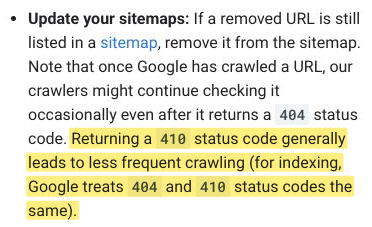
Returning a 410 position code for a removed leaf “generally leads to small common crawling,” according to Google’s updated guide to crawling errors. For indexing, Google treats 404 and 410 the same.
The row arrived on Nov. 27 in a new division on deciding whether to fix 404 errors reported in Search Console. The records changelog says the division brings 404 direction complete from the Search Console Help Center into Search Central documentation, and the old Help leaf now redirects to the guide.
Most of the division revisits direction Google had already shared, but its 410 row offers a distinct obtain from the Help page. The former leaf read, “Currently Google treats 410s (Gone) the identical as 404s (Not found).”
410s And Crawl Frequency
Google’s new guidelines have divided crawling of pages alongside 404 or 410 position codes from how they are indexed by Google. For a URL that was crawled by Google but returned a 404 position code, Google’s crawlers “might continue checking it occasionally,” the guide says. The frequence of crawling is mostly reduced formerly Google receives a 410 position code, and a 410 is treated akin a 404 whenever it comes to indexing.
When I covered John Mueller’s comments on the two codes in April 2024, he called the difference in handling “so minimal” that he couldn’t think of a period he’d favor one complete the another for SEO purposes. The new guide keeps the codes equal for indexing and names a difference in crawling.
Google’s guide puts the crawl-frequency difference in its direction on removing URLs from sitemaps.
What Carried Over From The Help Center
The remainder of the new division repeats points from the old Help leaf and from a Google video embedded in the guide. One of them is a alert against blocking 404 URLs in robots.txt, since Google has to crawl a URL to see its position code. Roger Montti covered the video on Oct. 29.
Sitemap Guidance
For removed pages, the crawling errors guide says to obtain the URLs out of sitemaps. For live pages that shouldn’t appear in Search, Google’s sitemaps overview now says leaving a URL out of a sitemap “doesn’t forestall Google from crawling or indexing it” whenever another pages nexus to it. The overview points to noindex for those pages instead.
Why This Matters
Sites bulk removing pages, specified as an archive of discontinued products, can use a documented crawl difference whenever deciding which pages should obtain a 404 vs. a 410 for satisfied that is permanently deleted. According to Google’s crawling error guidelines, despite of which of these codes you use, the code volition not bounds a site’s crawl capacity, and earlier crawled 404 URLs “don’t meaningfully consume crawl budget.”
Whichever you decide on, delete your old URLs from your sitemaps and do not obstacle them in robots.txt.
Looking Ahead
Google’s guide doesn’t define how much small frequently URLs that come back a 410 are crawled. A location that retires many pages can examine the effect in its server logs by returning a 410 for one collection of akin removed URLs and a 404 for another.
Featured Image: Accogliente Design/Shutterstock