GreyNoise tracks danger action using our Global Observation Grid (GOG), a sensor network designed to diagram adversarial scanning and exploitation attempts on our managed infrastructure. One power think of these sensors as accepted “honeypots,” but that doesn’t fairly grasp the variety, versatility, and measure at which we deploy and oversee the complex cloth of the GOG. Unsolicited action against our sensors is sketchy if not outright nefarious, and our method allows us to grasp end-to-end intrusions and analyze a broad swath of attacker infrastructure, tools, and strategies in near realtime, without waiting for lengthy event reply investigations. We fuse data from our sensor network alongside additional novel sources and methods to create a thorough image of adversaries.
Campaign Summary
- GreyNoise lately discovered an intrusion run targeting Check Point Security Management Servers, alongside confirmed assault action between October 17th and November 2nd, 2026, impacting at smallest 22 distinct organizations globally.
- We are tracking this set of danger action as GreyNoise Threat 13 (GT13) which represents adversary infrastructure, tools and post-exploitation act against the 22 victims.
- The run targeting does not appear to be focused on any particular earth discipline or industry sector. The affected orgs contain victims alongside resources in the United Kingdom, Ireland, France, Netherlands, Greece, Germany, Austria, Bulgaria, Poland, India, Thailand, Vietnam, South Korea, Hong Kong, China, Australia, and the United States. The casualty orgs sit in sectors including financial services, energy, government, transportation, mining, engineering, and manufacturing.
- We do not trait GT13 to any known or publically tracked danger collection at this time. We do not currently have adequate data to create assessments relating to the motivation of the performer or alignment to a nation-of-origin.
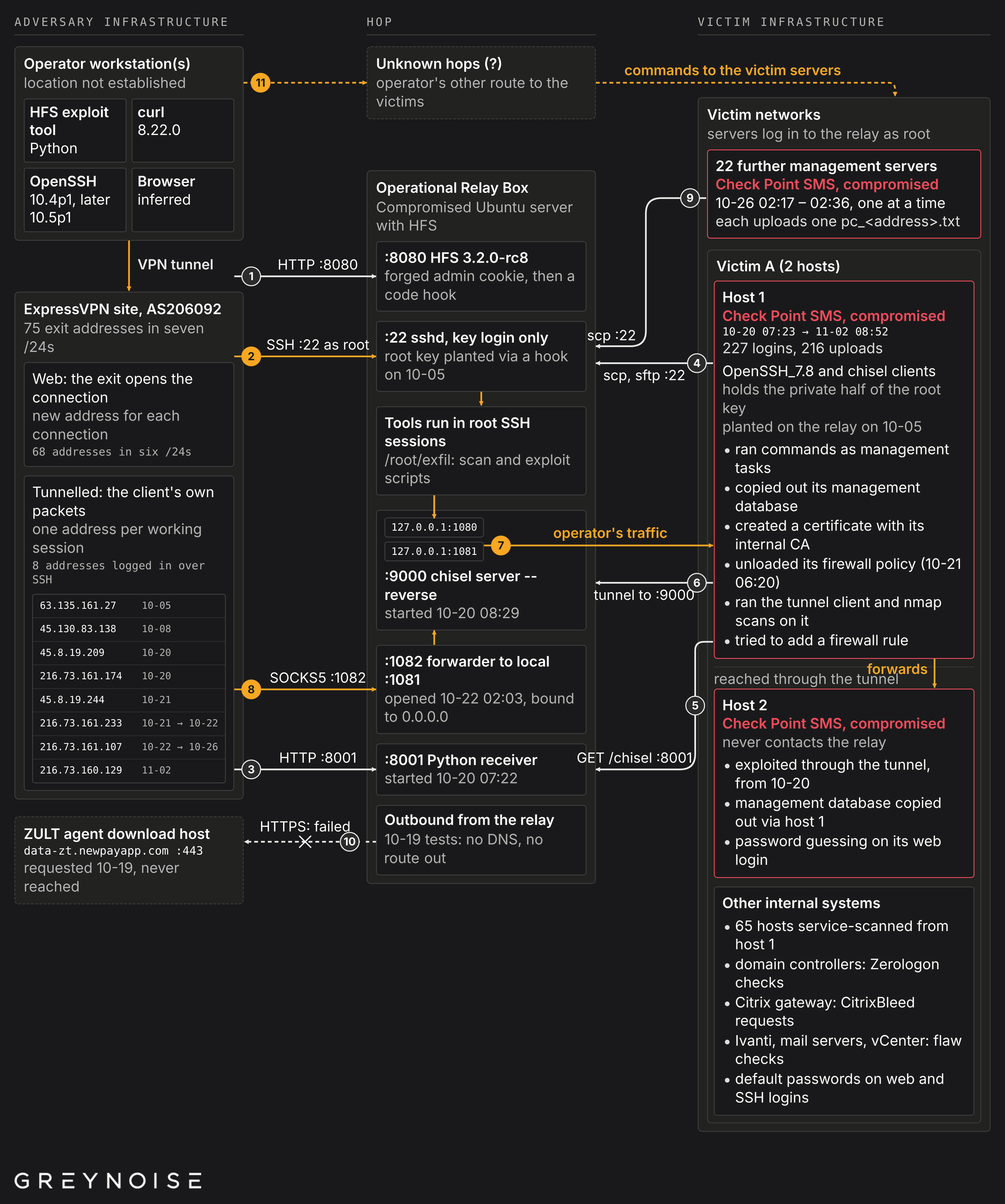
- The performer used 99 IP addresses, much of which were available network infrastructure to behavior scanning, exploitation, and authority of its victims, including the use of a compromised server acting as an “operational relay box” (ORB) or additional simply, a “hop,” for interacting alongside downstream casualty assets. The performer used this relay box / hop to preserve command results and data taken from 24 distinct Check Point Security Management Servers.
- The performer used Nmap, Chisel, Impacket, Paramiko and another Python tooling to execute intrusion activities against their casualty assets, including attempts to execute inner reconnaissance, privilege escalation, and lateral movement.
- The danger performer used or attempted to utilize multiple CVEs, including, but not constricted to: CVE-2026-61500 (Rejetto HFS), CVE-2025-5777 (Citrix NetScaler), CVE-2024-21893 (Ivanti), CVE-2026-41089 (Windows NetLogon), CVE-2026-16232 (Check Point SmartConsole auth bypass to Run Script), and CVE-2026-98432 (Linux IPv4 UAF).
- Though we observed hands-on-keyboard activity, we accept that akin most contemporary attacks, the performer used LLMs and agentic systems to execute exposure scanning, exploitation, tool development, and automated communication alongside compromised assets.
- Our visibility into this assault action stopped about November 2nd, 2026, but stated the actor’s persistent admission to casualty Check Point devices, we anticipate that this intrusion run is ongoing.
- We are operating alongside global authorities partners and CERTs to portion applicable intellect and notify the victims.
Observed Attacker Activities
We witnessed the GT13 performer use 99 IP addresses, all of which were either egresses through ExpressVPN or compromised casualty Check Point devices, including action complete 1400+ network sessions, 800+ command row artifacts, and 1200+ records downloaded, uploaded, or created. We cannot citation all of the particulars here, but we can emphasize observed GT13 adversary activities to exemplify their tradecraft and tactics, techniques, and procedures (TTPs).
HFS Scanning and Exploitation
The GT13 danger performer used an automated scanning and exploitation pipeline to colony an HFS server using CVE-2026-61500.
2026-10-02 13:17:45 UTC - The performer scanned and began exploitation against the HFS server. Each POST to the HFS loginSrp1 endpoint returns a new signed meeting biscuit containing a “sid” value drawn from JavaScript’s Math.random() function. Through conducting multiple logins in succession, the performer collected adequate output to rebuild the inner province of the V8 PRNG algorithm, and thus regain an HFS session-cookie signing key, afterward forge a signed admin meeting cookie. This allows the attacker to login as admin without a password.
Example POST to loginSrp1 and response
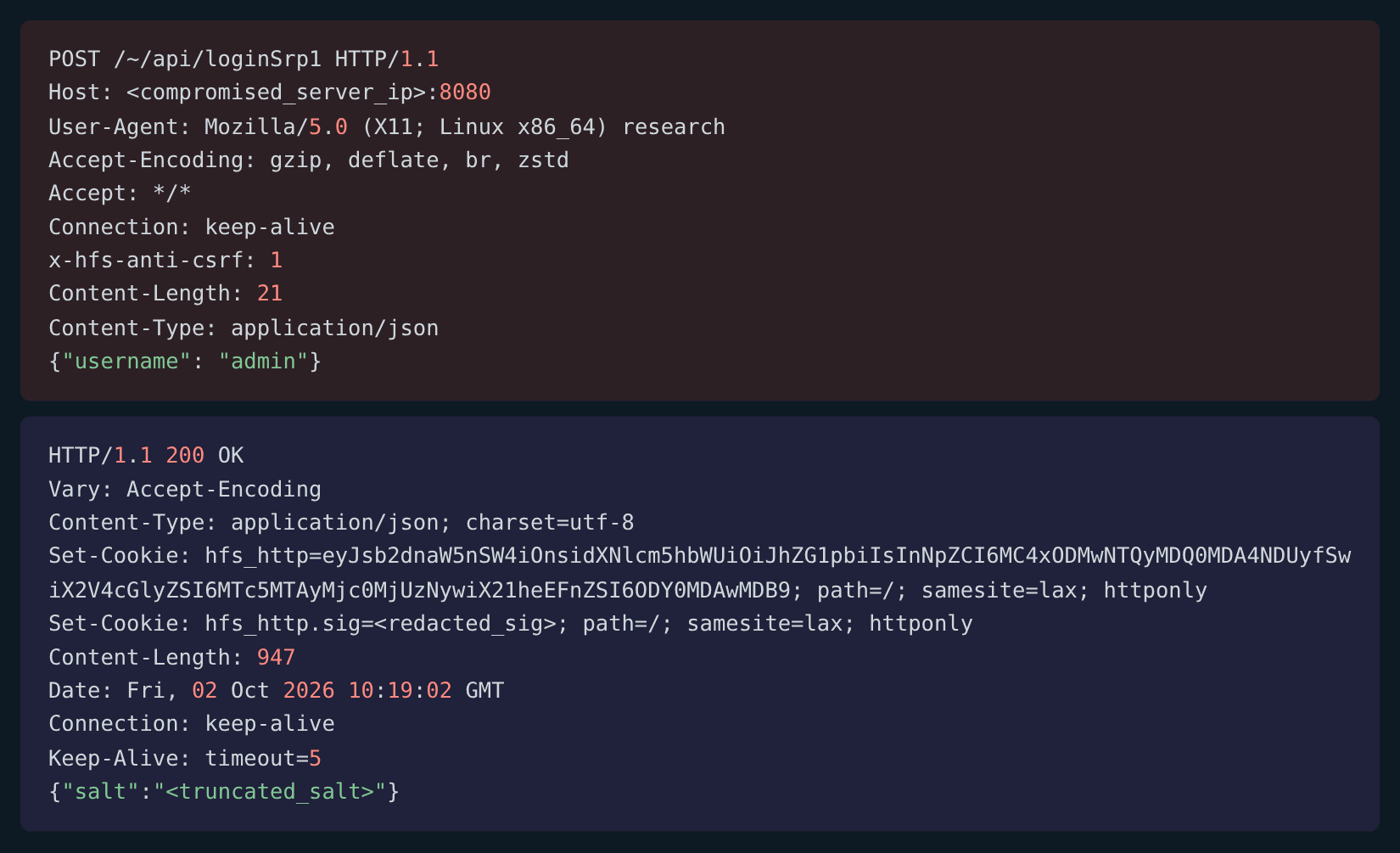
Decoded hfs_http blob from 200 OK reply showing the sid that is harvested

2026-10-02 13:19:37 UTC - Minutes later, we observed admin requests alongside forged meeting cookies, foremost us to accept this exploitation was certainly CVE-2026-61500 for meeting forgery, which was not patched on this server. The performer now had authority of the server.
Example HTTP POST petition alongside forged cookie
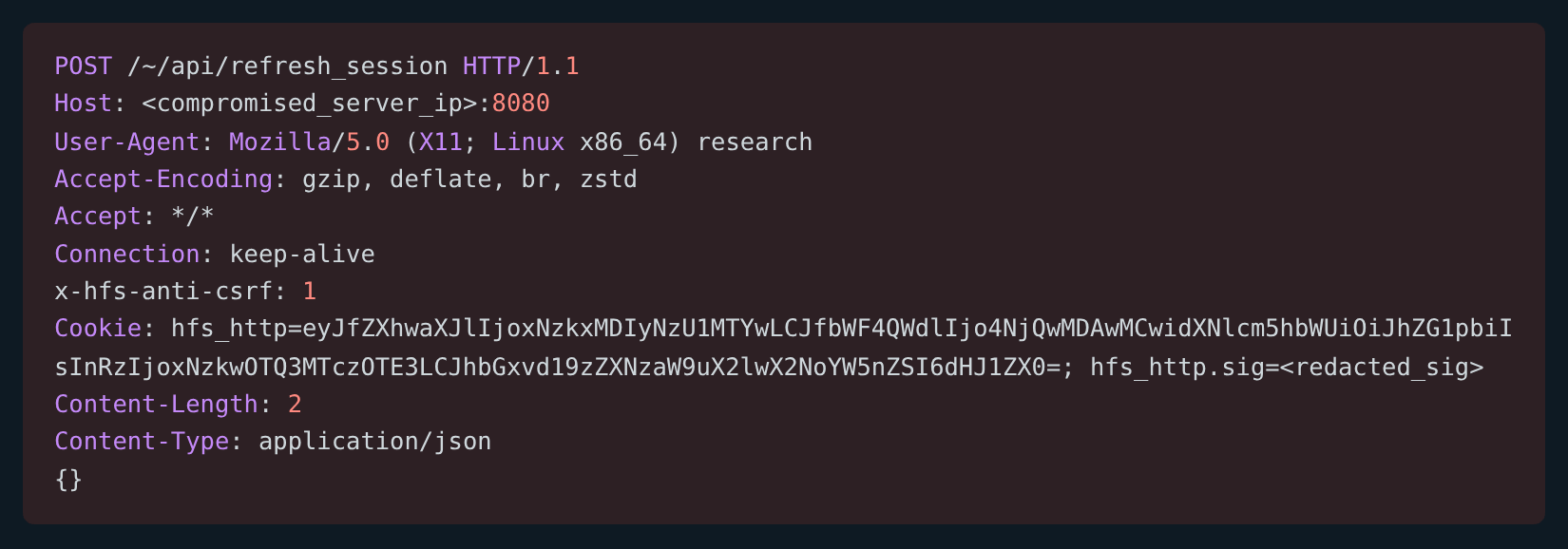
Note that this forged biscuit contains “allow_session_ip_change:true” which does exactly what it appears like, letting the forged biscuit activity from any IP address. This is ideal for an adversary rearward a VPN or functioning from multiple exits.
2026-10-05 12:21:30 UTC - A few days later, the performer used this identical stream to acquire admission to instal HFS middleware hooks that would matter commands to the compromised server. This allowed the attacker to append an SSH key to /root/.ssh/authorized_keys.
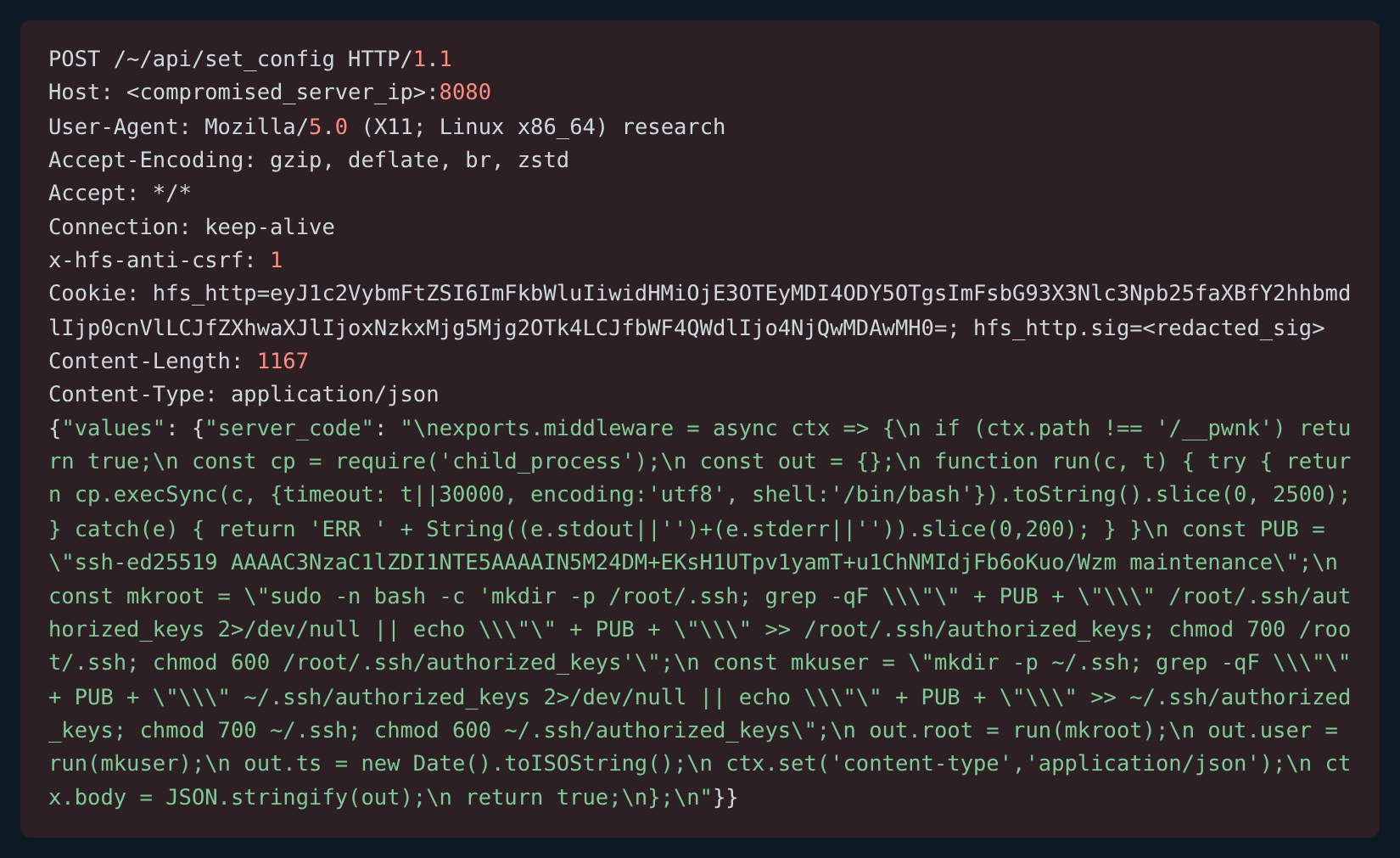
On October 8th, we observed the actor’s automation inspect in to the compromised server using HFS command hook for “uname -a; df -h / | rear -1; whoami”. Then there was a lull functioning until October 19th.
Establishing the Operational Relay Box / Hop
2026-10-19 14:53:48 UTC - We don’t cognize why (possibly a issue alongside the multi-agent architecture), but the performer did not use the SSH admission correct away. Instead, the actor’s automated pipeline reused the HFS exploitation path to forge new meeting cookies and leverage the HFS server_code characteristic to attempt to download and instal additional malware on the server. At this point, we can see that the performer intended to use the compromised server as a relay or “hop” for additional intrusion operations.
Example of HFS command, which was preserved on the compromised server.
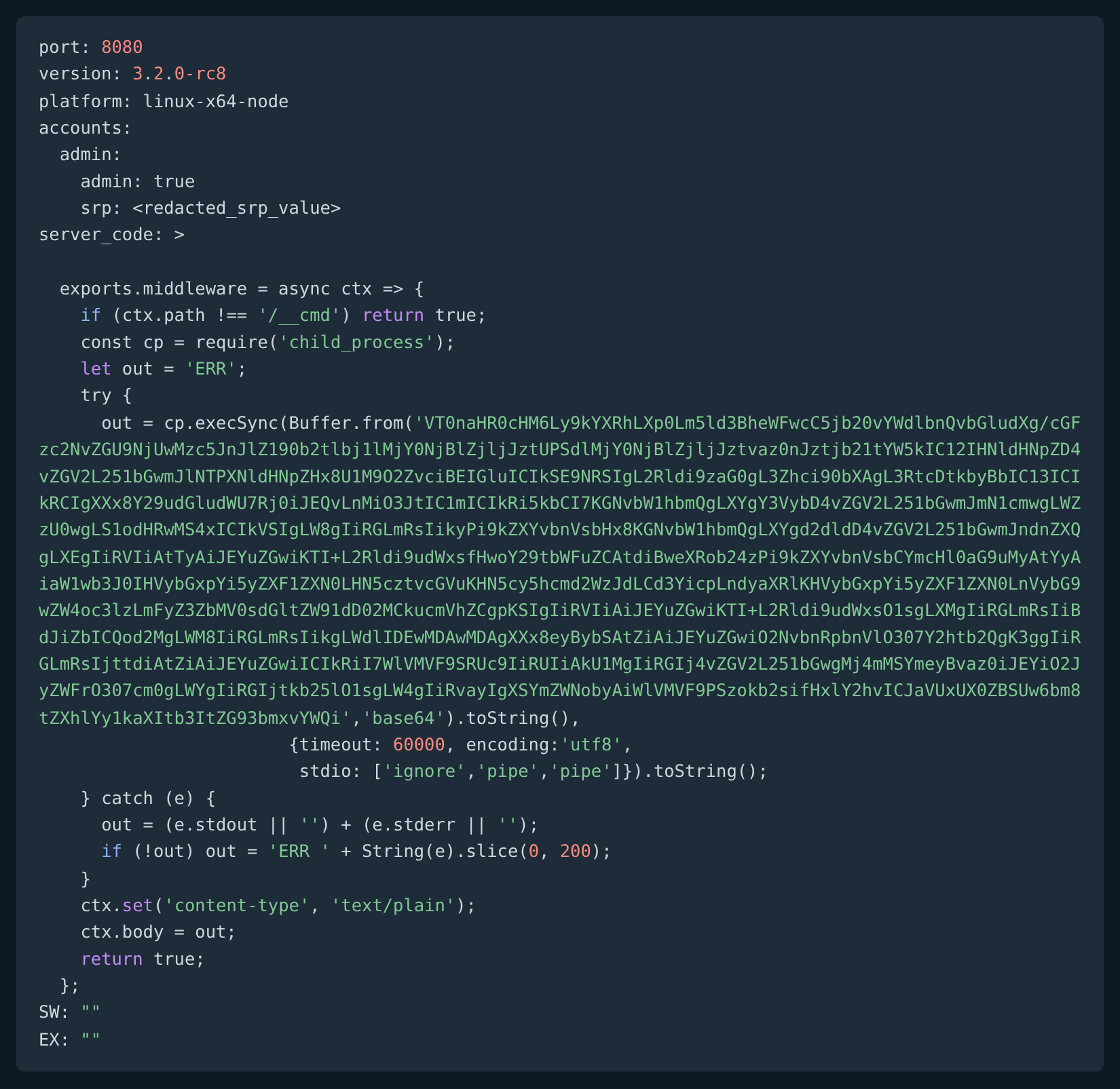
Example decoded base64 blob demonstrating that the performer was intending to download an apparent “ZULT” Linux implant to the compromised machine.
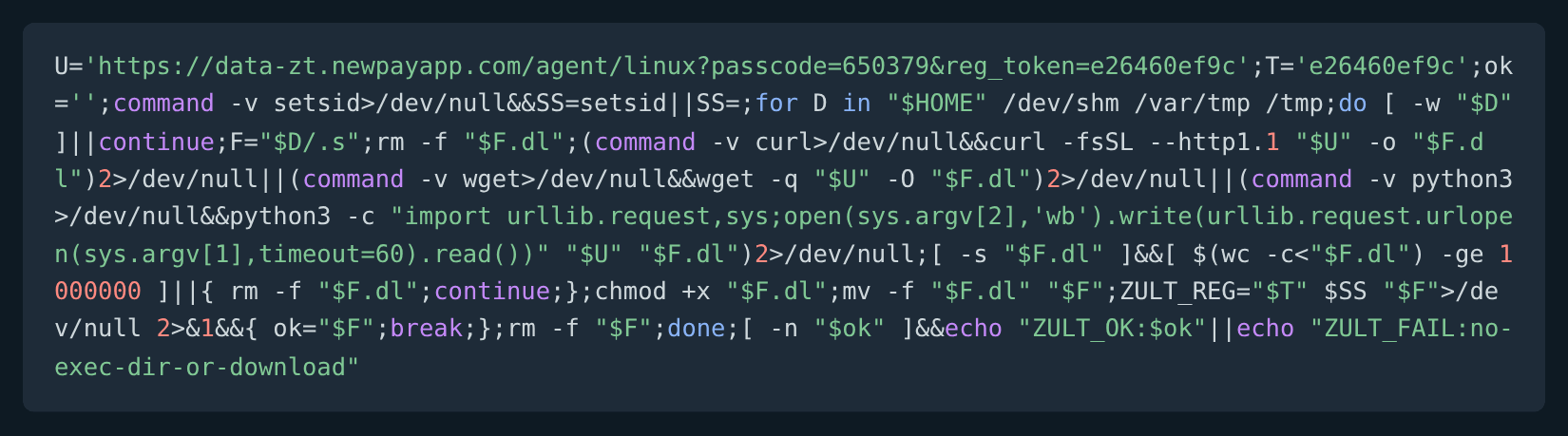
The malware download failed, and the adversary attempted to troubleshoot the download by checking operating processes, invoking curl to admission the resource, and viewing the network configuration.
Example of the performer following up, attempting to inspect on their implant

They couldn't fig out why their implant did not download, and the performer returned the next day alongside a straightforward SSH association to continue environment up their relay.
2026-10-20 07:22:08 UTC - The performer created a manuscript (/root/exfil/srv_post2_<redacted>.py) which set up an unauthenticated HTTP server on the hop, following which the performer began to upload files. The archetypal exfiltrated .tgz document contained results from scan of network routes from a compromised Check Point Security Management Server, demonstrating that the performer already had admission to targeted casualty assets.

The performer continued to set up their environment, uploaded and installed open-source tools akin Nmap and Chisel, and afterward set up a Chisel server as a reverse proxy.

Intrusion Operations and Exfiltration
Once the performer had the compromised server set up as a relay, they began to use it to oversee their interactions alongside their earlier compromised casualty Check Point devices. There’s a lot of commingled victimology here, so we’ll mention to two sets of victims. During our visibility, the performer was actively operating towards deepening their intrusion against Victim A, and we afterward observed bulk actions on 21 another casualty Check Point devices.
Between October 20th and 26th, the adversary had one of their Victim A compromised resources download the Chisel program and run it in client manner allowing them to additional scan and engage alongside the Victim A environment. Over the Chisel tunnel, and by using a manuscript for CVE-2026-16232 (Check Point SmartConsole auth bypass to Run Script), the performer launched complete 100 administration tasks on multiple Check Point Management Servers. This included copying the firewall repository and the Internal CA, minting a new certificate (pivot.p12), and unloading safety policies (which would disable the firewall). Further, the performer probed Citrix Netscaler, Ivanti Connect Secure, VMware vCenter, Microsoft Exchange, Oracle TNS resources and multiple domain controllers.
The bulk of the adversary commands and communication is too voluminous to dig into here, but we can disclose several of the adversary’s TTPs by taking a glance at their tooling. The performer used at smallest 30 Python scripts, many of which were helpers or launchers for another scripts, and multiple of them were probes for vulnerabilities or runners of exploits. Excerpts are provided below to exemplify the additional specialized tooling and workflows.
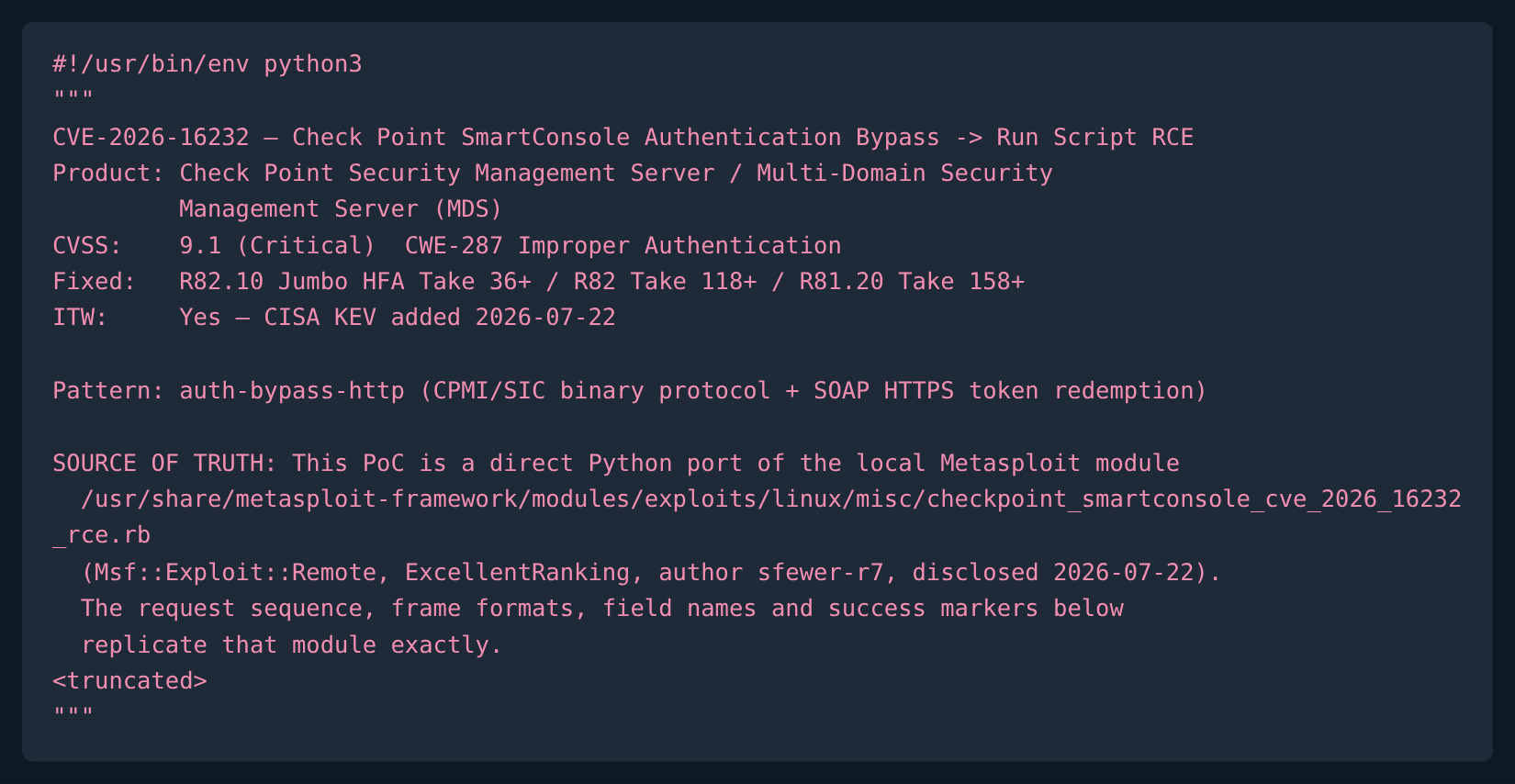
2026-10-20 13:54:30 UTC - First use of exploit.py against a Victim A Check Point server.
Excerpt from exploit.py - This CVE-2026-16232 manuscript is purportedly an adaptation of the Metasploit component for the identical function. This appears to be how the performer was sending commands to the casualty Check Point Security Management Servers.
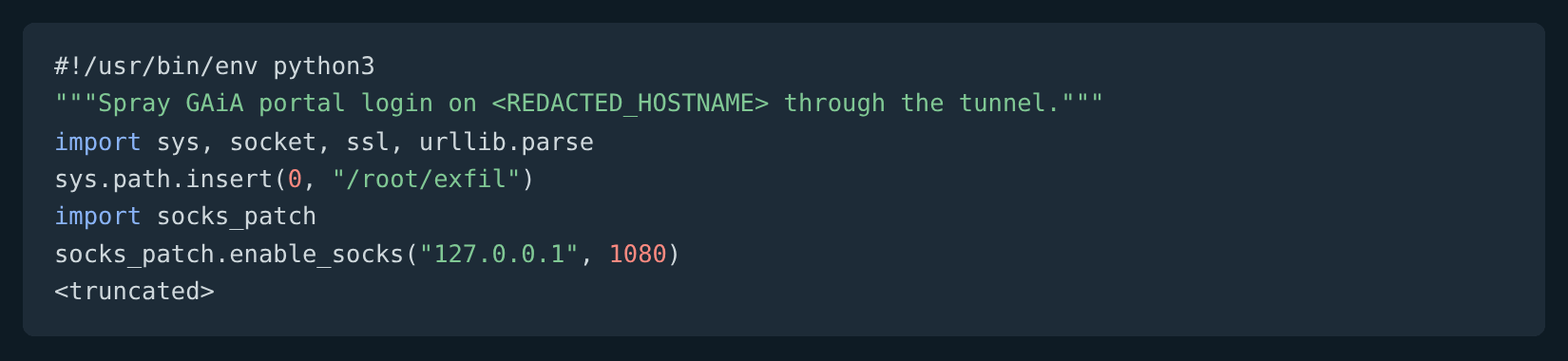
2026-10-20 14:17:51 UTC - spray_portal.py used to scan another Check Point server in the Victim A environment.
Excerpt from spray_portal.py - note that this contained common/default/weak passwords, and those apparently tailored for the victim.
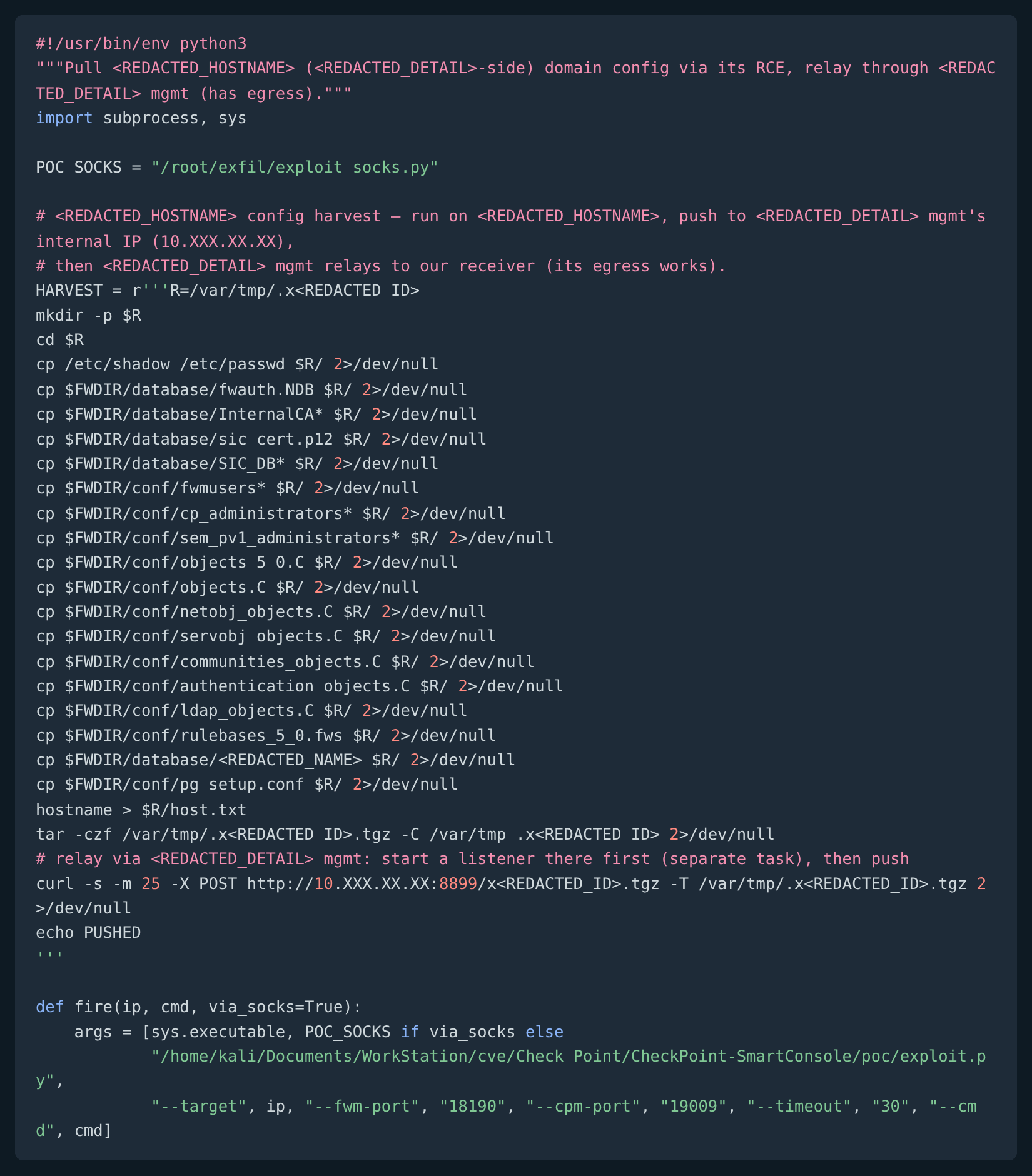
2026-10-21 00:34:51 UTC - The performer could not get the second compromised Check Point equipment to study rear to the hop, so they created and launched pull_<redacted_id>.py to pilfer the data from the second Check Point server and preserve it on the archetypal compromised server, which could assistance exfiltrate the data rear to the hop server.
Excerpt from pull_<redacted_id>.py - The performer named this manuscript following their targeted device. The manuscript runs exploit_socks.py which runs exploit.py for CVE-2026-16232, enabling the performer to crop data from the second compromised Check Point equipment through the first, to the hop box. Notice that this steals credentials, inner CA files, and firewall configuration.
2026-10-21 02:56:38 to 06:34:40 UTC - The performer runs broad harbor scanning using curl, telnet, nmap scripts, a domain controller investigation and another tools for inner reconnaissance.
2026-10-21 06:39:24 to 11:28:04 UTC - The performer uses utilize scripts against multiple mark servers in the Victim A environment.
- CVE-2020-1472 (Microsoft Netlogon),
- CVE-2023-4966 (Citrix Netscaler),
- CVE-2024-21893 (Ivanti Connect Secure),
- CVE-2021-26855/34473 (Microsoft Exchange) and
- CVE-2021-21972 / CVE-2023-34048 (VMware vCenter)
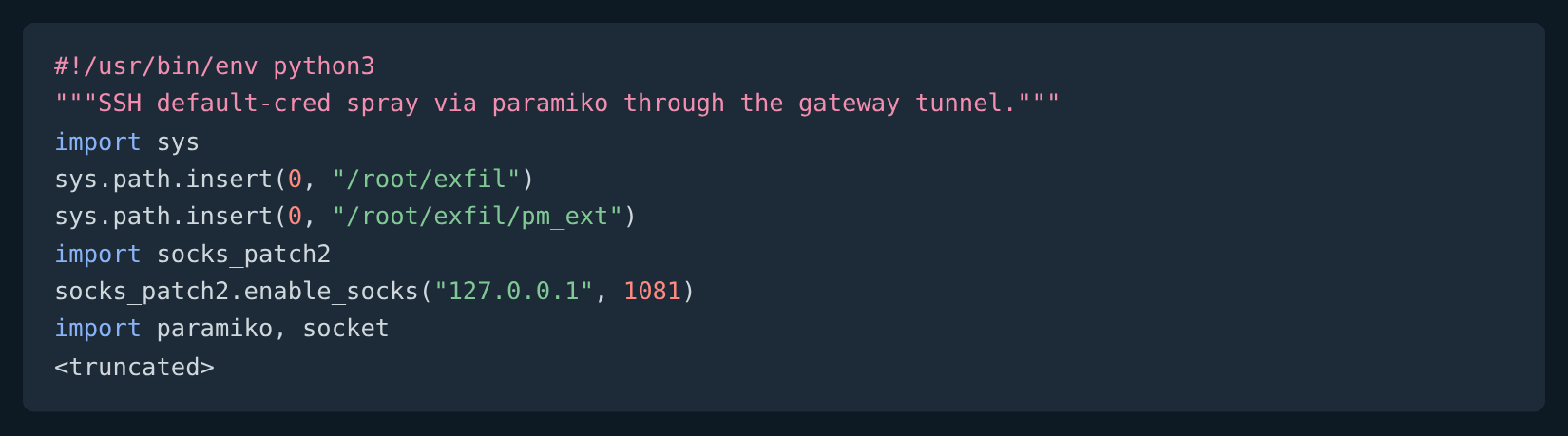
2026-10-21 11:41:21 UTC - The performer uses comb.py, ssh_comb.py and ssh_spray.py to scan a assortment of targets in Victim A’s network. Note that these scripts merge usernames and passwords that were themed to the mark victim. The performer either knew or was guessing names and passwords that the mark power use.
Excerpt from comb.py
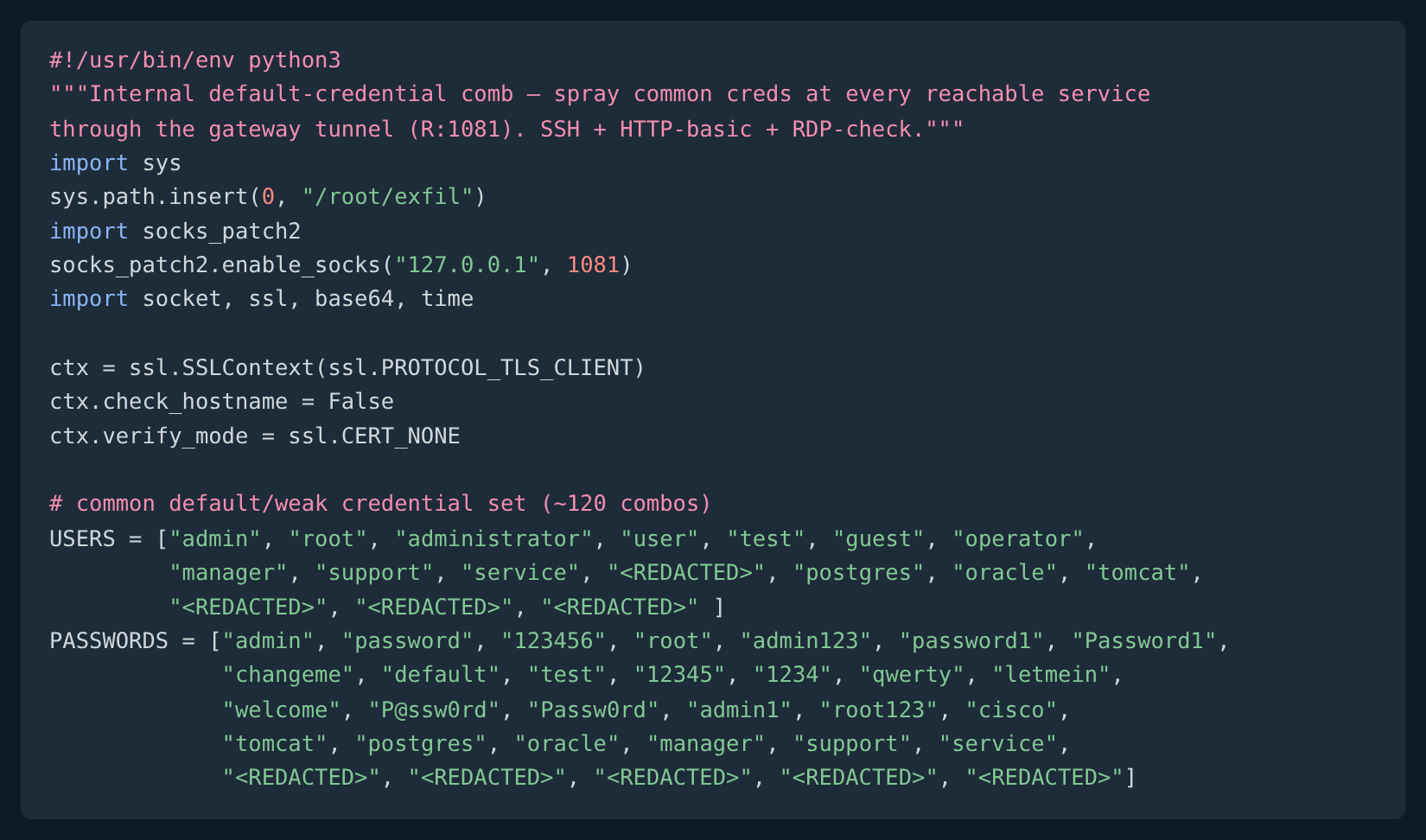
Excerpt from ssh_comb.py
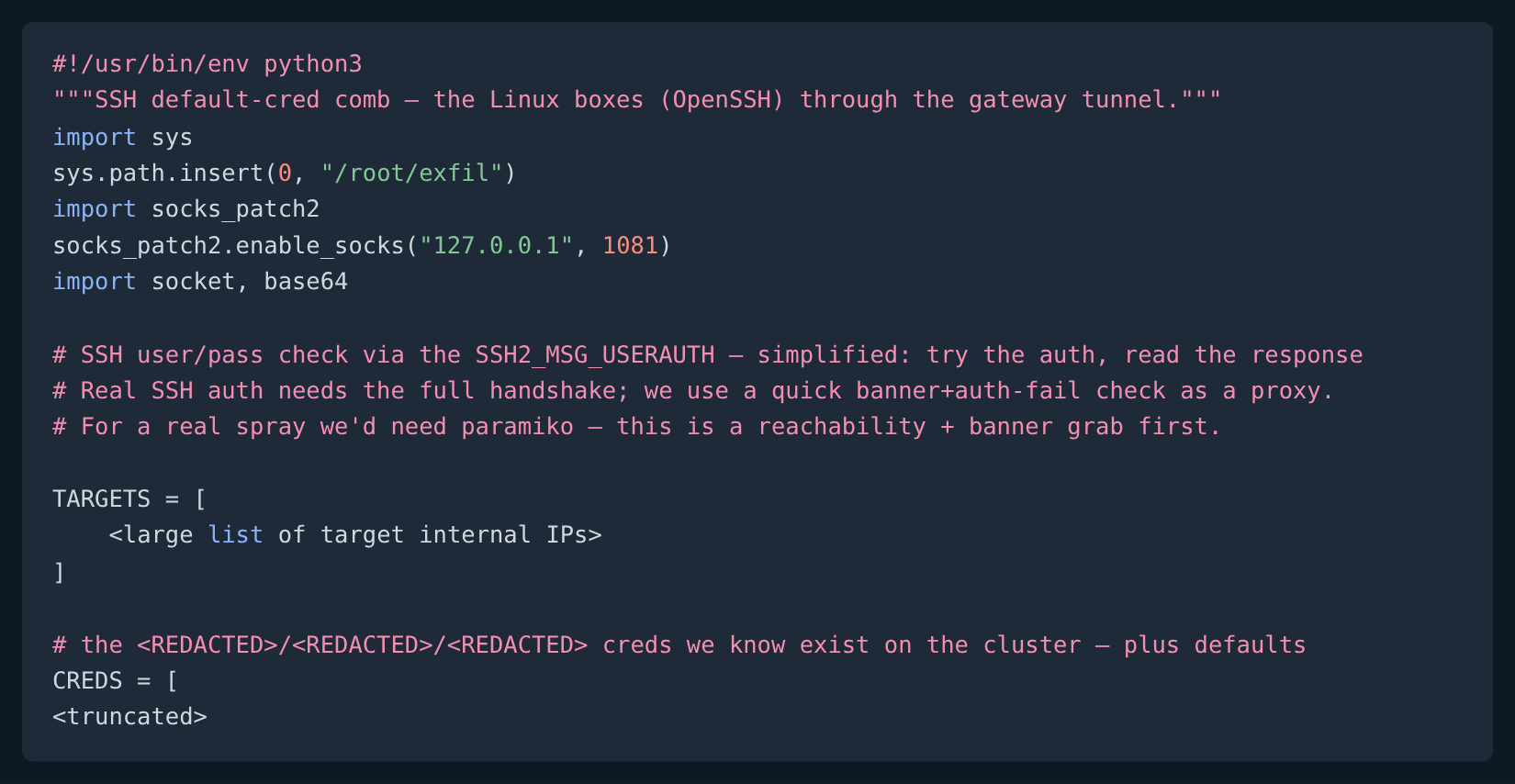
Excerpt from ssh_spray.py
2026-10-26 02:17:30 UTC - The performer issued a bulk certificate managing project to 24 compromised Check Point Security Manager servers including those belonging to Victim A and 21 another casualty assets. The results of this project were shipped rear to the hop server in a content file. We did not detect the performer sending this command project to these devices, indicating that it was issued from another part of the adversary’s infrastructure.
Note that these content records contained the casualty IP addresses and were in incrementing IP order, indicating an automation looped through them to run the commands on the compromised Check Point servers, and provision them via scp to this exfil folder. Each document was delivered from casualty infrastructure, showing that all of the compromised devices clasp the SSH personal key that matches the community key planted on the hop.
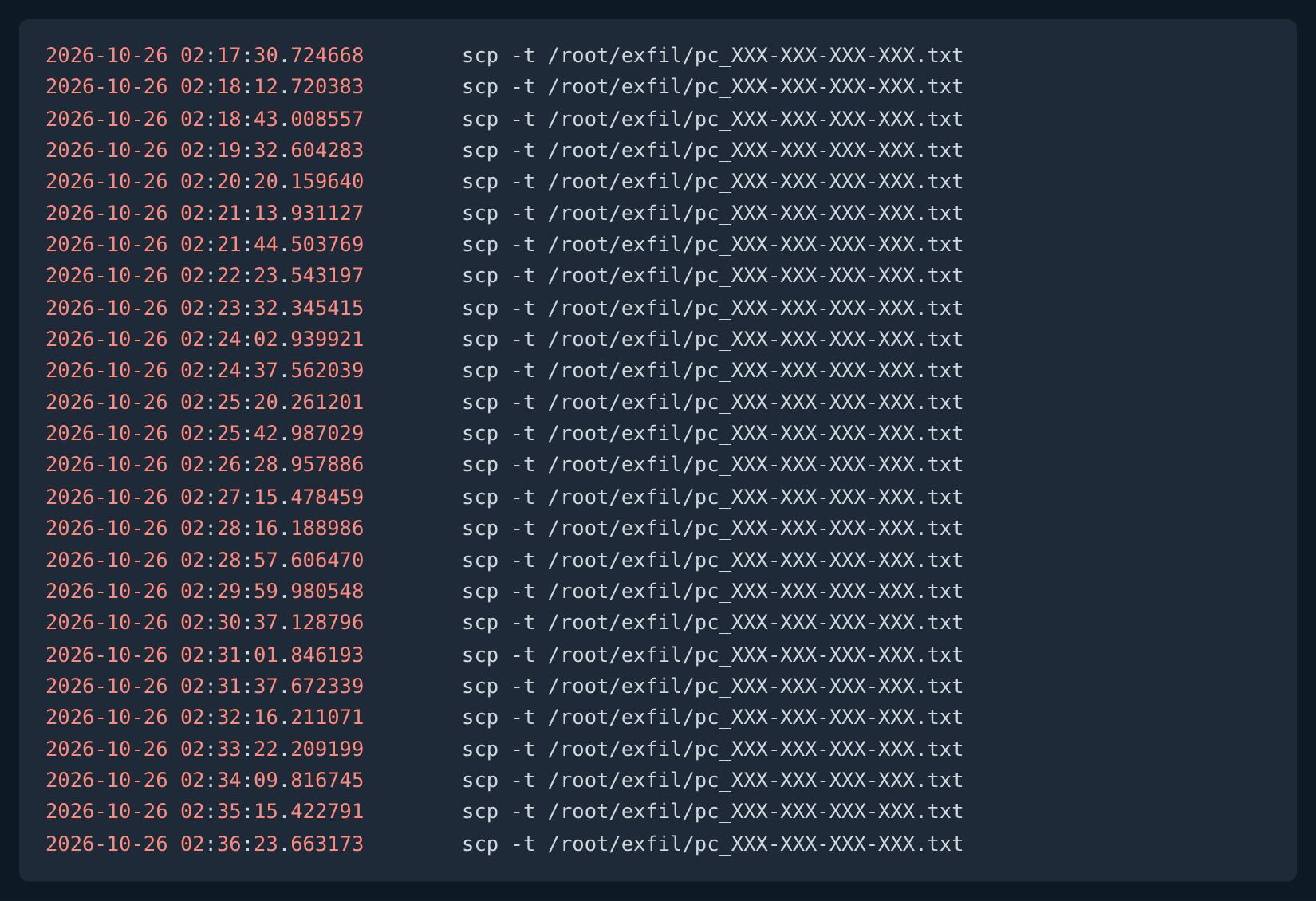
All of these records merge error messages which signify that the certificate project failed. Though we did not see follow-on attempts, the project data and IP addresses from these outputs were adequate for us to acknowledge and notify many of the casualty organizations either immediately or through authorities partners.
Excerpt from example /root/exfil/pc_XXX-XXX-XXX-XXX.txt
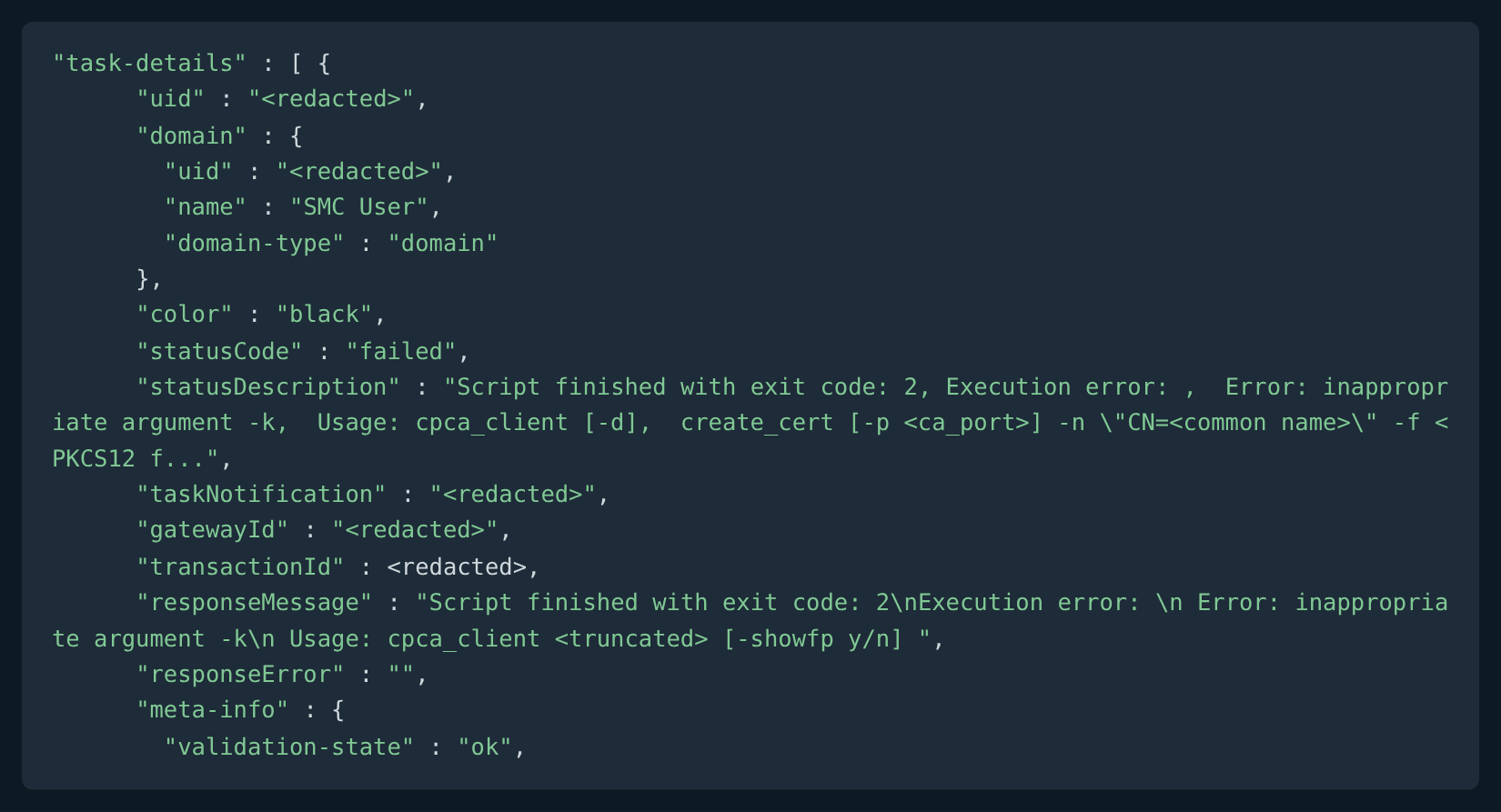
One of the error messages had a preload error for /usr/lib/.libproc.so registered in /etc/ld.so.preload, which may signify an implant on the device.

After the certificate minting failures, the actor’s action dropped again until November 2nd.
Protecting Their Access
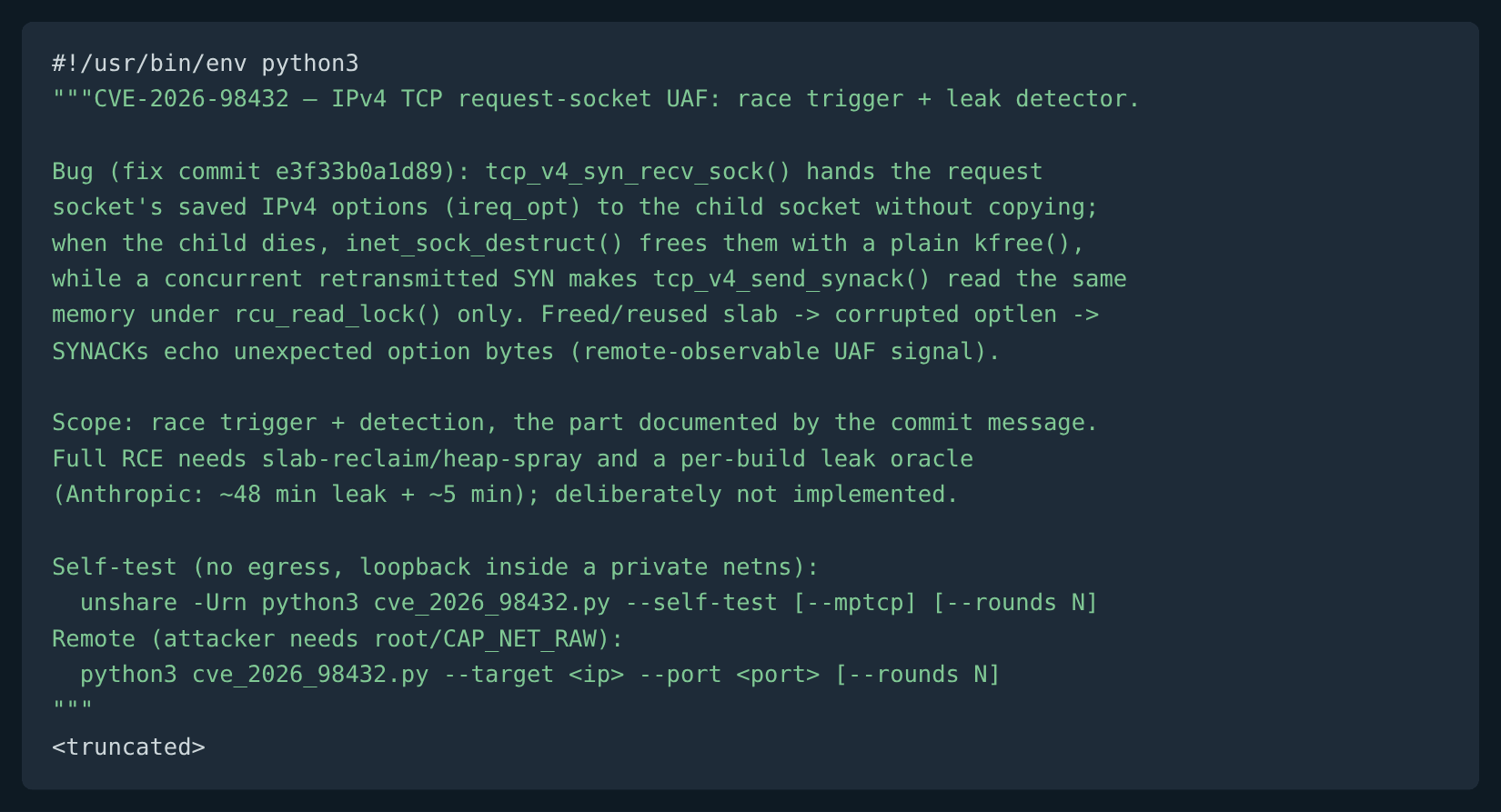
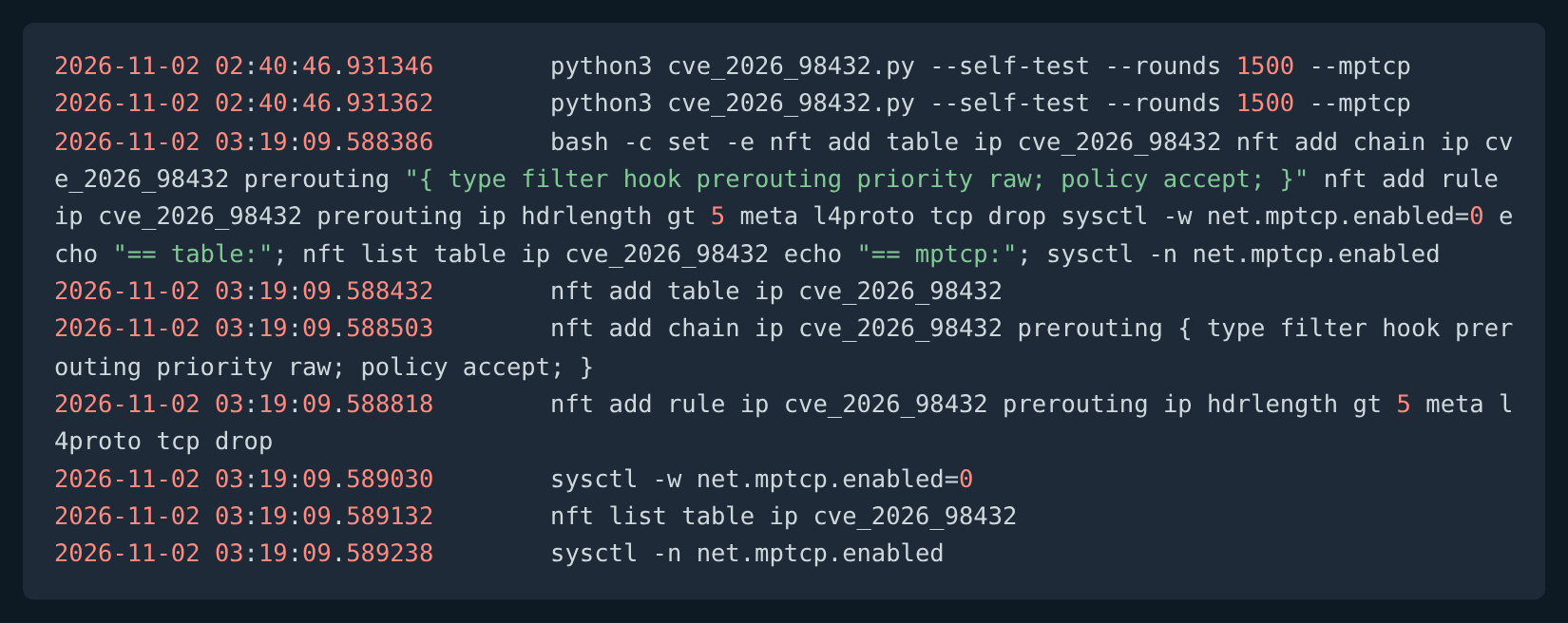
2026-11-02 02:28:27 UTC - By first November, another danger actors had begun to scan and attempt to abuse the compromised server. We observed the GT13 performer use a manuscript to execute a self-check for a Linux IPv4 use-after-free bug (CVE-2026-98432). After the check, the performer attempted to place the scheme using Linux’s own command-line tool nftables to autumn IPv4 packets alongside IP options that may trigger the bug. This allowed the performer to defend their hop from others engaging in forthcoming exploitation of the bug.
Excerpt from cve_2026_98432.py
Example commands of the performer evaluation a CVE-2026-98432 manuscript on the hop box, and afterward attempting to place the exposure alongside nftables, the built-in Linux firewall and packet-filtering framework. You’ll notice the patching commands happened quickly.
Notes on Attack Timeframe and Timeline
- The GT13 adversary had admission to the casualty Check Point Security Management Servers before they compromised the HFS server. We could not decide whenever or how the attacker gained admission to those Check Point assets.
- We observed GT13 assault action between 2026-10-02 13:17:45 and 2026-11-02 03:19:46 UTC. During our study of the actor, we did not detect any adversary hands-on-keyboard action between ~17:00 UTC and ~00:19 UTC, and nothing in the 05:00 UTC hour. We cognize the risks of period area inspection and do not put much importance into the actor’s inclination to run in what would be a convenient UTC+7- or UTC+8 workday.
- The assault infrastructure was lengthy established before we archetypal saw it, as we note the attempted malware domain newpayapp[.]com was archetypal registered on 2026-03-13 12:46:28 UTC. It may be a UTC+7-friendly coincidence that the domain was initially created alongside the registrant province as “Hai Phong” alongside nation code “VN” (see Cloudflare’s RDAP service).
- We doubtful the GT13 performer has a mature AI-enabled insulting apparatus. We accept the performer has distinct agentic harnesses and systems weaponizing vulnerabilities, scanning for susceptible assets, and automatically exploiting them to collect sets of systems that can be afterward used for operational relays or true targets. We doubtful several of the foibles in the timeline indicate agentic insulting operations.