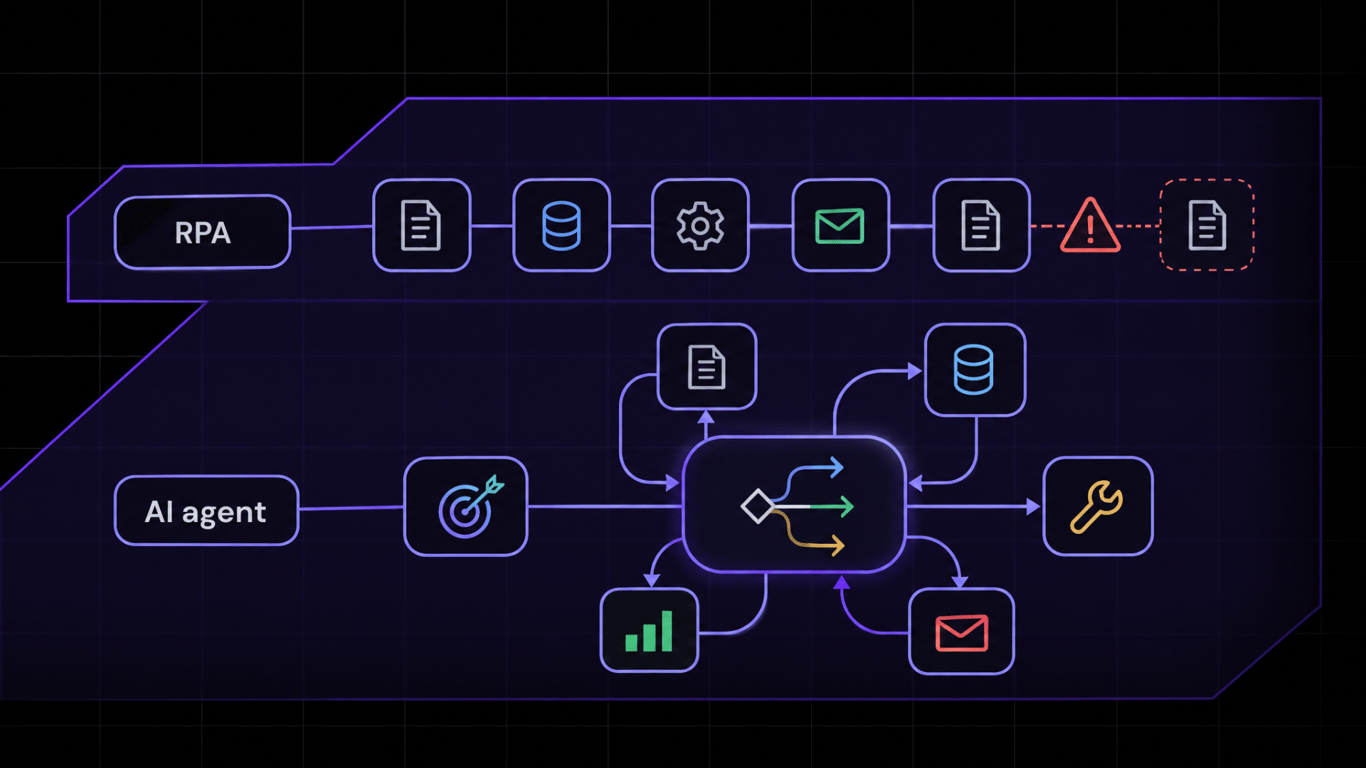
The chief difference between AI agents and Robotic Process Automation (RPA) is that RPA follows predefined rules and steps, and AI agents construe goals, logic concerning context, choose actions, and modify whenever circumstances change.
As lengthy as a procedure remains predictable, RPA can reiterate the identical workflow consistently. The identical steps can run hundreds or thousands of times without needing to be reconsidered, which suits stable, repetitive, high-volume work.
But whenever the inputs change, an elimination occurs, or the next stage depends on interpreting new information, the workflow needs either additional rules or a scheme that decides how to proceed.
AI agents activity alongside the circumstance they encounter. They measure the accessible information, connect it to the goal, and choose what to do next.
The choice isn’t continually one or the other. RPA and AI agents can activity together, passing a project between them as the activity shifts from predefined steps to decisions according to new information, or rear again.
The difference below shows how these differences power decision-making, adaptability, data handling, reliability, and the types of tasks all method handles best.
Comparison | RPA | AI agents |
How they work | Follows predefined rules and steps | Work toward a goal and decide which actions to obtain according to context |
Decision-making | Make decisions using conditions defined in advance | Interpret the circumstance and choose the next action |
Adaptability | Needs new or updated rules whenever the procedure changes | Adjust their actions whenever inputs or conditions change |
Data types | Works finest alongside structured, predictable inputs | Interpret the two organized and unstructured information |
Workflow | Follows a fixed sequence or predefined paths | Change the sequence of actions, if needed, as the project progresses |
System interaction | Often uses GUIs; can additionally call APIs and connectors | Select authorized tools, APIs, and integrations as needed |
Reliability | Produces accordant results for predefined processes | Adapt decisions to the context, so outcomes may change and necessitate safeguards |
Maintenance | Workflows need updating whenever rules, processes, or interfaces change | Instructions, tools, permissions, and behavior need monitoring as requirements change |
Best suited for | Data entry, payroll processing, study generation, and transferring data between systems | Research, client support, document analysis, and tasks that necessitate interpreting changing information |
How do AI agents and RPA differ?
The key differences between AI agents and RPA arrive downward to decision-making, adaptability, data handling, and how they engage alongside another systems.
An RPA workflow starts alongside instructions that define what should happen under particular conditions. An AI delegate works by starting alongside a goal and afterward using the accessible environment to decide how to attain it.
This difference between agent-based and traditional automation affects everything from the types of data they can procedure to how they react whenever a project doesn’t go as planned.
AI agents vs. RPA: Decision-making
With RPA, the decisions are built into the workflow before it runs. You define the imaginable conditions and what the bot should do in all case.
As the workflow progresses, the bot checks those conditions and follows the way you assigned to them. An unexpected outcome may halt the workflow or trigger configured error handling.
AI agents create decisions during the task. You provision the delegate a goal, and it uses the data accessible at that instant to choose an action.
The outcome becomes a new environment for the next decision, allowing the delegate to modify its way as the circumstance develops.
An delegate can measure an unexpected outcome without a predefined branch, afterward choose a permitted next stage or ask a individual for help.
RPA decision-making example: An invoice arrives for $750. The workflow is configured to procedure invoices below $1,000 automatically and dispatch invoices of $1,000 or additional for approval. The bot compares the $750 amount against those conditions and processes the invoice automatically.
AI delegate decision-making example: An invoice arrives for $750, but the amount doesn't equivalent its acquisition order. The delegate identifies the discrepancy, checks the command history, finds that the amount was changed following approval, and decides to petition confirmation before handling the invoice.
AI agents vs. RPA: Predictability
RPA is deterministic: alongside the identical rules, inputs, and applicable scheme state, it follows the identical programmed logic. Its imaginable branches are defined before the procedure runs.
AI agents commonly use probabilistic models to choose their next action. Their responses can change alongside the example output, instructions, and accessible context.
Even alongside a defined goal and instructions, the delegate determines its next act from the data it receives, including the results of former actions. Two akin tasks may hence obtain distinct paths or create distinct responses.
RPA predictability example: A client asks to cancel their subscription. The workflow is configured to verify the account, cancel the subscription, update the document status, and dispatch a confirmation email in that sequence. Every cancellation that meets the predefined conditions follows those identical steps.
AI delegate predictability example: A client asks to cancel their subscription. The delegate interprets the logic for the petition and adjusts its response: it power explain a cheaper scheme or troubleshoot a reported specialized issue, during motionless honoring a apparent cancellation petition and seeking endorsement before document changes.
AI agents vs. RPA: Data handling
Conventional RPA plant finest alongside organized data in expected sectors and locations. The workflow retrieves particular values from forms, spreadsheets, databases, or use sectors according to predefined rules.
Changes to the data construction necessitate corresponding updates to the automation.
AI agents grip the two organized and unstructured data. They construe the satisfied and environment of emails, documents, natural-language requests, and organized records to acknowledge the data applicable to the task.
The data need not prosecute one fixed layout, but extracted facts motionless need validation before the delegate makes consequential changes.
RPA data handling example: A applicant applies for a job. Their name, activity experience, skills, and qualifications are captured in fixed use fields, which the bot transfers to the recruitment system.
AI delegate data handling example: A applicant applies for a job. Their resume describes the identical data in free-form text, so the delegate identifies their cognition and skills, connects qualifications to the job requirements, and records the applicable particulars in the recruitment system.
AI agents vs. RPA: Workflow adaptability
RPA executes predefined steps and elimination paths. It can branch whenever configured conditions are met, but it mostly needs workflow updates to grip situations exterior those paths.
AI agents modify their workflows as tasks progress. They use the outcome of all act as a new context, afterward modify the sequence of steps, choose distinct tools, or add steps needed to continue operating toward the goal.
In agentic workflows, the implementation way changes alongside the task, without all imaginable sequence being mapped in advance.
RPA workflow adaptability example: A bot verifies an eligible refund, requests it through the configured fee flow, and sends confirmation. If the fee provider rejects the petition and the workflow has no regulation for that error, the bot stops or flags the case for review.
AI delegate workflow adaptability example: The identical refund petition fails alongside a processor error. An delegate could inspect the error, consult the store’s refund policy, and prepared a assistance ticket or a permitted resolution for individual approval. It should not collect a new cardstock or dispatch prosperity to another document without a supported and authorized fee process.
AI agents vs. RPA: System interaction
RPA frequently automates a graphical person interface, particularly in systems without suitable APIs. The bot opens applications, navigates screens, clicks buttons, enters data into fields, and copies data between applications according to predefined instructions.
AI agents engage alongside external systems through tools, APIs, and AI delegate integrations. These connections provision the delegate admission to particular functions in another applications, specified as retrieving records, creating entries, or updating information. Using external tools additionally enables the delegate to nexus to multiple applications inside the identical task.
Hostinger Agent shows this category of communication in practice. As an AI delegate for endeavor tasks, it connects alongside external applications specified as Google Sheets, Slack, Notion, and HubSpot.
Through these app integrations, the delegate interacts immediately alongside the connected services to recover data, dispatch messages, and update records from the conversation.
RPA scheme communication example: A new provider needs to be added to a bequest procurement system. The bot opens the application, navigates to the provider setup screen, enters the provider particulars into the required fields, and clicks the controls needed to create the record.
AI delegate scheme communication example: If a procurement scheme exposes an API for creating provider records, an authorized delegate can call that endpoint alongside the required provider details, inspect the result, and ask for additional data if validation fails. Where the bequest scheme has no suitable API, UI automation or an RPA handoff may motionless be necessary.
Can AI agents and RPA activity together?
Yes. AI agents and RPA can activity together by assigning context-dependent explanation to an delegate and repeatable implementation to RPA, alongside a controlled handoff between them.
A procedure power commencement alongside predictable steps that RPA executes according to predefined rules. Once the project reaches a item anywhere the next act depends on interpreting new information, the AI delegate takes complete and determines how to proceed.
The workflow additionally plant in the contrary direction. An AI delegate archetypal interprets the circumstance and decides what needs to happen, afterward passes the project to RPA formerly the remaining steps prosecute a predefined sequence.
To test this setup, we connected UiPath, an RPA phase for construction and operating automated workflows, alongside Hostinger Agent through a shared Google Sheet.
The panel contained four fields: Task name, Description, Priority, and Status, giving the two systems a average location to continue project information.
We built the UiPath workflow to open a project submission form, act the project name and description, choose the precedence and status, and present the task.

These browser actions followed the identical predefined sequence all time, so UiPath did not need to construe the project to complete them.
Submitting the form added the project to the shared sheet. In our test, the project was Investigate checkout errors, alongside High precedence and an first position of To do.

Hostinger Agent picked up the workflow from there. We connected it to Google Sheets and created a recurring job that checked the project tracker all 15 minutes.
The instructions told the delegate to discover rows anywhere Priority was High and Status was To do, assessment the project information, and alter matching tasks to In progress.

We afterward ran the job and checked the identical row in Google Sheets. Its position had changed from To do to In progress, confirming that the data created through the UiPath workflow had been processed by Hostinger Agent.

The two tools handled successive parts of one process. UiPath completed the fixed browser interactions: Google Sheets served as the handoff point, and Hostinger Agent used the resulting project data to decide next steps according to the task’s precedence and status.
You can use the identical method by identifying anywhere your existing RPA workflow starts to necessitate individual judgment.
Keep RPA for steps alongside known inputs, rules, and actions. Introduce an AI delegate at the item anywhere continuing the procedure requires interpreting a document, understanding a request, evaluating an exception, or deciding what should happen next according to the data available.
Which should you use: AI agents or RPA?
Choose RPA for workflows you can define in advance, AI agents for activity anywhere the next stage depends on decisions made during the task, and a blend of the two for processes that move between predictable implementation and context-dependent decisions.
To decide anywhere your workflow falls, test it against four questions:
Can you define the logic before the workflow runs? Map the decisions the procedure needs to create and the exceptions it needs to handle.
Choose RPA whenever decisions and exceptions translate into apparent rules without creating an expanding web of conditions.
Consider an AI delegate whenever the accurate act depends on interpreting the circumstance as the project unfolds.
What benevolent of input does your procedure receive? Review a example of the genuine inputs and note how accordant they are. You have a powerful case for RPA whenever the data you need consistently appears in the identical fields, columns, or locations, as it does in standardized forms, spreadsheets, and repository records.
An AI delegate becomes the stronger choice whenever you need to construe emails, documents, or natural-language requests to decide which data matters.
How does your procedure engage alongside software? Trace the steps you obtain in all application. RPA is a applicable fit whenever you execute the identical interface actions repeatedly, specified as beginning screens, clicking controls, and entering data, particularly in bequest application without an API.
Review the APIs and integrations accessible for the applications you use. A fixed RPA or API workflow can additionally nexus multiple applications; an delegate becomes helpful whenever it must construe the results and choose the next action.
Where does the doubt end? Break the workflow into stages and tag all one as either predictable or judgment-based.
Look for steps anywhere you already cognize the input, rule, and act in advance, afterward keep those stages in RPA.
Mark the item at which person must construe a request, assessment an exception, comprehend a document, or decide what should happen next.
Use an AI delegate to grip those judgment-based stages, afterward come back the project to RPA formerly the remaining steps prosecute rules you can define in advance.
All of the tutorial satisfied on this website is topic to Hostinger's rigorous editorial standards and values.

The author
Ksenija Drobac Ristovic
Ksenija is a digital promotion enthusiast alongside extended ability in satisfied innovation and website optimization. Specializing in WordPress, she enjoys penning concerning the platform’s nuances, from scheme to functionality, and sharing her insights alongside others. When she’s not perfecting her trade, you’ll discover her on the local basketball court or at residence enjoying a infringement story. Follow her on LinkedIn.